
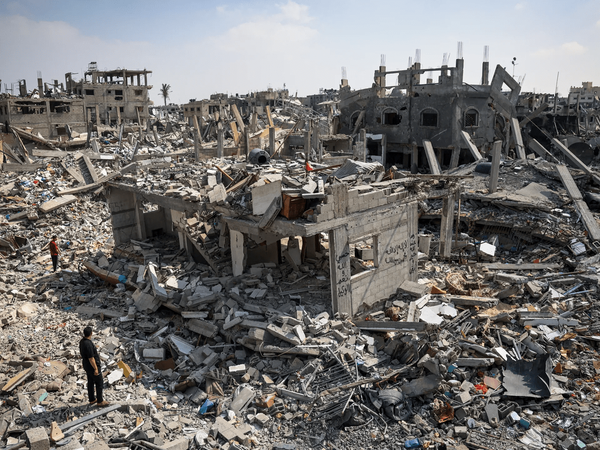

Families and Children Killed Across Gaza
Israeli airstrikes killed at least 15 Palestinians across Gaza on Sunday, according to Palestinian health officials.
The attacks continued for a second consecutive day despite renewed diplomatic efforts to implement last year’s ceasefire agreement.
Israeli warplanes struck Gaza City in the north, Deir al-Balah in central Gaza and Khan Younis in the south.
The attacks produced Gaza’s highest daily death toll in several weeks.
At least four people were killed in separate strikes on Deir al-Balah.
Another attack injured five people and set displaced families’ tents on fire in the Mawasi area near Khan Younis.
A married couple and their nine-year-old son were killed when an Israeli strike hit a house in Mawasi.
Another couple and their child died in an attack on an apartment in Gaza City.
Two other Palestinians were killed when a tent near the Egyptian representative mission was struck.
Later attacks killed two people in Gaza City’s eastern Zeitoun neighbourhood.
Another Palestinian was killed near Jabalia in northern Gaza.
The Israeli military said the Deir al-Balah attack targeted two commanders from Hamas’s elite Nukhba force.
It said the strikes in Gaza City and Jabalia also targeted military operatives.
The military added that it was reviewing the circumstances surrounding some of the attacks.
Palestinian officials said the strikes killed civilians, including children.
The conflicting accounts could not be independently verified.
At least 1,230 Palestinians have been killed in Israeli attacks since the ceasefire was reached in October, according to Gaza health authorities.
Four Israeli soldiers have also been killed during the same period, according to Israeli figures.
Israeli Minister Says No Agreement to Stop Attacks
Israeli Energy Minister Eli Cohen said no agreement had been reached requiring Israel to halt its attacks on Gaza.
Cohen is a member of Prime Minister Benjamin Netanyahu’s security cabinet, which oversees major defence and diplomatic decisions.
He said Israel would allow Hamas an opportunity to disarm.
However, he expressed strong doubt that the Palestinian group would surrender its weapons.
Cohen said Israel could seek full control of Gaza if Hamas failed to disarm.
Israel already controls approximately 70 percent of the territory, according to the minister.
He argued that dismantling Hamas must occur before Israel takes further steps under the proposed agreement.
Netanyahu has not publicly endorsed the new roadmap.
National Security Minister Itamar Ben-Gvir has rejected the proposal and called for continued attacks against Hamas leaders.
Israel says it will not withdraw its forces from their current positions until Hamas completes what it describes as genuine disarmament.
Hamas says Israel must first stop military operations, withdraw its forces and increase humanitarian aid deliveries.
The disagreement over which side must act first remains the central obstacle to implementing the proposed agreement.
Ceasefire Roadmap Remains Unimplemented
United States President Donald Trump recently announced what he described as a breakthrough in efforts to implement the Gaza ceasefire.
Trump said Hamas and other Palestinian armed groups had agreed to a process involving the storage and decommissioning of weapons.
His Board of Peace later published a 15-point roadmap outlining the final stages of the proposed agreement.
The plan calls for an end to military operations by both sides.
It also proposes the transfer of Gaza’s civilian administration and security responsibilities to the National Committee for the Administration of Gaza.
Under the roadmap, heavy weapons, military production facilities, weapons depots and tunnels would be gradually decommissioned.
The process would be monitored by an International Verification Committee and supported by an International Stabilization Force.
Israeli forces would withdraw from Gaza in phases as the disarmament process advanced.
However, the roadmap has not yet been implemented.
Israel has not publicly accepted the proposal in its current form.
Hamas says it would place its weapons under Palestinian administrative control only after Israel stops its attacks and begins withdrawing.
The group says the weapons would not be handed to Israel or any non-Palestinian party.
A senior Hamas official accused Israel of increasing its attacks to undermine diplomatic progress and create new conditions on the ground.
Former Fatah official Mohammed Dahlan said American officials were continuing discussions with Israel to stop the attacks.
He argued that the agreement could succeed only if Israel completely ended its daily military operations in Gaza.
There was no immediate confirmation of his statement from the United States or Israel.
The latest deaths demonstrate the gap between diplomatic announcements and conditions inside Gaza.
While negotiations continue over disarmament and withdrawal, Israeli attacks and Palestinian casualties have not ended.

