

Top officials from Pakistan, Saudi Arabia and Turkiye will meet in Istanbul on Monday for the first committee meeting under their new defence accord.
The meeting will bring together senior officials from the three countries. Their discussions will focus on regional security and strengthening defence cooperation.
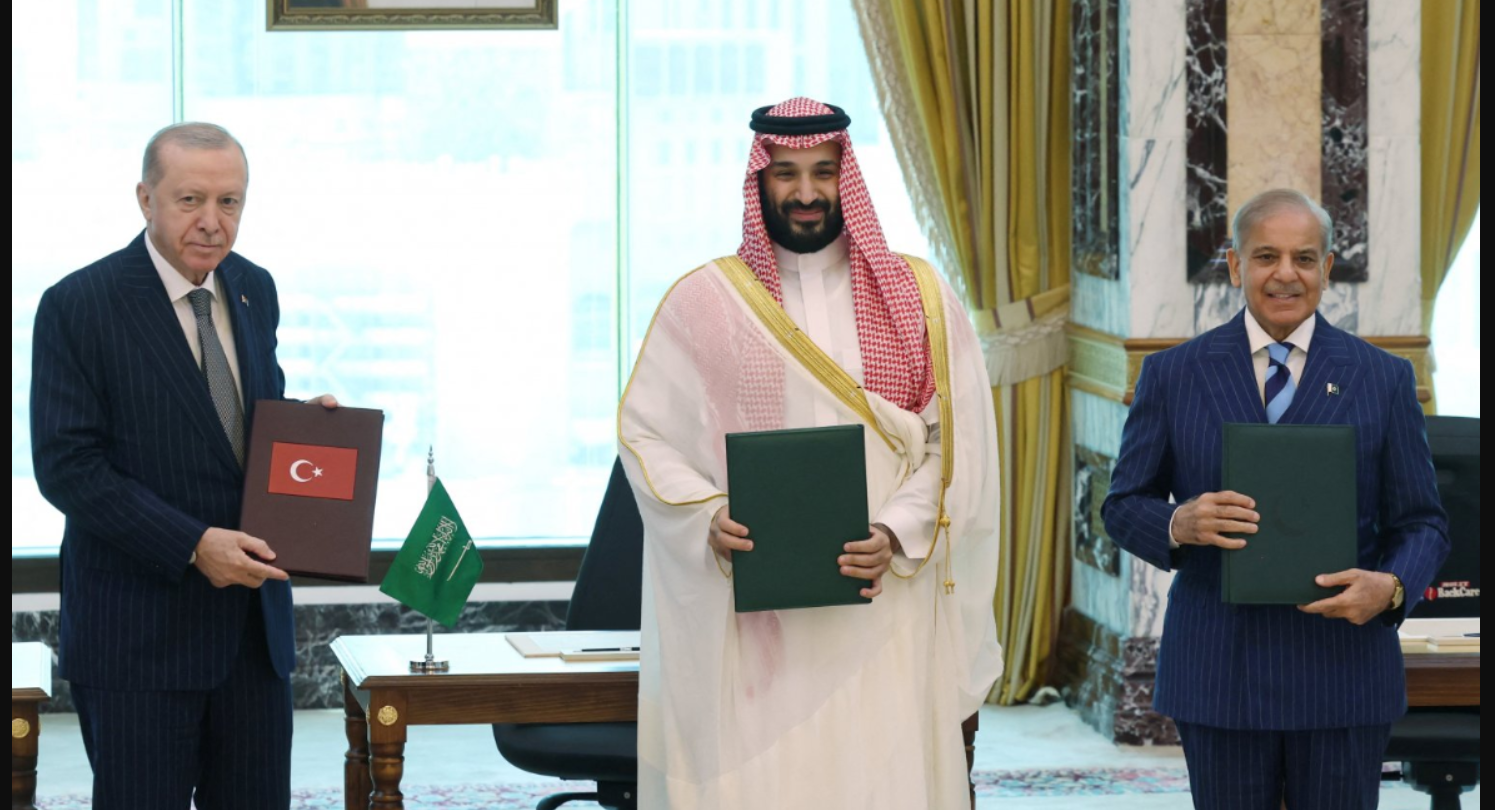
The first committee meeting follows the signing of the Makkah Joint Defence Agreement on August 7.
Prime Minister Shehbaz Sharif, Saudi Crown Prince and Prime Minister Mohammed bin Salman, and Turkish President Tayyip Erdogan attended the signing.
The agreement seeks to strengthen collective deterrence against any act of aggression. It also establishes a collective defence commitment among the three countries.
First Meeting of the Makkah Defence Agreement
A Turkish foreign ministry source said the meeting will take place in Istanbul on Monday.
Foreign and defence ministers from Pakistan, Saudi Arabia and Turkiye will attend the meeting. The chiefs of staff from all three countries will also participate.
The meeting will therefore bring together political, diplomatic, and military leadership from the three states.
“International security issues will be on the agenda,” the source said.
Discussions are expected to cover several areas of defence cooperation. These include enhancing defence capabilities and improving interoperability among the three armed forces.
The talks will also focus on deeper cooperation in the defence industry. This includes joint production and development.
What Does the Makkah Joint Defence Agreement Mean?
The three countries signed the Makkah Joint Defence Agreement on August 7.
The agreement aims to strengthen collective deterrence against acts of aggression. Under its terms, an armed attack against any one of the three countries would be regarded as an attack against all.
The arrangement therefore carries similarities to NATO’s Article 5 collective defence clause.
The agreement also refers to the right of defence under Article 51 of the United Nations Charter.
Its first committee meeting will now provide an opportunity for the three countries to discuss how they can deepen their defence cooperation.
Regional Security Takes Centre Stage
The meeting comes as regional security concerns continue to shape relations among major Middle Eastern powers.
The US-Israel war on Iran, which began on February 28, has had a major impact across the region.
The conflict has also drawn in several Gulf countries. Meanwhile, maritime traffic through the strategic Strait of Hormuz has faced major disruption.
Iran has launched multiple attacks on regional countries hosting US bases. It has also warned states against allowing their territory or facilities to support US attacks on Tehran.
Against this backdrop, Pakistan has remained in the spotlight because of its role as a mediator between the United States and Iran.
Pakistan’s Role in Regional Diplomacy
Pakistan has sought to play a key role in efforts involving the United States and Iran. However, six months after the US and Israel launched the war against Iran, negotiations remain at an impasse.
At the same time, the administration of US President Donald Trump has intensified efforts to impose financial pressure on Iran.
The administration has described those efforts as an “economic D-Day”.
These developments have added to the regional security challenges facing Pakistan, Saudi Arabia and Turkiye. Consequently, security cooperation among the three countries has gained greater importance.
Could the Defence Pact Expand?
Turkiye has indicated that the defence pact could expand in the future. Egypt has emerged as a potential candidate for participation in the arrangement.
However, Turkiye has also stressed that the agreement does not seek to replace existing alliances. The possibility of broader participation could give the pact a wider regional dimension.
In recent months, Turkiye, Saudi Arabia, Pakistan and Egypt have also formed a group to address regional issues. One of the main issues has been the war on Iran.
Turkiye has described the group as the R4. It has said the grouping aims to strengthen its partnership through concrete mechanisms.
Erdogan Says Pact Targets No Country
Turkish President Recep Tayyip Erdogan has emphasized the defensive nature of the agreement.
He previously said the joint defence pact with Saudi Arabia and Pakistan “targets no country and is open to the participation of all brotherly countries”.
Erdogan also highlighted the agreement’s focus on collective deterrence and defence cooperation.
“This agreement, based on collective deterrence, will contribute to advancing our security and defence cooperation, developing joint projects in the defence industry, and combating terrorism.”
He further said:
“The agreement, which also reaffirms the right of defence as defined in Article 51 of the UN Charter, targets no country and is open to the participation of all brotherly countries that aim for the peace, prosperity, and stability of our region.”
What Will the Three Countries Discuss?
The Istanbul meeting is expected to focus on practical areas of cooperation under the new defence agreement.
Enhancing defence capabilities will be among the expected areas of discussion. The three sides are also expected to consider greater interoperability among their armed forces.
Defence industry cooperation will form another important part of the talks.
This could include discussions on joint production and development, according to the Turkish foreign ministry source.
The participation of foreign and defence ministers, along with chiefs of staff, also gives the meeting significant political and military representation.
A New Phase for the Makkah Pact
The Istanbul meeting marks the first committee gathering under the Makkah Joint Defence Agreement.
For Pakistan, Saudi Arabia and Turkiye, it offers an opportunity to translate their agreement into practical cooperation.
The three countries have already committed themselves to collective deterrence and closer defence coordination. Now, their officials are expected to discuss the mechanisms needed to strengthen those commitments. The regional backdrop makes the meeting particularly significant.
With the war involving Iran continuing to affect regional security and maritime movement, the three countries are seeking closer coordination.
At the same time, Turkiye has left the door open for other brotherly countries to join the arrangement.
For now, however, the focus remains on the first committee meeting in Istanbul.
The discussions are expected to show how Pakistan, Saudi Arabia and Turkiye intend to develop their defence partnership after signing the Makkah agreement.

