
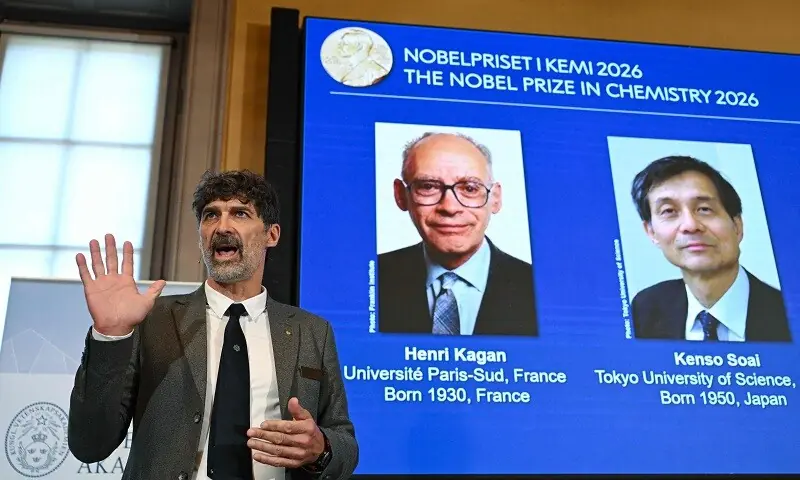

French scientist Henri B. Kagan and Japanese scientist Kenso Soai have won the 2026 Nobel Prize in Chemistry for discoveries that solved a longstanding mystery surrounding molecular asymmetry.
The Royal Swedish Academy of Sciences honoured the researchers for their discovery of “non-linear effects and autocatalysis in asymmetric organic synthesis.” Their work has helped scientists understand how chemical reactions can favour one of two molecular forms that are mirror images of each other.
Breakthrough in Molecular Chemistry
Many molecules exist in two mirror-image forms, similar to a person’s left and right hands. Although both forms may appear almost identical, they can behave differently in biological systems.
Living organisms predominantly use only one form of certain molecules, a phenomenon known as homochirality. Scientists have investigated this puzzle for more than a century.
Kagan made a major breakthrough in 1986 by demonstrating how chemical reactions could amplify a small imbalance between two molecular forms. Soai later advanced the research by developing asymmetric autocatalysis, allowing a reaction to increasingly favour one molecular form.
Importance for Pharmaceutical Development
The discoveries have significant implications for medicine because mirror-image molecules can produce very different effects inside the human body. One form can provide therapeutic benefits, while another may have unwanted or harmful effects.
The research has therefore become important for chemists developing medicines and designing manufacturing processes that produce specific molecular forms.
Kagan and Soai will share the 12 million Swedish kronor prize. They will receive their Nobel medals at a ceremony in Stockholm on December 10.
For the latest updates, visit and follow The Truth International website (www.thetruthinternational.com) and subscribe/follow the TTI YouTube Channel, Instagram, and Facebook

