

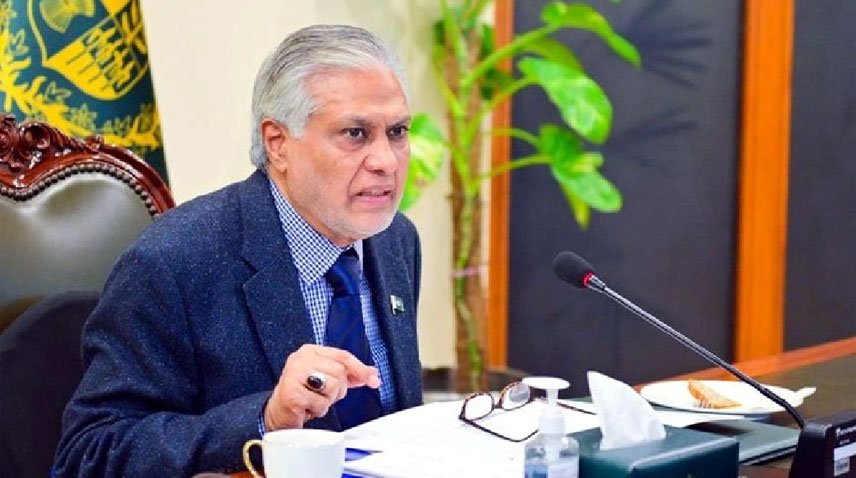

Deputy Prime Minister and Foreign Minister Ishaq Dar stated on Monday that Pakistan was “running well” and experiencing stability along with economic improvement, stressing that there was no requirement for a 27th Constitutional Amendment at this stage. His remarks came amidst ongoing speculation in Islamabad’s political and legal circles about the possibility of a new amendment aimed at restructuring the judiciary.
While addressing reporters during his visit to London, Dar explained that the government was still managing the effects of the 26th Constitutional Amendment, which itself has stirred controversy. He clarified that there was no urgency to introduce another amendment. “We are still digesting the 26th Constitutional Amendment, so there is no need for a 27th right now. The country is running well. There is stability and economic improvement,” he said.
He further emphasized that the government’s priority was economic growth and development under the leadership of Prime Minister Shehbaz Sharif. Dar recalled that during Nawaz Sharif’s tenure in 2017, Pakistan was recognized as the world’s 24th largest economy. He asserted that the current administration was working diligently to regain that position and was progressing quickly towards joining the G20 nations.
Speculations regarding the 27th Amendment have persisted since June, when the Islamabad High Court Bar Association expressed support for judicial reforms and endorsed the possibility of such an amendment.
Insiders had suggested that unresolved issues from the 26th Amendment, including the establishment of a separate constitutional court, might be taken up in a new amendment. However, no official confirmation had been provided until Dar’s comments put those rumors to rest, at least for the time being.
During his UK visit, Dar also held a series of meetings with British lawmakers of Pakistani origin. According to the Foreign Office (FO), he met with MPs Mohammad Yasin, Tahir Ali, Imran Hussain, Ayoub Khan, and Adnan Hussain.
In these discussions, Dar highlighted the strong cultural and historical ties between Pakistan and the United Kingdom, pointing to the vibrant Pakistani diaspora as a vital link that strengthens bilateral relations. He stressed that this diaspora plays a significant role in fostering cultural exchanges, mutual understanding, and people-to-people connections between the two countries.
Dar also underlined Pakistan’s commitment to enhancing bilateral parliamentary engagement with the UK. He noted that such exchanges were crucial for sharing democratic experiences, best practices, and values that are important for the growth of democratic institutions. The FO further reported that Dar appreciated the efforts of British MPs in raising awareness about human rights violations in occupied Kashmir, commending their work in highlighting the issue within the UK.
In addition, Dar met with Hamish Falconer, UK Parliamentary Under-Secretary of State for the Middle East, Afghanistan, and Pakistan, at the Foreign, Commonwealth, and Development Office (FCDO). The meeting covered the full spectrum of bilateral relations, including political, economic, and climate cooperation, while also reviewing regional and global issues.
Dar reaffirmed Pakistan’s stance on peace and stability in South Asia and stressed the importance of a just resolution of the Jammu and Kashmir dispute in line with UN Security Council resolutions. Both sides expressed satisfaction with the growing trajectory of Pakistan-UK ties and agreed on the importance of regular, high-level engagement to further deepen cooperation.
Dar also held discussions with Kashmiri community leaders in the UK, reiterating Pakistan’s unwavering support for their cause and stressing the significance of international advocacy on the Kashmir issue.
