

Midair Crash Claims Greek and Danish Crew Members
Two firefighting crew members were killed after two helicopters collided while battling a major wildfire west of Athens on Sunday.
The accident occurred near Psatha in Greece’s Attica region. Both aircraft were supporting efforts to contain a fast-moving fire threatening communities near the capital.
The helicopters were privately operated Bell aircraft hired for Greece’s summer firefighting campaign. Each helicopter was carrying two crew members when the collision occurred.
Television footage appeared to show one helicopter striking the lower section of the other aircraft. One helicopter then caught fire and crashed to the ground.
The two crew members aboard the falling aircraft were taken to hospital in an unconscious condition. Doctors later confirmed their deaths.
Greek authorities identified the victims as one Greek national and one Danish national.
The second helicopter managed to avoid a fatal crash. Its two crew members, a Greek and a British national, were rescued alive.
The exact cause of the collision remains under investigation. Officials have not confirmed whether strong winds, poor visibility, communication problems or pilot error contributed to the accident.
Greece’s fire service grounded Bell helicopters operating in the affected region while investigators examined the crash.
Prime Minister Kyriakos Mitsotakis expressed sorrow over the deaths and paid tribute to the crews conducting dangerous aerial missions.
The accident increased the number of people killed during Greece’s latest wildfire emergency to five. Three firefighters had already died while responding to separate fires in Crete and the Peloponnese.
Strong Winds Push Fire Towards Communities Near Athens
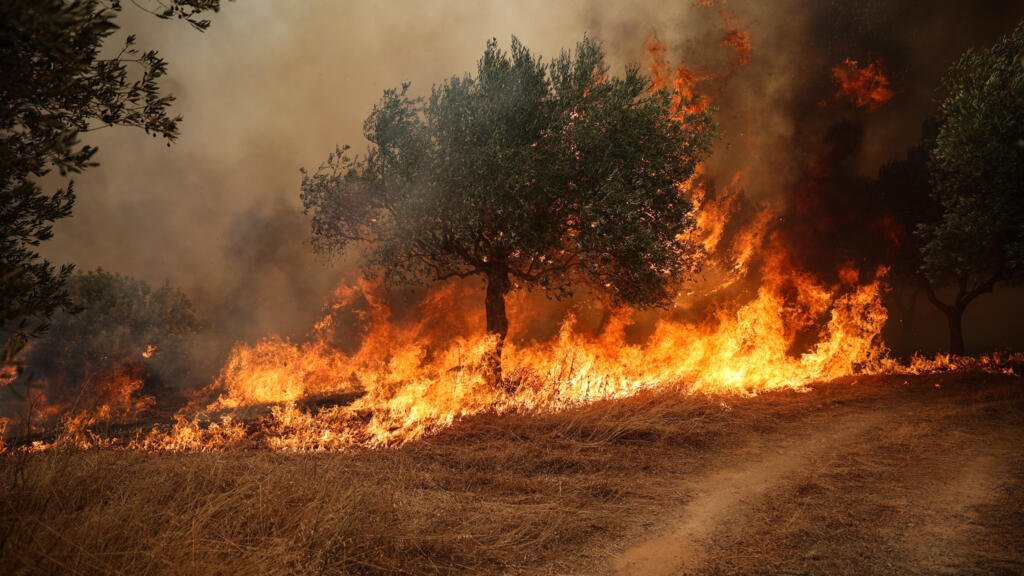
Hundreds of firefighters continued battling the wildfire west of Athens after it crossed mountainous terrain overnight.
Emergency crews worked to prevent the flames from reaching more populated areas. Aircraft dropped water and fire retardant whenever weather conditions allowed.
Strong winds made the operation extremely dangerous.
Greek officials said wind speeds had reached approximately 100 kilometres per hour during the crisis. Severe turbulence prevented some aircraft from collecting water or completing accurate drops.
Mitsotakis warned that firefighting aircraft could not operate safely when winds reached such extreme levels.
Ground teams, municipal workers, volunteers and local residents joined the effort to defend homes and villages.
The fire near Porto Germeno and the Gulf of Corinth damaged or destroyed more than 100 homes, according to reports from the affected region. Several communities were evacuated as flames approached residential areas.
Authorities ordered residents in Agia Paraskevi, Kryo Pigadi, Agios Nektarios and other threatened locations to leave their homes.
More than 200 people were also evacuated by sea from Agios Vasileios during the wider emergency.
Many residents were forced to leave pets and livestock behind.
Municipal teams and volunteers later entered damaged communities to rescue dogs and leave food for cats that could not be captured.
Early estimates suggested that more than 6,500 hectares had burned around the Gulf of Corinth.
Some wildfire experts said the affected area near Porto Germeno could exceed 10,000 hectares. They warned that the blaze may eventually be classified as a megafire.
Strong northerly winds weakened slightly on Sunday. However, conditions remained dangerous, and officials warned that the fire could change direction with little notice.
Greece Faces Hundreds of Fires and Rising Investigation Pressure
Greek fire officials said approximately 220 forest and agricultural fires had broken out nationwide since Monday.
The scale of the emergency pushed fire departments close to their operational limits.
Authorities were also battling fires on islands including Kefalonia, Crete and Paros.
On Kefalonia, police arrested a 44-year-old man on suspicion of deliberately starting a fire. The allegation remained under investigation.
Two electricity company employees were also detained in connection with the fire near Porto Germeno.
Investigators were examining whether sparks from electrical equipment or power infrastructure started the blaze. No final conclusion had been announced.
The helicopter operator, Australia-based McDermott Aviation, had deployed 15 aircraft to support Greece during the 2026 fire season.
The company’s fleet included Bell 214ST and Bell 214B helicopters. It has participated in Greek firefighting operations for seven consecutive years.
The fatal collision highlighted the risks faced by aerial firefighting crews.
Helicopter pilots often fly at low altitude in poor visibility. They must navigate smoke, mountains, power lines, violent winds and several other aircraft operating in the same airspace.
Greece’s civil protection authorities warned that Attica, nearby Voiotia and the island of Evia would remain under an extremely high fire risk.
Firefighters were expected to continue working throughout the night to contain active fronts and protect residential communities.
The emergency came after Greece had initially avoided the most severe heatwaves and fires seen elsewhere in Europe during the summer.
However, prolonged dry conditions and powerful winds quickly transformed local fires into a national emergency.
Authorities urged residents to follow evacuation orders immediately and avoid travelling near active fire zones.
Investigations into both the helicopter collision and the causes of several major fires are continuing.

