

Mexico Breaks With Concacaf as Football World Divides
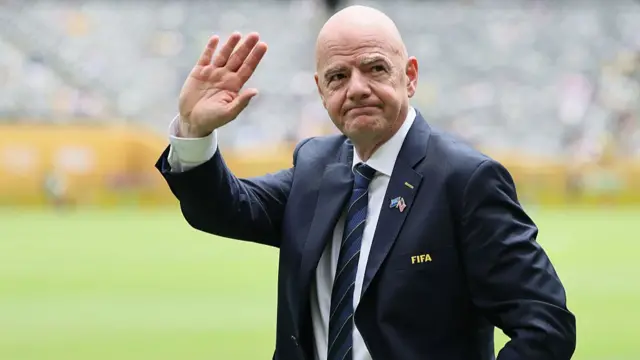
The global dispute over FIFA President Gianni Infantino has intensified after Mexico and Argentina publicly backed his leadership.
Their support comes as Infantino faces growing criticism over FIFA’s abandoned proposal to sell stakes linked to the commercial rights of the World Cup and other competitions.
The plan triggered one of the biggest governance disputes at FIFA in recent years.
European football body UEFA strongly opposed the proposal. Concacaf, which governs football across North America, Central America and the Caribbean, also demanded a broader review of Infantino’s leadership.
The Asian Football Confederation later expressed solidarity with UEFA and Concacaf.
However, several major football nations and regional bodies have refused to join calls against Infantino.
The Mexican Football Federation has now openly backed the FIFA president despite Concacaf’s critical position.
Mexico was one of the three hosts of the recently concluded 2026 FIFA World Cup alongside the United States and Canada.
In a statement, the Mexican federation said it would not recognise any attempt to remove or challenge Infantino outside FIFA’s established institutional procedures.
It stressed that any major leadership decision should involve FIFA’s full membership.
FIFA currently has 211 national member associations.
The Mexican federation said it supports Infantino’s continued leadership and his efforts to strengthen football institutions worldwide.
The move represents a significant break between Mexico and its own regional confederation during an increasingly bitter political battle inside world football.
Argentina Backs Infantino Despite Acknowledging FIFA Mistakes
Argentina’s Football Association has also offered strong support to Infantino.
In a letter to the FIFA president, the AFA praised the work carried out by FIFA during the past decade.
Argentina said FIFA’s leadership had focused on global football development and institutional stability.
The association also praised what it described as a clear and transparent governance structure.
However, Argentina acknowledged that FIFA made mistakes when developing the controversial commercial rights proposal.
The AFA said the proposal created more uncertainty than clarity.
It also accepted that errors had occurred during the process.
Despite those concerns, Argentina argued that the solution should be continued cooperation within FIFA rather than an attempt to remove Infantino outside established procedures.
South American governing body Conmebol has taken a similar position.
Conmebol has expressed concern about repeated unilateral decisions at FIFA.
However, it rejected any attempt to force Infantino out without a formal vote involving FIFA’s 211 member associations.
The dispute therefore appears to be dividing football not only between continents but also within individual confederations.
The Confederation of African Football has provided Infantino with another major source of support.
CAF’s executive committee unanimously backed his leadership this week.
The African body thanked Infantino for his support for football development across the continent.
That endorsement strengthened the FIFA president’s position at a time when European and several other football authorities have openly challenged him.
UEFA Maintains Pressure as Infantino Faces Crucial Election
The controversy began after FIFA explored a plan that could have allowed private investors to acquire an interest in commercial operations connected to major competitions.
Critics argued that the World Cup should never be treated as an investment asset.
UEFA and its 55 national associations strongly rejected the idea.
The proposal was eventually abandoned after widespread opposition.
FIFA later apologised to its members for mistakes surrounding the process.
Following high-level meetings in Rabat, the organisation also promised to review how the proposal had been developed and communicated.
FIFA has maintained that its actions complied with existing regulations.
It argues that the problems involved process and communication rather than violations of governance rules.
However, UEFA has said withdrawing the proposal is not enough.
European football officials want guarantees that similar attempts will not be made again.
UEFA has also maintained its loss of confidence in Infantino’s presidency.
Its threat to boycott FIFA competitions therefore remains part of the wider dispute unless its concerns are addressed.
Individual national associations have also started taking sides.
Croatia has withdrawn its support for Infantino following concerns about recent FIFA developments.
England and Albania have taken similar positions.
The Croatian Football Federation said its decision followed a reassessment of recent events surrounding FIFA and the 2026 World Cup.
Players’ union FIFPRO has been even more critical.
It described the commercial proposal as more than a governance failure and accused FIFA’s leadership of abusing presidential authority.
Infantino now faces a significant political challenge ahead of the FIFA Congress scheduled for March 2027.
He is expected to seek another term as president.
Only months ago, his re-election appeared almost certain.
The commercial rights dispute has changed that political landscape.
However, no clear candidate has yet emerged with enough support to seriously challenge him.
Backing from Mexico, Argentina, CAF and other associations also demonstrates that Infantino retains significant influence across world football.
The coming months are therefore likely to determine whether the controversy develops into a genuine leadership challenge or strengthens Infantino’s supporters ahead of the election.
For now, FIFA remains deeply divided between organisations demanding major governance changes and those insisting that any leadership decision must take place through the organisation’s formal voting system.

