
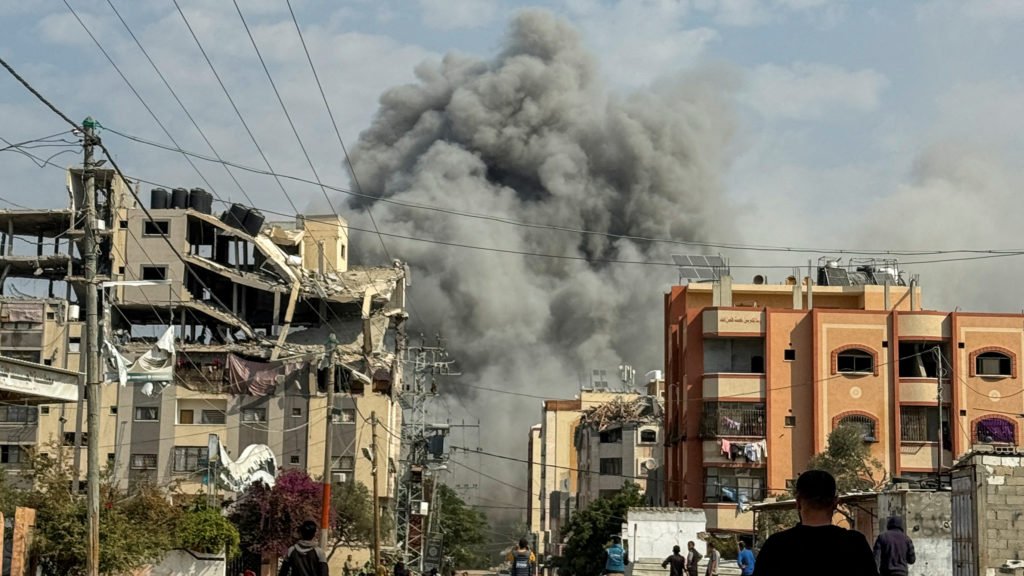

At least seven Palestinians, including a father and his 13-year-old son, died in Israeli attacks across the Gaza Strip on Tuesday, November 10, 2026. Local health officials confirmed the deaths as fresh violence raised concerns about the fragile ceasefire.
Israeli forces carried out strikes in several parts of Gaza City. Medics also reported deadly gunfire in southern Gaza. The attacks came as efforts to advance a US-backed peace agreement remained stalled.
Health officials identified two victims as Fadi Rajab and his teenage son, Abubakr. An Israeli airstrike struck the roof of a shelter housing displaced Palestinians in Gaza City’s Zeitoun neighborhood, killing both.
The incident highlighted the continuing danger facing families who have already fled their homes. Many displaced Palestinians remain in temporary shelters as Gaza struggles with widespread destruction.
Another Israeli airstrike killed a Palestinian near a school in the Daraj neighborhood of Gaza City. Local health authorities confirmed the death shortly after the attack.
The Israeli military said it targeted militants in both Zeitoun and Daraj. However, it did not provide further details about the operations or the identities of those targeted.
ReutersFeed
Meanwhile, Israeli gunfire killed another Palestinian in Khan Younis, a city in southern Gaza. Medical workers confirmed the incident but provided limited information about the circumstances.
Later that day, an Israeli airstrike hit a metal foundry in Gaza City’s Sabra neighborhood. The attack killed three more Palestinians, according to local medics.
These deaths brought Tuesday’s reported toll to at least seven Palestinians.
The Israeli military did not immediately respond to requests for comment about the incidents in Khan Younis and Sabra.
The latest attacks have renewed concerns about the future of Gaza’s ceasefire agreement. The United States helped broker the deal in 2025 to reduce fighting and create a path toward rebuilding the territory.
However, negotiations have made little progress. Key disagreements continue to prevent the parties from moving forward with the agreement.
One major dispute involves the disarmament of Hamas. Israel wants the group to surrender its weapons as part of the peace process.
Another disagreement concerns the withdrawal of Israeli troops from Gaza. Israeli forces currently control about two-thirds of the territory, according to reports.
Residents have received orders to leave several areas under Israeli military control. These restrictions have added to the difficulties facing displaced families.
Israel accuses Hamas of rebuilding its military strength and replacing weapons lost during the conflict.
Hamas rejects accusations that it has abandoned the ceasefire. The group says it remains committed to the agreement and accuses Israel of undermining its terms.
Both sides continue to blame each other for the lack of progress. The disagreements have delayed plans for Gaza’s recovery and reconstruction.
Reuters
The humanitarian situation remains severe despite international efforts to maintain the ceasefire.
According to Gaza health officials, Israeli attacks have killed at least 1,600 Palestinians since the ceasefire agreement took effect.
Israel says four of its soldiers have died during the same period.
The continuing casualties have raised questions about whether the agreement can provide lasting protection for civilians.
Gaza has suffered extensive damage since the war began in October 2023. Large areas of the territory have lost homes, roads, schools, and essential services.
Palestinian authorities say Israeli military operations have killed more than 74,000 people since the conflict began.
The war followed the Hamas-led attacks on southern Israel on October 7, 2023, which killed approximately 1,200 people.
Since then, repeated military operations have forced many Palestinian families to flee their homes.
The destruction has also complicated plans to rebuild Gaza. Aid organizations face major challenges in restoring housing, healthcare, and other essential services.
The latest deaths have placed additional pressure on diplomatic efforts to prevent further violence.
Negotiators still need to resolve disputes over security arrangements, military withdrawal, and the territory’s future administration.
Without progress, the ceasefire remains vulnerable to further attacks and renewed fighting.
For Palestinian families, the uncertainty continues to shape everyday life. Many remain displaced and face serious risks even in areas where they have sought shelter.
The deaths of Fadi Rajab and his 13-year-old son have once again drawn attention to the human cost of the conflict.
As negotiations remain stalled, the latest Israeli attacks raise a difficult question: How can Gaza move toward lasting peace while civilians continue to die?

