
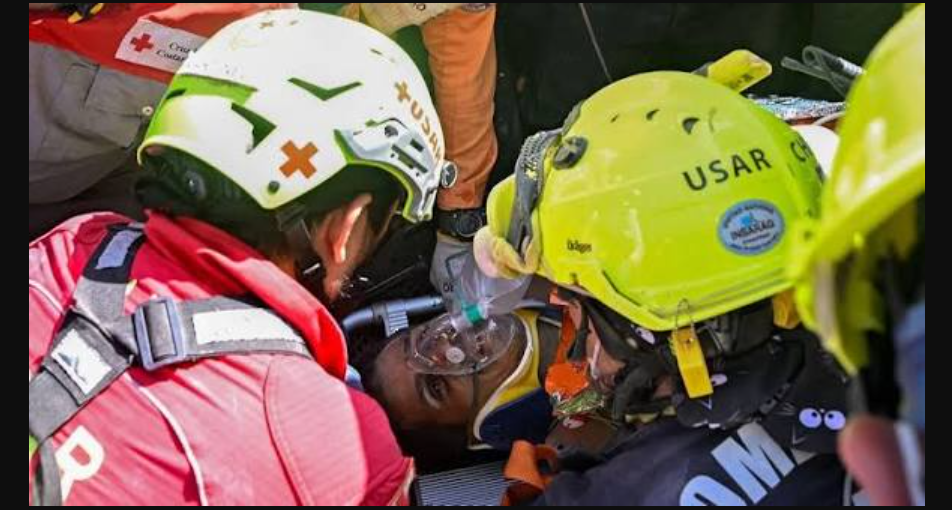

Rescue teams in Venezuela pulled a 43-year-old man alive from the rubble of a collapsed building eight days after two powerful earthquakes struck the country.
The dramatic rescue sparked celebrations among hundreds of emergency workers. They cheered and embraced after successfully bringing Hernan Gil to safety.
Gil, a security guard, had been trapped beneath a collapsed seven-story building in Catia La Mar. The coastal area suffered widespread destruction during the June 24 earthquakes.
Meanwhile, the country’s official death toll has climbed to nearly 2,600. Thousands of people also remain missing, making Gil’s survival an extraordinary moment amid the tragedy.
Rescuers Worked Around the Clock
Emergency teams from Venezuela, Chile, the United States, Portugal, Costa Rica, El Salvador, and Mexico joined the operation.
For three days, specialists worked continuously to reach Gil beneath the debris.
Throughout the rescue effort, responders supplied him with more than ten liters of water through a hose. They also installed an oxygen tube to help him survive underground.
Finally, rescuers carried him from the wreckage on a stretcher after completing a delicate extraction. His wife, Gusbimar Gonzalez, watched the operation unfold. She said, “This is truly a miracle.”
Cristian Vera, who led the Chilean rescue team, described the challenges faced during the mission. He said, “It wasn’t easy to reach the exact spot where the victim was located.”
During the final stage, nearly 30 rescuers cleared heavy debris. At the same time, two rescuers dug a three-meter tunnel to reach Gil safely.
Hope Fades for More Survivors
Although Gil’s rescue inspired hope, emergency officials acknowledged that finding additional survivors has become increasingly unlikely.
Earlier this week, rescuers also saved a three-year-old boy who had remained trapped for six days. However, the critical 72-hour survival window has long passed for most missing victims. Mexican firefighter Cesar Gonzalez explained the difficult reality facing rescue teams.
He said, “One is for detecting the living, the other for cadavers. Just two days ago, there was much more hope. Now, it would take a miracle.” Search operations now focus largely on recovering victims while continuing limited searches for survivors.
Death Toll Continues to Rise
Authorities said the death toll has reached 2,595. More than 12,400 people have also suffered injuries.
Although officials have not released an official missing persons figure, the United Nations estimates that as many as 50,000 people remain unaccounted for.
The twin earthquakes measured 7.2 and 7.5 in magnitude. They devastated large parts of oil-rich Venezuela and destroyed entire neighborhoods.
According to NASA data, nearly 60,000 buildings were either damaged or completely destroyed. Officials also reported that around 13,000 people have been left homeless. Many families are now living in temporary shelters, parks, vacant lots, and tents.
Families Continue Searching for Loved Ones
Across the affected regions, relatives continue searching for missing family members.
In the Los Corales area, Hernan Sandoval desperately searched for his eight-year-old son Ronald and two young relatives trapped beneath the collapsed La Gambarra residential complex.
He recalled the terrifying moments after the disaster. He said, “I ran out like a desperate madman.” He added, “My heart broke. I cried a little and then kept going. I’ve searched for him in so many places.” Despite the overwhelming loss, he said, “I still have a lot of faith.”
Humanitarian Crisis Deepens
Attention is now shifting toward the growing humanitarian crisis. Food and clean water are becoming increasingly scarce. Meanwhile, hospitals remain under enormous pressure as medical teams treat thousands of injured people. Experts have also warned about the growing risk of disease outbreaks.
The World Food Programme has appealed for 50 million dollars to provide food assistance for around 500,000 people over the next three months. Aid queues continue to grow longer each day. Many survivors now depend entirely on volunteers and donated supplies.
Maria Arteaga, a 33-year-old mother of four, is among those forced to sleep in a temporary shelter. She described the scale of her family’s loss. She said, “We lost everything, except our lives. We’re even barefoot.”
Government Defends Disaster Response
Some survivors have criticized what they describe as a slow government response. However, Interim President Delcy Rodriguez defended the emergency efforts. She said, “In the first 24 hours, it reached 4,000 personnel, and within 48 hours there were 11,000 officials.” Rodriguez also confirmed that authorities have no plans to establish mass graves for earthquake victims.
As rescue operations continue, Venezuela remains focused on recovering victims, supporting survivors, and rebuilding communities devastated by one of the country’s worst natural disasters.

