
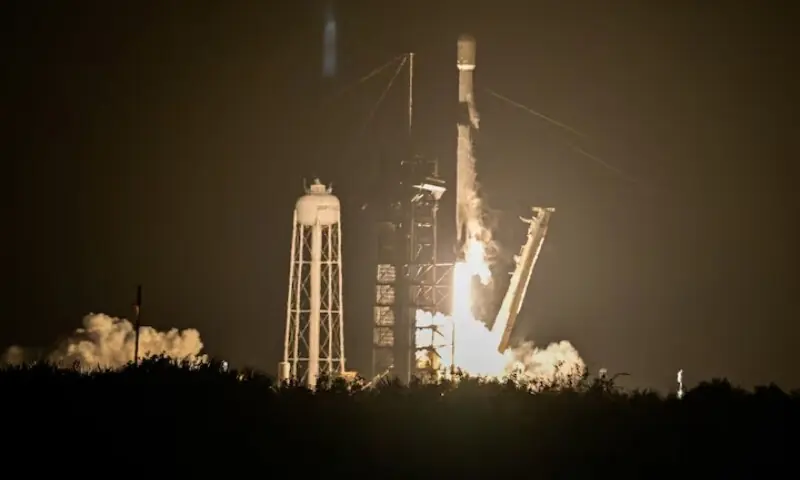

A large piece of SpaceX rocket hardware was expected to slam into the Moon early Wednesday after drifting through space for more than a year. The school-bus-sized object is the second stage of a Falcon 9 rocket. It launched a lunar lander developed by Firefly Aerospace toward the Moon in January 2025. The uncontrolled rocket stage was expected to strike the lunar surface at high speed. However, scientists could not immediately confirm the impact.
SpaceX Rocket Stage Headed for Lunar Impact
The rocket stage weighs around four metric tons. It was expected to hit the Moon at approximately 2:35am ET, or 11:35am PKT.
At impact, the object would have been travelling at around 5,400 miles per hour.
Scientists expected the collision to create a cloud of lunar dust. Sunlight could illuminate the plume, but observers on Earth would struggle to see it directly.
Furthermore, spacecraft orbiting the Moon were not positioned to capture the collision live. Scientists therefore expected confirmation to take several hours.
Researchers planned to examine telescope images from observatories across the Americas to identify evidence of the impact.
The rocket stage was expected to strike Einstein Crater near the Moon’s western limb. That region can be difficult to observe from Earth.
SpaceX said the collision was accidental.
Why Did the Rocket Stage Reach the Moon?
Rocket stages normally return to Earth after completing their missions. They often burn up in the atmosphere or fall into the ocean.
However, this mission required significantly more thrust because it sent a lunar lander toward the Moon. As a result, the Falcon 9’s second stage remained in space.
The empty stage eventually joined thousands of other objects classified as space junk. Active spacecraft must carefully avoid such debris while operating in orbit.
Astronomers only determined earlier this year that the rocket stage was following a trajectory that would eventually intersect with the Moon.
Julianna Scheiman, SpaceX director of NASA science and Dragon programmes, explained that natural forces changed the object’s path.
“What has happened is essentially a mixture of solar activity and gravity forces has put it on a path toward the moon,” she said.
The stage had already released its remaining fuel and could no longer be controlled. Consequently, scientists could not redirect it away from the Moon.
Could the Impact Help Scientists?
Although the collision was accidental, researchers believe it could provide limited scientific information.
Astronomer Bill Gray, who developed widely used astronomy software, said the impact might offer some minor scientific value.
However, he also raised concerns about how space agencies and companies manage discarded hardware.
Space junk collisions with the Moon remain uncommon. Still, several spacecraft and rocket stages have previously struck the lunar surface.
In March 2022, a Chinese rocket stage crashed into the Moon after completing a lunar test mission.
NASA deliberately caused another lunar impact in 2009. The agency used the collision to study the plume of lunar material produced by the crash.
NASA also intentionally crashed stages from its Saturn V rockets into the Moon during the 1970s. Scientists studied the resulting seismic effects.
Previous Spacecraft Crashes on the Moon
Several lunar missions have also ended in accidental crashes.
Russia’s Luna-25 mission lost control and struck the Moon in 2023. The spacecraft carried a small plutonium-238 power source, which is expected to remain harmless on the lunar surface.
India’s Chandrayaan-2 lander crashed during its attempted landing in 2019.
That same year, Israel’s Beresheet lander also failed to land safely. Its payload included microscopic tardigrades, which can survive extreme conditions.
Scientists believe those tiny organisms may still remain on the lunar surface.
NASA and SpaceX Consider Future Precautions
The latest incident has renewed attention on how lunar missions handle leftover rocket hardware.
NASA and SpaceX are discussing ways to reduce the possibility of future uncontrolled lunar impacts.
The issue could become more important as lunar activity increases. NASA plans to establish a sustained presence on the Moon through its Artemis programme.
The agency also aims to support regular astronaut missions to the lunar surface later this decade.
As more spacecraft travel to the Moon, managing leftover hardware will become increasingly important. Preventing uncontrolled impacts could help protect future lunar bases, astronauts and scientific equipment.
For now, the SpaceX rocket stage’s journey highlights an unexpected challenge of lunar exploration. Even after a mission ends, discarded hardware can remain in motion and eventually become part of the Moon’s surface.

