
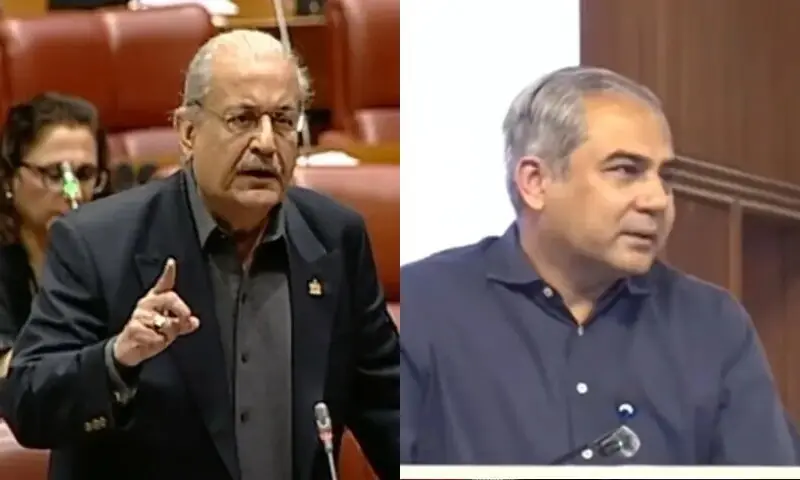

ISLAMABAD: Interior Minister Mohsin Naqvi’s call for new provinces has sparked a wider debate over Pakistan’s governance structure. However, key coalition leaders argue that changing provincial boundaries will not solve the country’s deeper institutional problems.
Defence Minister Khawaja Asif urged Naqvi to focus first on implementing the National Action Plan (NAP). Meanwhile, former Senate chairman Mian Raza Rabbani rejected the idea of creating new provinces altogether. Both leaders pointed toward constitutional compliance, institutional strength, and effective governance as more urgent priorities.
Khawaja Asif Urges Naqvi to Implement NAP
Khawaja Asif responded to Naqvi’s remarks in a post on X. He also referred to recent comments by the military’s spokesperson about governance reforms.
“Mohsin Naqvi sahib expressed his views on the dire state of the system. I more or less personally agree with these views,” Mr Asif wrote, describing the interior minister as a “powerhouse”.
However, Asif argued that Naqvi should begin reform efforts through his own ministry. He specifically urged the interior minister to implement the National Action Plan.
The defence minister also called for political reforms to address long-standing institutional weaknesses. According to him, Pakistan’s political development has suffered from personal and factional interests.
Asif said meaningful reforms should emerge through constitutional institutions. He suggested parliament and the federal cabinet as the appropriate forums for such changes.
Asif Questions Naqvi’s Approach to Reform
Asif noted that Naqvi serves as a cabinet member and parliamentarian. However, he claimed that the interior minister rarely attends parliamentary or cabinet sessions.
“This way, these institutions and the system would be strengthened, and change would come through a constitutional process,” he said.
The defence minister also questioned Naqvi’s decision to discuss major governance reforms before a gathering of business leaders.
“In my opinion, treating these institutions as irrelevant and making such a major statement before a captive audience after inviting the country’s eminent and respected businessmen does not carry the same weight that it would have had if made at the relevant constitutional forums,” he said.
Furthermore, Asif pointed to Naqvi’s influence within the government over recent years.
“Had he wanted, he could have spoken about changing the system or made progress on it during this time,” he said.
Defence Minister Calls for PCB Reform
Asif also challenged Naqvi to bring major changes to the Pakistan Cricket Board (PCB). Naqvi currently heads the PCB alongside his role as interior minister.
“Naqvi sahib, systems evolve continuously and they should. As an example, bring about a revolution in the PCB. Cricket fans are not satisfied with its performance,” he wrote.
He further highlighted Naqvi’s authority within the cricket board.
He added that in the PCB, “all authority rests with you. There is neither a prime minister, nor parliament, nor any outdated system standing in your way.”
The comments added another dimension to the growing disagreement over Naqvi’s governance proposal.
Naqvi Calls for New Administrative Units
Naqvi recently argued that Pakistan’s governance system had “collapsed”. He said the country needed new administrative units to improve public services, accountability, and access to justice.
He also called for new leadership focused on merit and opportunities for young people. According to Naqvi, the country’s youth wanted justice, jobs, and merit instead of stipends and laptops.
A day later, the military spokesperson also urged political parties to consider an administrative reset. He argued that Pakistan’s security and stability depend on a governance structure suited to modern demands and population growth.
The remarks have since intensified discussion about whether Pakistan needs new provinces or deeper reforms within its existing structure.
Raza Rabbani Rejects New Provinces Proposal
Former Senate chairman Mian Raza Rabbani has strongly opposed the creation of new provinces. He argued that Pakistan’s governance crisis stems from constitutional violations rather than the number of federating units.
Rabbani warned that redrawing administrative boundaries would not resolve the country’s long-standing institutional problems. Instead, he identified the erosion of provincial autonomy and democratic institutions as major causes.
The veteran politician listed several factors behind Pakistan’s governance challenges. These include repeated disruptions to democracy and the growing influence of civil-military bureaucracy.
He also criticised the centralisation of powers in Islamabad and the weakening of the federation. Additionally, he pointed to constitutional amendments introduced under military dictatorships.
Rabbani also criticised repeated experiments with governance models since 1947. He said authorities have often made important policy decisions outside parliament.
According to him, the country has also struggled with free and fair elections. He further highlighted constitutional violations, weak separation of powers, and the denial of provincial autonomy.
“This is just the tip of the iceberg,” Mr Rabbani said.
Rabbani Calls for Constitutional Governance
Instead of creating new provinces, Rabbani proposed several institutional reforms. First, he called for strict adherence to the supremacy of the 1973 Constitution. He also urged authorities to strengthen the rule of law. Moreover, he stressed the need to protect provincial autonomy under the Constitution.
Rabbani further called for strict observance of the constitutional separation of powers. He also supported greater political, administrative, and financial authority for elected local governments.
The former Senate chairman referred specifically to Article 140-A, which provides for local government systems.
The debate therefore extends beyond the question of creating new provinces. It raises broader questions about constitutional governance, institutional accountability, provincial autonomy, and local representation.
For supporters of administrative restructuring, smaller provinces could improve service delivery and bring government closer to citizens. However, critics argue that structural changes alone cannot fix weak institutions.
The growing disagreement suggests that Pakistan’s debate over new provinces will remain closely tied to constitutional reform. Ultimately, the challenge is not simply where administrative boundaries should fall. It is whether existing institutions can deliver effective, accountable, and constitutionally compliant governance.

