
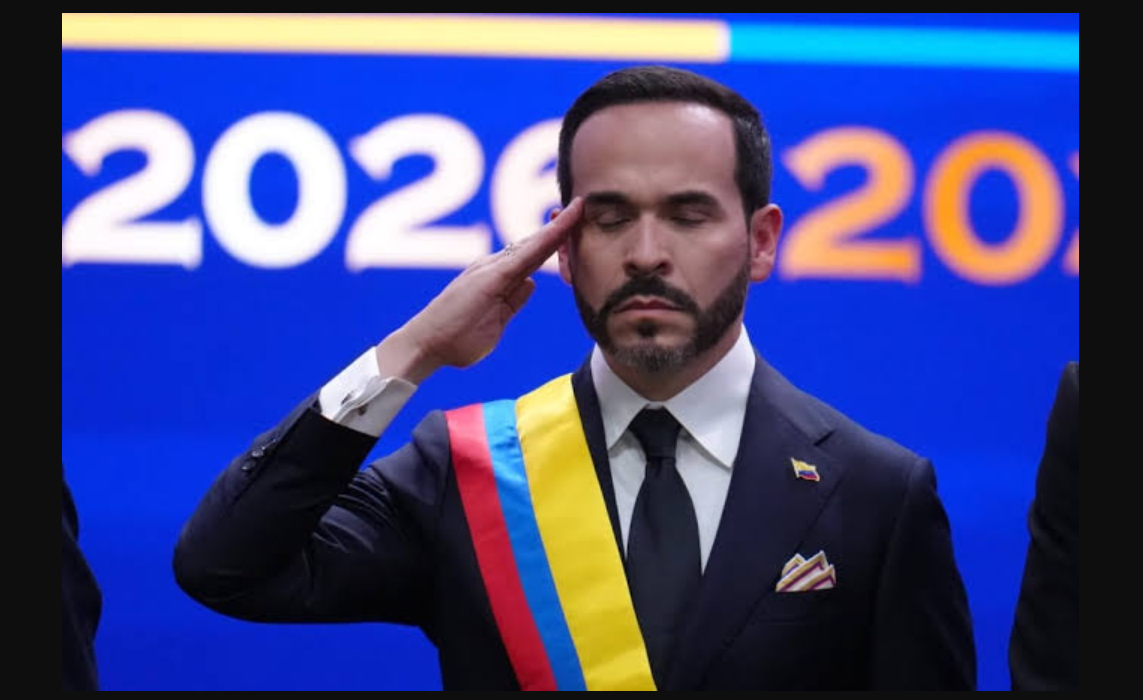

Abelardo de la Espriella took office as Colombia’s president on Friday. His inauguration signals a major political shift for the Andean nation.
The former lawyer has promised tougher action against drug-running guerrillas. He also plans closer relations with the United States.
De la Espriella has pledged to target cocaine laboratories operating in Colombia’s jungles. He has also proposed building “mega-prisons” for criminals.
At the same time, he wants to reduce the size of the Colombian state.
The 48-year-old president holds both US and Colombian citizenship. He has also offered to conduct joint military operations with Washington.
Moreover, he has suggested hosting US troops on Colombian territory.
Inauguration Held in Cali
De la Espriella and Vice President Jose Manuel Restrepo took their oaths during a ceremony in Cali.
The two leaders later embraced and performed their campaign’s characteristic military salute.
Unlike traditional presidential inaugurations, the ceremony did not take place in Bogota.
Instead, Cali hosted the event in a significant break from convention. The tropical southwestern city is widely known as Colombia’s salsa capital.
The ceremony attracted several prominent international figures.
Argentina’s President Javier Milei attended the event, while Todd Blanche represented the United States as its delegation head.
FIFA President Gianni Infantino was also among the guests.
However, De la Espriella’s predecessor, Gustavo Petro, did not attend the inauguration.
Petro had earlier left the presidential residence in Bogota, bidding “farewell, freedom and life.”
Colombia Begins a New Political Era
De la Espriella’s victory ended four years of Colombia’s first leftist government.
He defeated left-wing rival Ivan Cepeda by less than one percentage point.
After his victory in June, De la Espriella declared, “We are beginning a new era!”
However, his government faces an immediate political challenge.
The new president does not hold a majority in a divided Congress. Therefore, passing major legislation could prove difficult.
His supporters expect a tougher response to crime and armed groups.
They also hope his government can reverse the security deterioration that followed years of stalled peace efforts.
“This government has a lot to prove. A lot was said during the campaign,” said 46-year-old Marisol Peira in Cali.
Security Takes Centre Stage
Cali faced heightened security during the inauguration because of its recent history of violence. The city has experienced several guerrilla pipe bomb attacks in recent years.
Authorities deployed around 11,000 troops for the ceremony. They also installed an anti-drone system to strengthen security.
De la Espriella has made national security a central part of his political agenda.
He has promised an aggressive campaign against guerrillas and criminal organisations involved in drug trafficking.
A Major Shift After Petro’s Peace Strategy
Petro attempted to negotiate peace with Colombia’s numerous armed groups during his presidency. However, those efforts failed to deliver the expected results.
Experts say many armed groups have increasingly focused on profits from cocaine trafficking and other illegal businesses.
According to those assessments, some groups used government truces to expand their operations. De la Espriella now plans to take a significantly different approach.
Meanwhile, Petro has continued to challenge the new government. He called for mass protests in major cities on Friday. He also alleged election fraud without providing evidence.
De la Espriella Plans a New ‘Plan Colombia’
De la Espriella has branded himself “The Tiger” and wants a stronger military partnership with the United States. He also plans to build a military alliance involving Washington and Israel.
His proposed strategy, known as “Plan Colombia II”, takes its name from an earlier agreement with the United States.
The original Plan Colombia involved substantial US support during the 2000s. Its objective included combating drug cartels and leftist armed groups. De la Espriella now wants to revive that model with a stronger security focus.
“We have to support him so there won’t be so much crime,” said German Angulo, a 63-year-old contractor. “We need a complete change.”
Plan Colombia’s Controversial Legacy
The original Plan Colombia weakened several major armed groups. However, the campaign also faced allegations of serious human rights abuses.
That history could create challenges for De la Espriella as he pursues his proposed security strategy. His government therefore begins with major promises on crime, drugs and military cooperation.
At the same time, a divided Congress could limit his ability to implement those plans quickly.
For Colombia, the new administration marks a clear departure from the previous government’s political direction.
The coming months will show whether De la Espriella can turn his campaign promises into a new security and foreign policy approach.

