
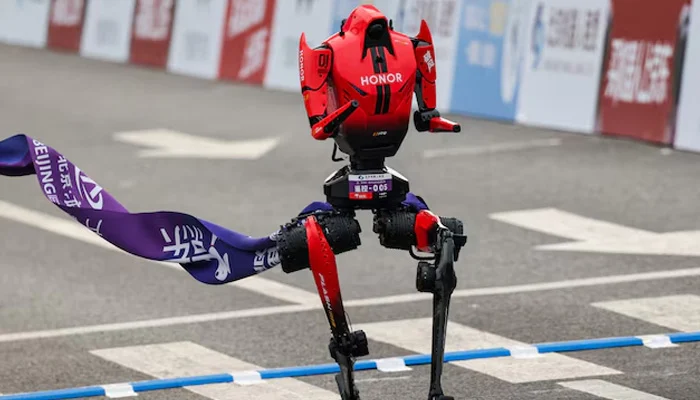

Honor’s Lightning Reaches Peak Speed of 14.5 Metres Per Second
A Chinese humanoid robot has completed a 100-metre sprint in 9.32 seconds, recording a time faster than Usain Bolt’s longstanding human world record.
The robot, named Lightning, was developed by Chinese smartphone maker Honor.
China’s state broadcaster reported the performance on Saturday during preparations for the second World Humanoid Robot Games in Beijing.
Lightning reached a peak speed of 14.5 metres per second during the test.
Its 9.32-second performance was 0.26 seconds faster than Bolt’s official men’s 100-metre world record of 9.58 seconds.
Bolt set the record at the 2009 World Athletics Championships in Berlin.
His 9.58-second mark remains the official human men’s 100-metre world record. The robot’s performance does not replace Bolt’s athletics record because it was achieved by a machine during a robotics test rather than an officially sanctioned human race.
Lightning is expected to compete in the 100 metres, 400 metres and 1,500 metres at the World Humanoid Robot Games.
The event opened in Beijing on August 22 and will continue through August 26. Chinese reports say the competition features dozens of sporting and practical challenges designed to test humanoid robot technology.
Robot Upgraded With Longer Legs Ahead of Beijing Games
Honor’s development team made significant changes to Lightning ahead of the competition.
During an earlier half-marathon event, the robot stood 169 centimetres tall and had legs measuring approximately 95 centimetres.
Researchers have since extended its legs by around 10 centimetres to 1.05 metres, according to China Central Television.
The longer legs are intended to increase stride length and improve performance during short, high-speed races.
Chinese reports said engineers also worked on reducing the robot’s overall weight and improving its joint systems.
The upgrades were designed to produce greater torque and faster response while maintaining stability at extreme speeds.
The 100-metre test represents another major milestone for Lightning.
Only four months earlier, the robot attracted international attention by winning the Beijing E-Town humanoid robot half-marathon.
Lightning completed the approximately 21-kilometre course in 50 minutes and 26 seconds.
That was considerably faster than the current men’s human half-marathon world-record time of 57 minutes and 20 seconds cited during the event.
The result demonstrated how rapidly humanoid running technology has improved.
China Pushes Humanoid Robots Toward Real-World Applications
Lightning’s latest performance comes as China places growing strategic importance on humanoid robotics.
Chinese policymakers view the sector as an emerging industry with potential applications far beyond sporting demonstrations.
Companies are investing heavily in artificial intelligence, mechanical design, batteries, sensors and motion-control systems.
The long-term objective is to deploy humanoid robots in manufacturing, logistics, hazardous environments and consumer services.
Competitions such as the World Humanoid Robot Games allow manufacturers to test technologies under demanding conditions.
Running at high speed requires robots to continuously maintain balance while processing movement, terrain and positioning information.
Failures can reveal weaknesses in motors, joints, cooling systems, batteries and software that may also matter when robots are deployed in workplaces.
The World Humanoid Robot Games have therefore become more than a sporting spectacle.
They are increasingly being used as a testing ground for technologies that companies hope will eventually move from competition arenas into factories and commercial environments.
Lightning’s 9.32-second sprint does not take Usain Bolt’s official athletics record away from him.
However, the test provides another striking demonstration of how quickly humanoid machines are improving in speed, balance and physical performance.

