
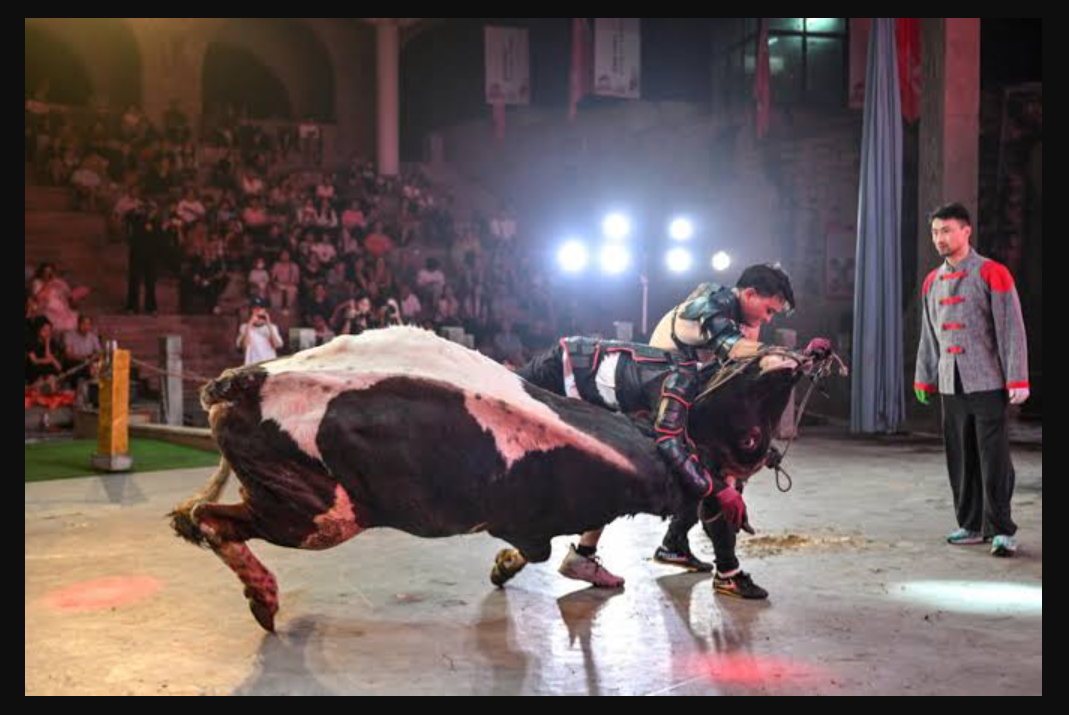

China’s traditional bull wrestling sport, known as guanniu, continues to survive despite limited recognition and growing challenges.
For centuries, the sport remained part of local cultural identity. However, changing interests and limited financial support have placed its future under pressure.
In eastern China, practitioners and trainers are now working to preserve the centuries-old tradition and attract a younger generation before interest fades further.
What Is Guanniu and Why Does It Matter?
Guanniu is a traditional Chinese bull wrestling practice that dates back more than 600 years.
The sport developed after Hui Muslim communities introduced it to Jiaxing, a city located south of Shanghai. Over time, what began as a practical livestock-handling skill evolved into a competitive folk tradition.
Unlike Spanish bullfighting, guanniu does not involve weapons and does not end with the killing of the animal.
Instead, participants rely on physical control and technique. Wrestlers grab the bull’s horns and attempt to force it to the ground. Competitors earn additional points if they successfully jump onto the animal’s back or move beneath its body.
As a result, the sport places equal importance on timing, balance, strength, and movement.
Young Competitors Step Into the Arena
Inside a partially covered amphitheatre known as the China Bullfighting Hall, younger participants continue testing themselves against the demanding sport.
Among them is 20-year-old Wang Shuangshuang, who competed by pressing his shoulder against a bull while attempting to bring it down.
Students occasionally participate in annual competitions. However, only a few choose to continue after completing their education.
Wang described the sport’s physical demands and said:
“You have to go with its flow, shift your shoulders constantly to follow its resistance, lock its neck, and then throw it down.”
He added:
“Strength and technique, neither can be missing.”
Although Wang remains interested in the tradition, he has not decided whether he will pursue it professionally.
Another participant, 20-year-old Xu Zhiqian, explained what attracts him to guanniu.
“I think this sport is very youthful, very hot-blooded.”
However, despite enjoying the competition, Xu plans to continue working in his academic field instead of making the sport a career.
Can Guanniu Survive Without New Talent?
For many involved in preserving guanniu, attracting committed participants remains the biggest challenge.
Seventy-two-year-old master Han Haihua believes financial support is essential for the sport’s future.
He said:
“Our heritage right now is neither dead nor alive.”
Han also stressed the importance of investment and training opportunities.
“To bring in talent, you need money… I’m not bragging — give me 30 or 50 kids, train them here for three years, and I’ll make the whole world know about guanniu.”
His concerns reflect a broader struggle facing traditional sports that compete with modern entertainment and changing career priorities.
One of the Few Who Chose Guanniu Full-Time
Thirty-year-old Li Bo remains one of the rare examples of someone pursuing guanniu professionally. He joined Han’s martial arts school as a teenager after developing an interest in martial arts films.
Today, Han considers him among the country’s strongest guanniu performers. Still, Li worries about the future.
“Nobody wants to do this full-time. That makes our inheritance extremely difficult.”
To support operations, the school has expanded beyond competitions.
It now performs at tourist locations, organises events, sells souvenirs, and even runs a halal steamed-bun business.
Additionally, Li has worked to increase visibility through public events and storytelling initiatives linked to the sport’s history.
Recognition Helped — But Challenges Remain
According to Han, guanniu received renewed attention during the early 2000s when efforts expanded to preserve traditional cultural practices.
Later, recognition as intangible cultural heritage brought support measures including venues, annual subsidies, sponsorship opportunities, and organised competitions.
Nevertheless, practitioners say long-term development still requires stronger investment. Current training and cattle facilities remain temporary.
During recent competitions, bulls were reportedly housed in improvised spaces due to limited infrastructure. Despite those limitations, Han remains determined.
“I am committed to keeping this tradition alive,”
He added:
“I will raise money or borrow money myself to keep it running.”
A Tradition Standing Between Survival and Revival
Guanniu remains one of China’s lesser-known cultural traditions. Yet for those involved, it represents more than competition.
It reflects heritage, identity, and generations of local history. Although challenges continue, supporters believe the sport still has a chance to survive. Whether younger generations embrace it may ultimately decide its future.

