



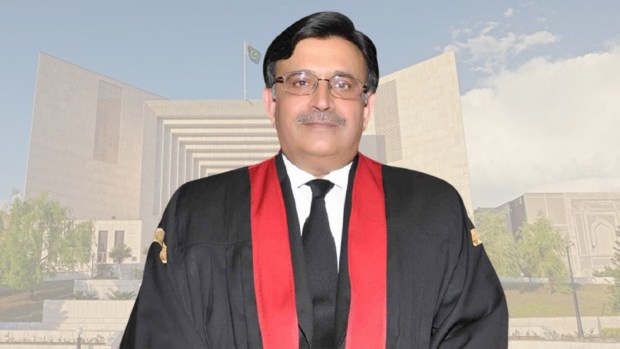
ISLAMABAD: Chief Justice of Pakistan (CJP) Umar Ata Bandial said that the court would issue a “reasonable order” today on the the legality of the current situation in the country following the dismissal of a no-confidence motion against Prime Minister Imran Khan by National Assembly (NA) Deputy Speaker Qasim Suri and the subsequent dissolution of the NA by President Arif Alvi on the prime minister’s advice.
He remarked this during hearing of a larger bench of the Supreme Court – comprising the CJP, Justice Ijazul Ahsan, Justice Mazhar Alam Khan Miankhel, Justice Munib Akhtar and Justice Jamal Khan Mandokhail, which took up the dissolution of National Assembly matter.
During the hearing today, the court rejected a plea by Farooq H. Naek, who is representing the PPP and other opposition parties, to form a full court bench to hear the matter. Naek had said that the case concerned complex matters of the law and therefore all judges of the apex court should sit on the bench.
The CJP, however, asked Naek if he had objections to any judge on the five-member bench. “If there is a lack of confidence in any of the judges, the bench will rise,” Justice Bandial said. To this, Naek said he had full confidence in all judges on the bench.
Meanwhile, Justice Munib Akhtar of the Supreme Court said that speaker of the Assembly has discretion to reject the no-confidence move, but deputy speaker was not in a position to reject the move.
Justice Muneeb Akhtar of the Supreme Court of Pakistan observed this during the hearing of the suo motu notice on the constitutional crisis triggered after National Assembly deputy speaker ruled the no-confidence resolution against Prime Minister Imran Khan “unconstitutional.”
A five-member larger bench of the apex court, headed by Justice Umar Ata Bandial and comprising Justice Muneeb Akhtar, Justice Aijazul Ahsan, Justice Mazhar Alam, and Justice Jamal Khan Mandokhel resumed hearing the notice taken by CJP Bandial.
At the outset of the hearing, PPP’s counsel Farooq H Naek pleaded before to the court to form a full-court bench to hear the case
Responding to Naek’s request, CJP Bandial remarked that the bench would wrap up if Naek says he doesn’t have confidence in anyone.
The chief justice inquired if Naek would like to share which of the constitutional questions need the formation of a full-court bench.
The CJP said “The full-court bench held 66 hearings on a case for two years and 12,000 cases piled up due to full-court bench hearings.
The court will let you know if a full-court bench is needed over the constitutional questions in the case, the CJP added.
The larger bench of the apex court will hear the notice alongside the presidential reference seeking interpretation on Article 63(A) of the Constitution.
“Any orders and actions that Prime Minister Imran Khan and President Arif Alvi regarding the dissolution of the National Assembly shall be subject to the order of this court,” CJP Bandial had said taking the notice.
Later, the SC restrained state institutions from taking any extra-constitutional steps and directed them to act strictly in accordance with the Constitution, besides asking all political forces of the country to remain peaceful.
Sunday’s hearing was attended by the Attorney General for Pakistan Khalid Javed Khan, the President of the Supreme Court Bar Association Ahsan Bhoon and other counsels representing different parties.
During the hearing on Sunday evening, the CJP issued notices to Attorney General of Pakistan Khalid Javed Khan and Ministry of Defence secretary while directing the latter and Interior secretary to submit a report regarding law and order situation. before it today. The apex court also directed all the political parties involved in the process of the no-confidence motion in the National Assembly and other political forces to become respondents in the case, while directing them to observe the law and maintain peace and public order.
The notice issued to the AGP stated about the constitutionality of the decision of the deputy speaker to dismiss the motion of no confidence on the basis of Article 5 of the Constitution.
Similarly, the court also issued notice to Supreme Court Bar Association and the Pakistan Bar Council to assist the Court in these suo moto proceedings and the Constitution Petitions filed under Article 184(3).
