
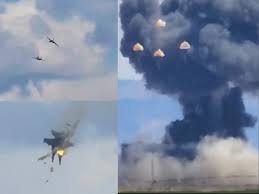

A dramatic midair collision between two United States Navy fighter jets stunned spectators during an air show near Mountain Home Air Force Base in Idaho on Sunday. Despite the serious nature of the incident, all four crew members safely ejected from the aircraft before the crash.
The accident involved two E/A-18G Growler electronic warfare jets participating in the Gunfighter Skies Air Show. According to officials from the US Navy, the collision occurred approximately two miles away from the air base during an aerial performance demonstration.
Emergency teams responded immediately after the crash, while authorities quickly secured the surrounding area. The incident forced the temporary lockdown of Mountain Home Air Force Base as investigations began.
Officials confirmed that no fatalities were reported among the flight crews. The condition of the crew members has not been publicly detailed, but all were confirmed safe after ejecting from the aircraft.
Navy Fighter Jets Collide During Air Demonstration
The collision happened at around 12:10 p.m. local time during one of the featured aerial demonstrations at the two-day Gunfighter Skies Air Show. The event marked the return of the air show after an eight-year break.
Cmdr. Amelia Umayam, spokesperson for Naval Air Forces under the US Pacific Fleet, confirmed that the two military jets collided while performing synchronized maneuvers in the air.
The aircraft involved were assigned to Electronic Attack Squadron 129 based at Whidbey Island in Washington. The squadron is known for operating advanced electronic warfare aircraft used by the United States Navy.
The E/A-18G Growler is a highly specialized military aircraft designed for electronic attack missions. It supports combat operations by disrupting enemy radar and communication systems.
Witnesses at the air show described moments of panic after seeing the two jets collide midair. Videos and images shared online showed emergency responders rushing toward the crash site shortly after the incident.
Authorities have not yet released details regarding the exact cause of the collision. Aviation experts say investigations into military air accidents often involve extensive technical reviews and pilot interviews.
Investigation Underway After Idaho Air Show Crash
The US Navy announced that a formal investigation has already started. Officials said more information will be shared after investigators complete preliminary assessments.
Military authorities are expected to examine flight recordings, aircraft maintenance history, weather conditions, and communication data to determine what caused the collision.
Mountain Home Air Force Base remained under temporary lockdown following the accident. Security protocols were activated to protect the crash area and support emergency operations.
The Gunfighter Skies Air Show had attracted large crowds eager to watch military aviation displays and aerial stunts. The event featured several military aircraft and demonstration teams from different branches of the armed forces.
Sunday’s collision revived memories of a previous tragedy connected to the same air show. During the last Gunfighter Skies Air Show in 2018, a hang glider pilot lost his life in a separate crash incident.
Air Show Safety Under Renewed Public Attention
The latest accident has once again raised questions about safety measures during military air demonstrations. Air shows remain popular public events, but aerial stunts and close-formation flying always carry significant risks.
Military aviation experts note that pilots involved in demonstration teams undergo advanced training before participating in public events. Even with strict safety standards, unexpected mechanical failures or human errors can still lead to dangerous situations.
The successful ejection of all four crew members likely prevented a far more serious tragedy. Aviation safety systems inside modern military jets are designed to protect pilots during emergencies, especially during high-risk flight operations.
As investigators continue their work, the US Navy is expected to review operational procedures linked to demonstration flights and air show performances.

