

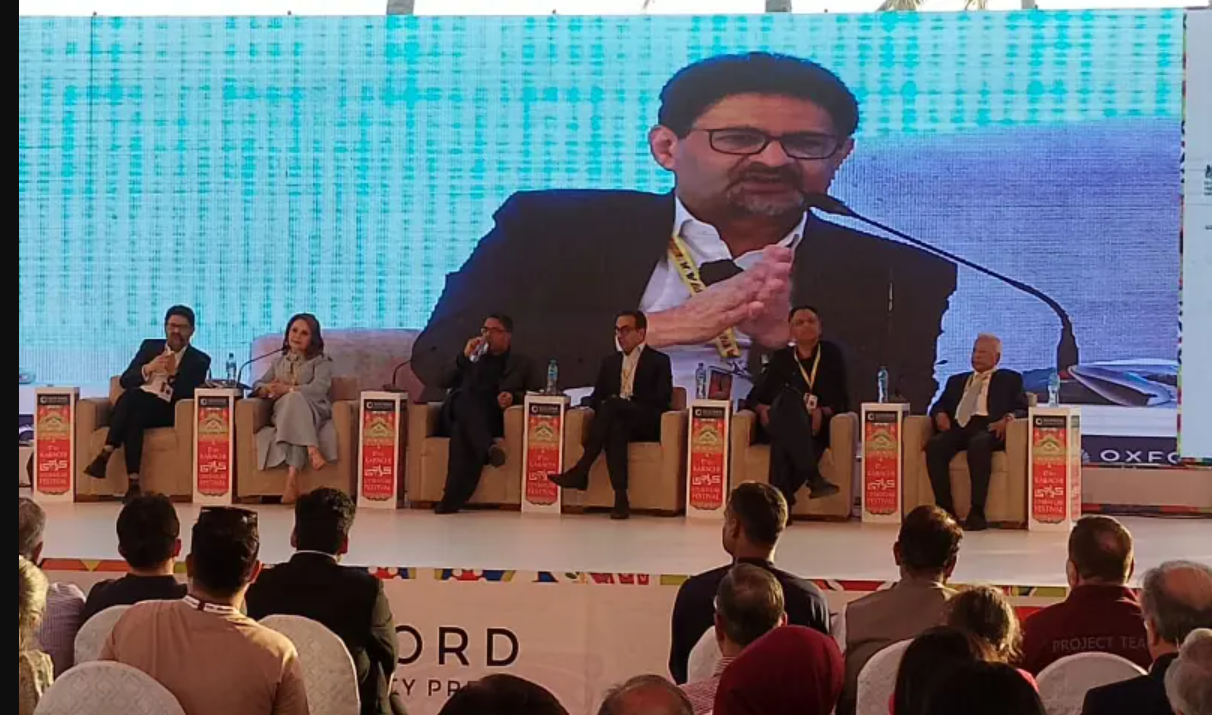

Pakistan’s leading economists, policymakers, and business leaders have warned that short-term economic fixes can no longer stabilise the country. They called for deep structural reforms, strict fiscal discipline, and long-term policy continuity to reset the economy.
The discussion took place during a session titled “Fixing the Fundamentals: Pakistan’s Economic Reset.”
The session was held at the 17th Karachi Literature Festival at a local hotel in Karachi.
Panel Highlights Weak Economic Foundations
The panel featured Adviser on Privatisation Muhammad Ali, former finance ministers Asad Umar and Miftah Ismail, and economist Dr Ishrat Husain.
Pakistan Business Council Chairperson Zeelaf Munir also joined the discussion. Former investment minister Muhammad Azfar Ahsan moderated the session. The panellists examined weak macroeconomic fundamentals, rising fiscal imbalances, and poor investment confidence.
They also discussed privatisation challenges and the urgent need to restore institutional credibility.
Structural Reforms Take Centre Stage
Muhammad Ali stressed that Pakistan’s economic issues cannot be resolved through temporary measures. He emphasised better economic documentation to improve taxation. He also called for a reduced government footprint and higher export growth.
Additionally, he highlighted the importance of women’s workforce participation and empowered local governments.
Asad Umar said economic reset requires changing industrial and economic structures. He argued that Pakistan fails to produce what global markets demand. Moreover, he linked sustainable growth to fair competition and democratic stability.
Security and Investment Concerns
Miftah Ismail stated that economic growth depends on a secure environment. He warned that progress would remain limited without eliminating terrorism completely.
Dr Ishrat Husain cautioned against Pakistan’s dependence on raw materials and imports. He urged investment in steel, petrochemicals, pharmaceuticals, and lithium battery sectors. He also supported a transition toward services-led growth.
Governance, Trust and Policy Continuity
Zeelaf Munir said open forums allow honest economic debate. She stressed trust, transparency, and accountability as reform essentials.
In his opening remarks, Azfar Ahsan urged policymakers to face economic realities honestly. He warned against ad hoc decisions and supported a long-term policy framework.
Shared Consensus on the Way Forward
Panellists agreed on export-led growth and better governance of state-owned enterprises. They also emphasised consensus-driven reforms and sustained policy continuity. The session attracted a large and engaged audience.
The Karachi Literature Festival continues to serve as a platform for national dialogue.
