
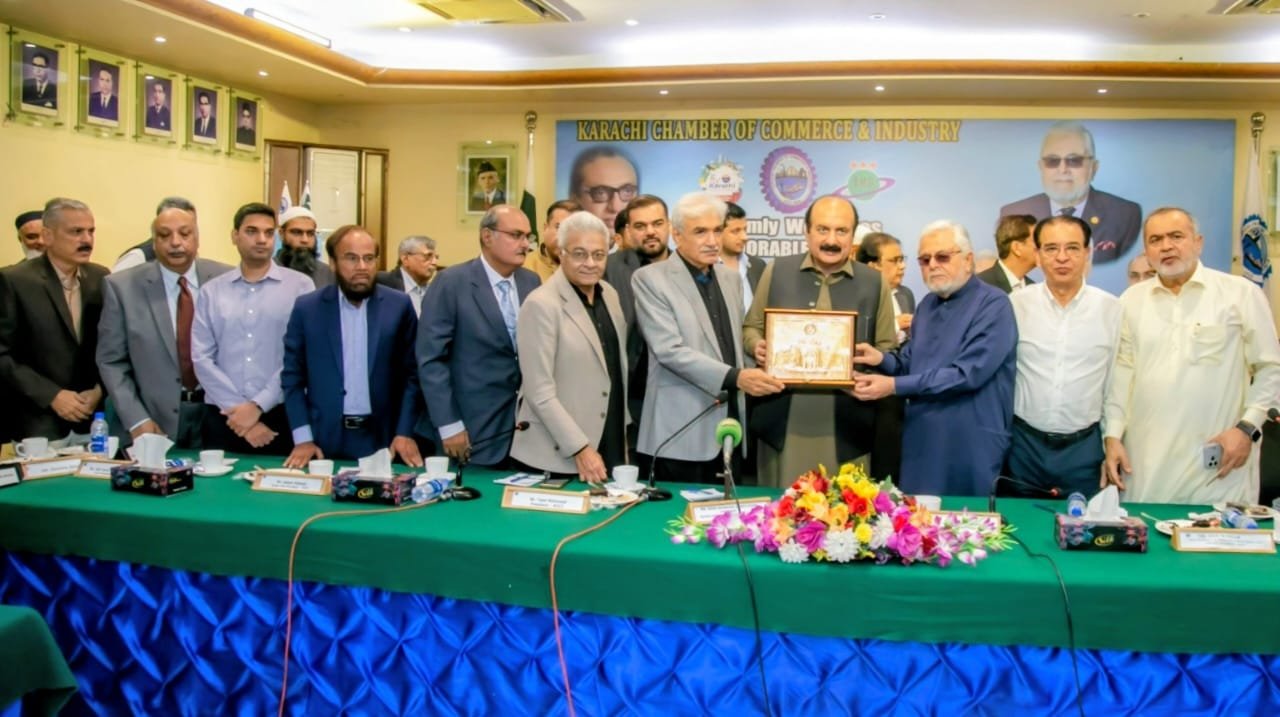

Federal Minister and Prime Minister’s Youth Programme (PMYP) Chairman Rana Mashood has announced an employment initiative targeting 25,000 young people across 12 districts of southern Balochistan. The pilot phase aims to facilitate jobs for around 6,000 to 7,000 candidates, while further efforts will connect the remaining youth with skills training and employment opportunities.
Speaking at the Karachi Chamber of Commerce and Industry (KCCI), Mashood urged businesses to help tackle unemployment, poverty and insecurity in Balochistan. He said cooperation between the government and private sector could create economic opportunities and support lasting peace.
Why Is the Government Seeking Karachi’s Support?
Mashood said Pakistan was approaching a defining moment, with emerging international opportunities that could strengthen its economic and strategic position. However, he stressed that national progress must also address challenges in vulnerable regions, particularly Balochistan and Khyber Pakhtunkhwa.
He reiterated the government’s zero-tolerance policy towards those taking up arms against Pakistan and its Constitution. Moreover, he emphasised that security measures must go hand in hand with economic opportunities.
“How long will we continue to carry the coffins of our young soldiers, and how long will the country continue to suffer from terrorism?” he asked.
Mashood highlighted Karachi’s industrial and commercial sector as a key partner because of its contribution to revenue, innovation and economic growth. He urged companies to identify vacancies, share workforce requirements and help develop training courses suited to industry needs.
How Will the Youth Employment Programme Work?
The initiative will coordinate federal and provincial institutions to connect young people with relevant training and employment pathways.
Participating organisations will include the National Vocational and Technical Training Commission (NAVTTC), provincial technical education and vocational training authorities, and the Small and Medium Enterprises Development Authority (SMEDA).
Other institutions include Pakistan Bait-ul-Mal, the Trade Development Authority of Pakistan (TDAP), the Pakistan Poverty Alleviation Fund and rural support programmes. The government is also pursuing coordination with provincial administrations and business organisations.
Training courses will generally last three to six months, depending on the selected trade. They will cover technical skills, certification, soft skills, professional ethics and civic responsibility.
Where suitable facilities exist, authorities will arrange training within Balochistan. Additionally, selected institutions and universities in Sindh may provide training capacity, along with boarding and lodging where required.
Business Leaders Call for Industrial Investment
Chairman of the Businessmen Group (BMG) Zubair Motiwala welcomed the initiative but stressed that training alone would not resolve unemployment. He called for a broader industrial revival and investment package to create sustainable jobs.
Motiwala urged the government to reduce production costs, address energy-sector inefficiencies and strengthen export competitiveness. He also proposed partial wage support for businesses employing trained youth from Balochistan.
Furthermore, he identified fisheries, seafood processing and agricultural value addition as sectors with potential to generate employment and exports.
BMG Vice Chairman Anjum Nisar called for more industries within Balochistan. He argued that local employment would allow young people to work near their communities instead of facing the difficulties of relocating.
Nisar highlighted the province’s approximately 770-kilometre coastline as an opportunity to develop the blue economy. He recommended investment in modern fisheries, seafood processing, cold storage and export facilities, alongside mining and digital industries.
KCCI Leaders Highlight Wider Economic Challenges
BMG Vice Chairman Jawed Bilwani warned that industrial closures, declining exports and inconsistent policies were worsening unemployment. He called for measures to protect existing industries, improve competitiveness and address rising freight and transportation costs.
Bilwani also urged the government to reconsider restrictions affecting industrial productivity. Additionally, he proposed linking social protection assistance with children’s education to combat child labour, improve export compliance and support employment generation.
KCCI President Talat Mahmood highlighted the business community’s confidence in the Chamber’s leadership. He said the group secured approximately 91 percent of votes cast in the recent election.
Mahmood attributed this support to direct engagement with members, practical problem-solving and consistent follow-up on business concerns. He emphasised that leaders must turn commitments into tangible results.
Government Seeks Industry Partnerships to Deliver Results
Several business and institutional representatives attended the meeting, including BMG leaders Zubair Motiwala, Anjum Nisar and Jawed Bilwani, alongside KCCI officials. NAVTTC Head Nadia Karim-Shaw, TDAP Secretary Sheryar Taj and Pakistan Muslim League-Nawaz Business Forum President Mirza Ishtiaq Baig also participated.
Senior NAVTTC officials and KCCI Executive Committee members joined the discussions.
Concluding the meeting, Mashood urged businesses to support the initiative through employment partnerships, training sponsorships and internships. He stressed that cooperation between the government and private sector could expand economic opportunities for Balochistan’s youth.
The programme aims to connect young people with market-relevant skills and potential jobs. Its wider objective is to reduce economic deprivation, strengthen regional stability and support a more peaceful and prosperous Pakistan.
For the latest updates, visit and follow The Truth International website (www.thetruthinternational.com) and subscribe to the YouTube Channel.

