
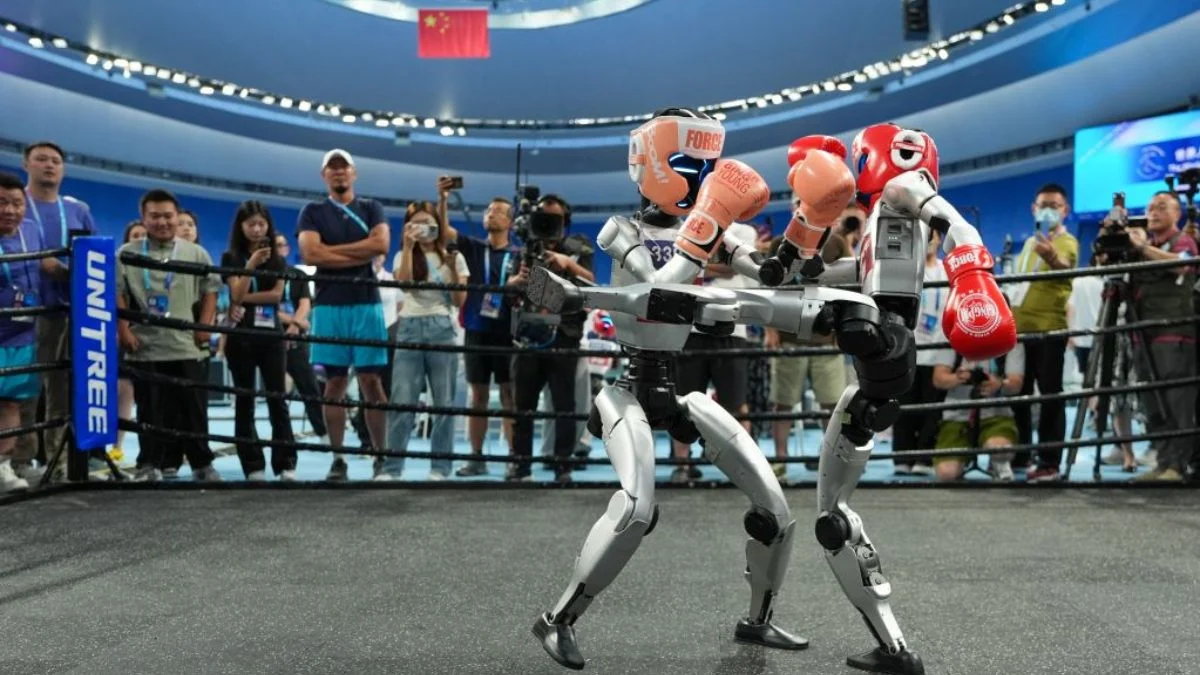

World Humanoid Robot Games Return With Four Times More Entries
The World Humanoid Robot Games will return to Beijing this August with more than 2,000 robots competing across sports and real-world challenges.
The international event will take place from August 22 to August 26, 2026.
Organizers say participation has expanded dramatically compared with the inaugural competition held last year.
A total of 666 teams and 2,056 humanoid robots from 16 countries are expected to participate.
Jiang Guangzhi, director of the Beijing Municipal Bureau of Economy and Information Technology, said the number of competing robots has roughly quadrupled from the first edition.
Teams from major robotics nations, including the United States, Germany and Japan, will take part.
Brazil has also assembled a national team consisting of five RoboCup squads.
China will provide the overwhelming majority of participants.
A total of 641 Chinese teams and 1,975 robots will compete.
The domestic participants represent 157 companies along with around 200 universities and research institutions.
Twenty-seven of China’s leading universities will also participate.
Many of the country’s major robotics companies are expected to showcase their latest humanoid machines.
The large turnout reflects rapid growth in the global humanoid robotics industry.
Robots to Compete in Long Jump, Weightlifting and Table Tennis
This year’s competition will feature more than 30 events.
Organizers have expanded the programme by adding several new athletic challenges.
Humanoid robots will compete in events including long jump, weightlifting, tug-of-war and table tennis.
These contests are not designed only for entertainment.
Organizers say they will test critical engineering capabilities.
Long jump competitions will examine balance, movement coordination and landing control.
Weightlifting will put robot strength, stability and structural design under pressure.
Tug-of-war will test power delivery and the ability to remain stable under extreme force.
Table tennis will require fast visual processing, accurate movement and rapid reaction times.
Together, these competitions will allow developers to assess motion-control systems, hardware durability and mechanical performance.
The sporting events could also expose weaknesses that may not appear during controlled laboratory testing.
Engineers can then use competition results to improve future humanoid robots.
Factory, Hotel and Home Challenges Push Robots Toward Real Jobs
The World Humanoid Robot Games will also go beyond athletics.
Several competitions will place robots in simulated real-world working environments.
These scenarios will include factories, hotels, homes and logistics centres.
Robots will be asked to perform tasks such as industrial assembly, housekeeping and emergency response.
Other competitions will test logistics operations and library book sorting.
The practical challenges are designed to determine whether humanoid robots can perform complex tasks in environments built for humans.
Such skills are considered essential if humanoid machines are eventually to work alongside people in factories, offices and service industries.
Jiang said some rules developed for the competition could eventually contribute to technical standards for the robotics industry.
The aim is to turn technological breakthroughs demonstrated during competitions into practical commercial applications.
He said robots capable of mastering difficult final-stage tasks could move quickly from competitions into workplaces.
Companies could then transform strong performances into commercial orders.
The rapid expansion of the event also highlights how quickly humanoid robotics has developed over the past year.
The first World Humanoid Robot Games were held in Beijing in August 2025.
That inaugural event attracted around 280 teams and slightly more than 500 humanoid robots from 16 countries.
In 2026, the number of participating robots has risen beyond 2,000.
The sharp increase signals growing investment from governments, universities and technology companies seeking to develop machines capable of operating in human environments.
This year’s games will therefore serve not only as an international competition but also as a major testing ground for the future of humanoid robotics.

