
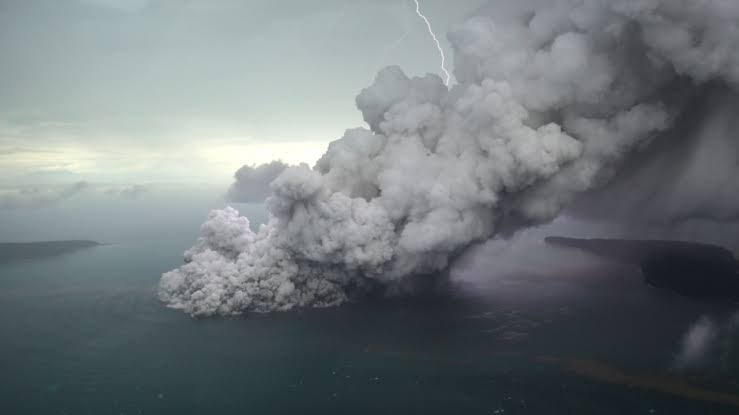

Indonesia temporarily suspended operations at its main international airport near Jakarta after volcanic ash from Anak Krakatoa entered the surrounding airspace.
The eruption disrupted air travel for thousands of passengers and affected hundreds of flights, including major international routes.
Authorities initially suspended operations at Soekarno-Hatta International Airport early Sunday after volcanic ash was detected in the area.
The airport serves as Indonesia’s primary international gateway and handles a large volume of domestic and international traffic.
Volcanic Ash Forces Airport Closure
Anak Krakatoa erupted on Saturday, sending lava into the air and producing powerful sounds that were reportedly heard hundreds of kilometres away.
Indonesia’s geology agency said the eruption produced a fountain of lava and loud explosive activity.
Two additional eruptions were recorded on Sunday, indicating that volcanic activity was continuing.
Following the eruptions, authorities detected volcanic ash in the airspace around Soekarno-Hatta International Airport.
The initial suspension began at 1:30am local time on Sunday.
Officials later extended the closure after testing confirmed the presence of volcanic ash around the airport.
Indonesia’s Transport Ministry said the latest paper-based ash test produced positive results, confirming the spread of volcanic material into the airport area.
The initial closure was scheduled to end at 9:30am, but the suspension was later extended by another four hours because of increased volcanic activity.
The airport authority announced the extension through social media.
More Than 22,000 Passengers Affected
The airport disruption affected more than 22,000 passengers, according to Indonesia’s Transportation Ministry.
A total of 209 flights were affected by the suspension.
International flights to and from Singapore were among the most affected.
Other disrupted international routes included Doha, Sydney and Kuala Lumpur.
The eruption also caused disruptions to domestic travel.
At least 16 flights to Bali were cancelled, according to local airport authorities.
Airlines and passengers faced uncertainty as authorities monitored the movement of volcanic ash and assessed whether conditions were safe for aircraft operations.
Volcanic ash presents a serious risk to aircraft because it can reduce visibility and potentially affect aircraft engines and other critical systems.
The suspension was therefore extended as authorities continued assessing the situation.
Ships Warned Over Anak Krakatoa Activity
The volcanic activity has also prompted warnings for vessels operating near the Sunda Strait.
Anak Krakatoa is located in the strait separating Indonesia’s islands of Java and Sumatra.
Local port authorities warned ships passing through the area to increase vigilance because volcanic activity could affect navigation safety.
Authorities also prohibited vessels from approaching within a three-kilometre exclusion zone around the volcano.
The restrictions are intended to reduce risks to ships and crews operating close to the active volcanic island.
Officials continue to monitor Anak Krakatoa for further eruptions and changes in volcanic activity.
Volcano Has a Deadly History
Anak Krakatoa has been intermittently active since emerging from the sea in the early 20th century.
It developed inside the caldera created by the catastrophic 1883 eruption of Mount Krakatoa.
That historic eruption was among the most destructive volcanic events recorded in modern history.
The disaster caused massive explosions, tsunamis and widespread destruction.
An estimated 35,000 people were killed in the 1883 disaster, with most deaths attributed to the resulting tsunamis.
Anak Krakatoa later emerged from the same volcanic system and has remained an active volcano.
Its latest activity has once again highlighted the risks faced by communities, shipping routes and aviation networks across Indonesia.
Indonesia Remains Highly Vulnerable to Volcanic Activity
Indonesia is one of the world’s most volcanically active countries.
The Southeast Asian archipelago lies along the Pacific Ring of Fire, a region where major tectonic plates meet.
This geological setting produces frequent earthquakes, volcanic eruptions and other seismic activity.
For Indonesia, volcanic eruptions can have consequences far beyond the immediate area surrounding a volcano.
Ash clouds can disrupt aviation, while eruptions can threaten coastal communities and shipping routes.
The latest Anak Krakatoa eruption demonstrates how volcanic activity at a location more than 150 kilometres from Jakarta can still disrupt one of the country’s busiest airports.
Authorities are continuing to monitor volcanic conditions and assess the risks to aviation and maritime traffic.
The reopening of affected flight operations will depend on volcanic ash levels and safety assessments by the relevant authorities.

