
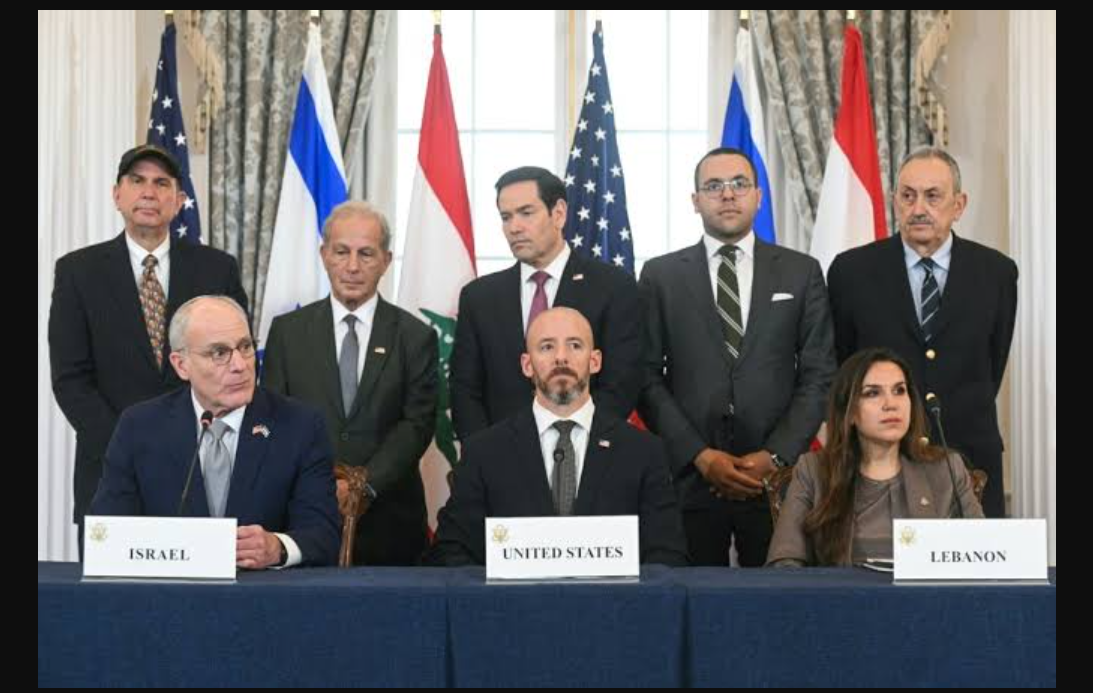

Lebanon, Israel and the United States have signed a trilateral framework agreement that aims to open a path toward a future peace arrangement between the two long-time regional rivals.
The agreement emerged after multiple rounds of negotiations and is being presented as an attempt to reduce tensions and establish a process for long-term security and political stability.
Although officials described the development as an important milestone, they also acknowledged that major challenges remain before any lasting settlement can be achieved.
Framework Agreement Sets Direction for Future Negotiations
The agreement outlines initial measures intended to lower tensions and create conditions for broader political progress.
Under the proposed framework, Lebanese forces would gradually assume control in selected areas currently occupied by Israeli forces.
At the same time, the agreement introduces a broader process linked to restoring state authority and addressing the issue of armed groups operating outside official institutions.
US Secretary of State Marco Rubio described the agreement as an early but meaningful step.
The deal, he said, “begins to put in place a framework for lasting peace and security.”
He also added:
“It’s the beginning of the beginning. There’s a lot of work ahead.”
The comments reflected cautious optimism while recognizing that implementation remains complex.
Lebanon Sees Agreement as Step Toward Sovereignty
Lebanese officials welcomed the agreement and presented it as an opportunity to strengthen national control and support the return of displaced communities.
Lebanon’s ambassador to Washington, Nada Hamadeh Moawad, said:
“is a first step on the road to restoring Lebanese sovereignty and territorial integrity, securing a permanent and final cessation of hostilities (and) enabling our people to go back to their land.”
The agreement also outlines a process under which Lebanese authorities would work toward restoring sovereign control across national territory.
According to the framework, reconstruction efforts and civilian returns would gradually begin in designated areas once security conditions improve.
Security Arrangements and Hezbollah Remain Central Issues
One of the most sensitive parts of the agreement concerns the future status of Hezbollah and broader security arrangements.
The framework outlines steps linked to the verified disarmament of non-state armed groups.
Progress under those measures would allow for a phased Israeli military redeployment from Lebanese territory.
Israeli officials presented the agreement as a shift in regional dynamics.
Israel’s envoy to Washington, Yechiel Leiter, said:
“Iran is out, Hezbollah is out, and the road to peace between Israel and Lebanon is in.”
However, major differences remain.
Hezbollah leader Naim Qassem insisted that Israeli forces must leave Lebanese territory without conditions.
He stated that Israel has “no option but to withdraw completely from every inch of our Lebanese land,” and added that forces “must leave unconditionally.”
Meanwhile, Israeli Prime Minister Benjamin Netanyahu said Israel would not withdraw until Hezbollah gives up its weapons.
Pilot Areas and International Support
The agreement introduces a pilot arrangement involving two specific areas.
One area lies south of the Litani River, while another is located north of it.
Under the plan, Lebanese security forces would take responsibility in those zones.
International reconstruction support would also begin alongside security measures.
The United States announced additional commitments to support implementation.
These include humanitarian assistance and financial support intended to strengthen Lebanese military capabilities and operational readiness.
Can the Agreement Lead to Lasting Peace?
Despite the signing, uncertainty remains over implementation and political acceptance inside Lebanon and across the region. A previous ceasefire effort announced earlier failed to fully stop hostilities.
Therefore, this agreement enters a complicated regional environment. Supporters view it as an opening for diplomacy. Critics, however, argue that difficult questions still remain unresolved.
Even so, the signing marks one of the most significant diplomatic developments in recent months.
Whether it develops into a broader peace process will depend on political decisions, security commitments and sustained international engagement.
For now, officials describe the agreement as a starting point rather than a final settlement.

