


Peace Talks
Thailand announced late Saturday that it has agreed in principle to a ceasefire with Cambodia and expressed readiness to engage in bilateral dialogue aimed at resolving the most intense border conflict between the two Southeast Asian nations in over a decade.
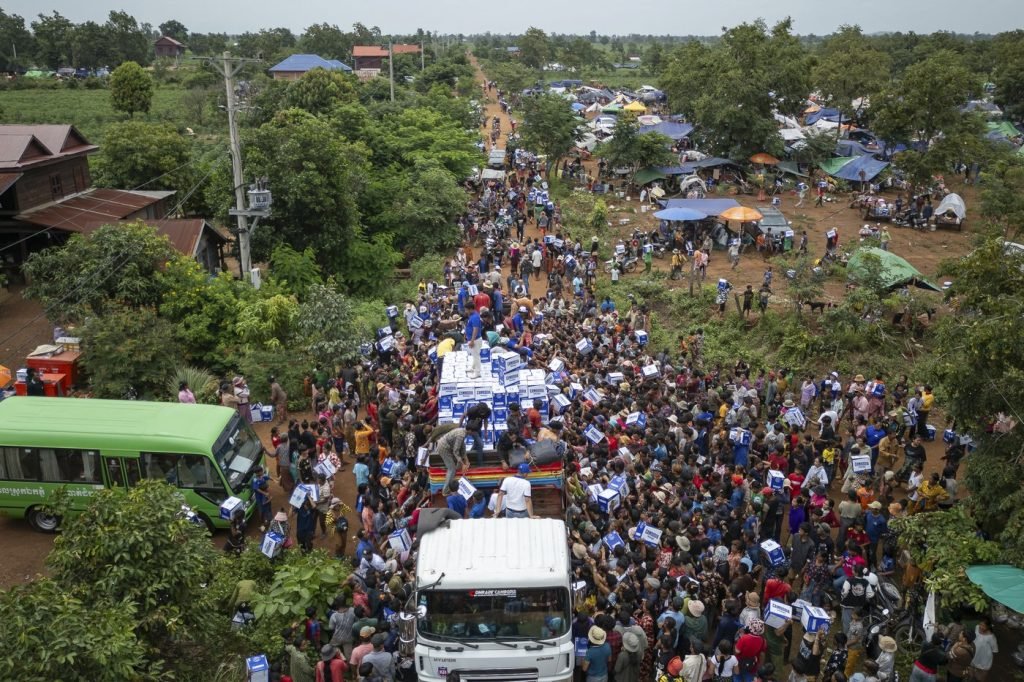
The announcement comes after three consecutive days of artillery exchanges along the contested frontier, which have left at least 33 people dead and forced more than 150,000 to flee their homes.
In a statement issued on social media platform X, Thailand’s foreign ministry confirmed its willingness to enter into a ceasefire agreement, adding that it hopes to see genuine intent from Cambodia to end hostilities.
The development followed a statement by U.S. President Donald Trump, who revealed that he had spoken with Cambodian Prime Minister Hun Manet and Thailand’s acting Prime Minister Phumtham Wechayachai. According to Trump, both leaders agreed to work toward a swift ceasefire and direct dialogue.
Thailand’s foreign ministry confirmed the call between Trump and Phumtham, noting that the Thai leader had asked the U.S. President to convey to Cambodia the urgency of beginning bilateral talks. The Thai government emphasized its desire to establish concrete mechanisms and procedures to ensure a ceasefire and work toward a peaceful resolution of the conflict.
Despite diplomatic overtures, clashes escalated on Saturday, extending beyond the heavily contested temple zones into coastal regions near the Gulf of Thailand—about 250 kilometers southwest of the main battle areas. Residents in these zones reported hearing artillery fire and were seen evacuating en masse. At a shelter in Kanthararom, Thailand, 76-year-old evacuee Samlee Sornchai described the ordeal: “It feels like I’m escaping a war zone.”
The conflict, rooted in long-standing territorial disputes, erupted earlier this week with the deployment of jets, tanks, and ground troops. Tensions had been simmering over ancient temple sites located along the border, and the fighting has since spread across rugged hills, jungle terrain, and farmlands where locals cultivate rubber and rice.
The casualty toll continues to climb. Cambodia’s defence ministry reported 13 deaths—eight civilians and five soldiers—along with 71 wounded. Thai authorities confirmed the deaths of 13 civilians and seven soldiers on their side. In total, over 138,000 people have been evacuated from Thai border areas, while another 35,000 Cambodians have fled their homes.
At an emergency United Nations Security Council meeting on Friday, Cambodia’s UN envoy Chhea Keo reiterated his country’s demand for an immediate ceasefire and a peaceful diplomatic resolution.
UN Secretary-General António Guterres expressed deep concern on Saturday, calling for an urgent cessation of hostilities and a return to dialogue. “The Secretary-General condemns the tragic and unnecessary loss of lives, injuries to civilians, and the destruction of homes and infrastructure,” said UN Deputy Spokesman Farhan Haq.
As both nations accuse one another of firing first, tensions remain high. Cambodia has alleged that Thailand used cluster munitions, while Thailand has accused Cambodia of deliberately targeting civilian infrastructure, including a hospital reportedly hit by shelling.
This latest round of violence marks a dramatic escalation in a territorial dispute that has strained bilateral relations for years. A 2013 International Court of Justice ruling had temporarily eased tensions by clarifying claims around key areas. However, the situation deteriorated again in May after a Cambodian soldier was killed in a clash, reigniting old hostilities.
Relations worsened further last month when Cambodia’s former Prime Minister Hun Sen released a leaked phone conversation with Thailand’s then-premier Paetongtarn Shinawatra, in which the Thai leader was heard criticising her own military’s handling of the border issue. The political fallout led to her suspension by a court order, adding to the instability surrounding the conflict.
With international pressure mounting and the humanitarian toll growing, both Thailand and Cambodia face increasing urgency to move from confrontation to negotiation. The coming days will be crucial in determining whether these initial steps toward dialogue can evolve into a lasting peace.
