


Galaxy
On Thursday, scientists announced they had captured the first-ever close-up image of a star located outside the Milky Way galaxy.
The image reveals a blurry view of a massive red supergiant star, estimated to be 2,000 times larger than the Sun, situated in the Large Magellanic Cloud, a neighboring galaxy to the Milky Way.
This monumental achievement was made possible through the European Southern Observatory’s (ESO) Very Large Telescope in Chile, equipped with a cutting-edge instrument called GRAVITY.
This tool combines light from four telescopes, significantly enhancing the telescope’s imaging capabilities.
Keiichi Ohnaka, an astrophysicist at Chile’s Andres Bello National University, celebrated the milestone, stating, “For the first time, we have succeeded in taking a zoomed-in image of a dying star.”
The star, like all red supergiants, is among the largest stars in the universe. These giants swell in size as they approach the final stages of their lives, leading to explosive supernova events.
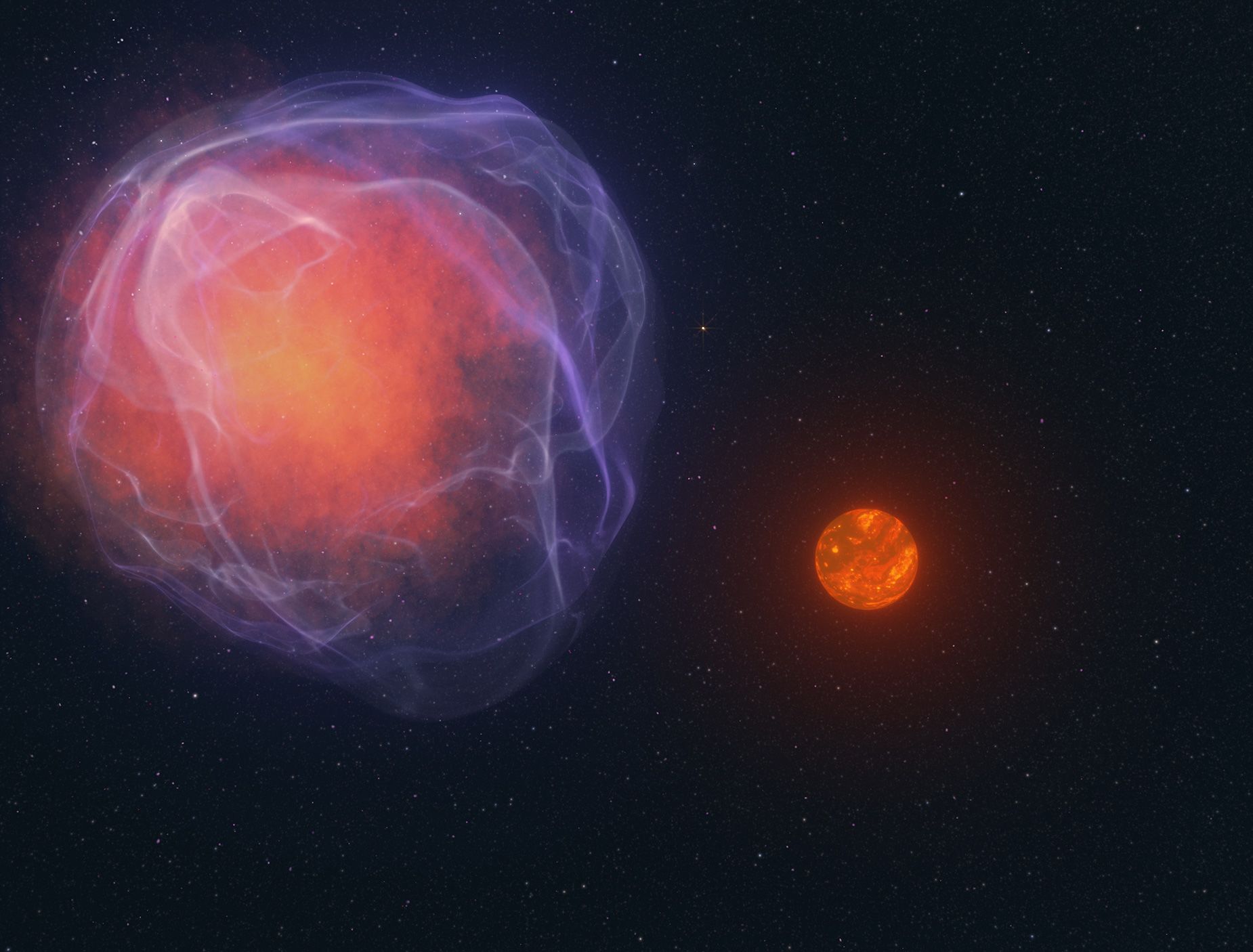
The image showcases the star glowing brightly, albeit blurry, with a peculiar oval-shaped cocoon surrounding it.
Ohnaka explained that the cocoon likely represents material being ejected by the star in its final throes, a precursor to its eventual supernova explosion.
The findings, detailed in the journal Astronomy & Astrophysics, also revealed surprising changes in the star’s brightness over the past decade.
The research team had been observing the star since 2005, initially using the Very Large Telescope’s interferometer, which combined light from two telescopes. However, capturing a clear image was unattainable until GRAVITY’s recent debut.
The star’s dimming and the cocoon’s unusual egg-like shape offer clues about the processes unfolding in its final stages.
Study co-author Gerd Weigelt of Germany’s Max Planck Institute for Radio Astronomy described the discovery as a rare chance to “witness a star’s life in real time.”
Another possible explanation for the cocoon’s shape could involve the presence of an unseen companion star. Such dual-star systems are known to interact and influence their shared environment.
Co-author Jacco van Loon of Keele University in the UK noted the significance of observing such drastic changes in a red supergiant.
These stars, including the well-known Betelgeuse in the Orion constellation, shed layers of gas and dust over thousands of years.
This material may account for the dimming effect seen in the star’s light and the cocoon’s irregular shape.
As scientists continue to monitor this red supergiant, they gain valuable insights into the dramatic transformations that occur during the final stages of a star’s life, paving the way for further groundbreaking discoveries in astrophysics.
