

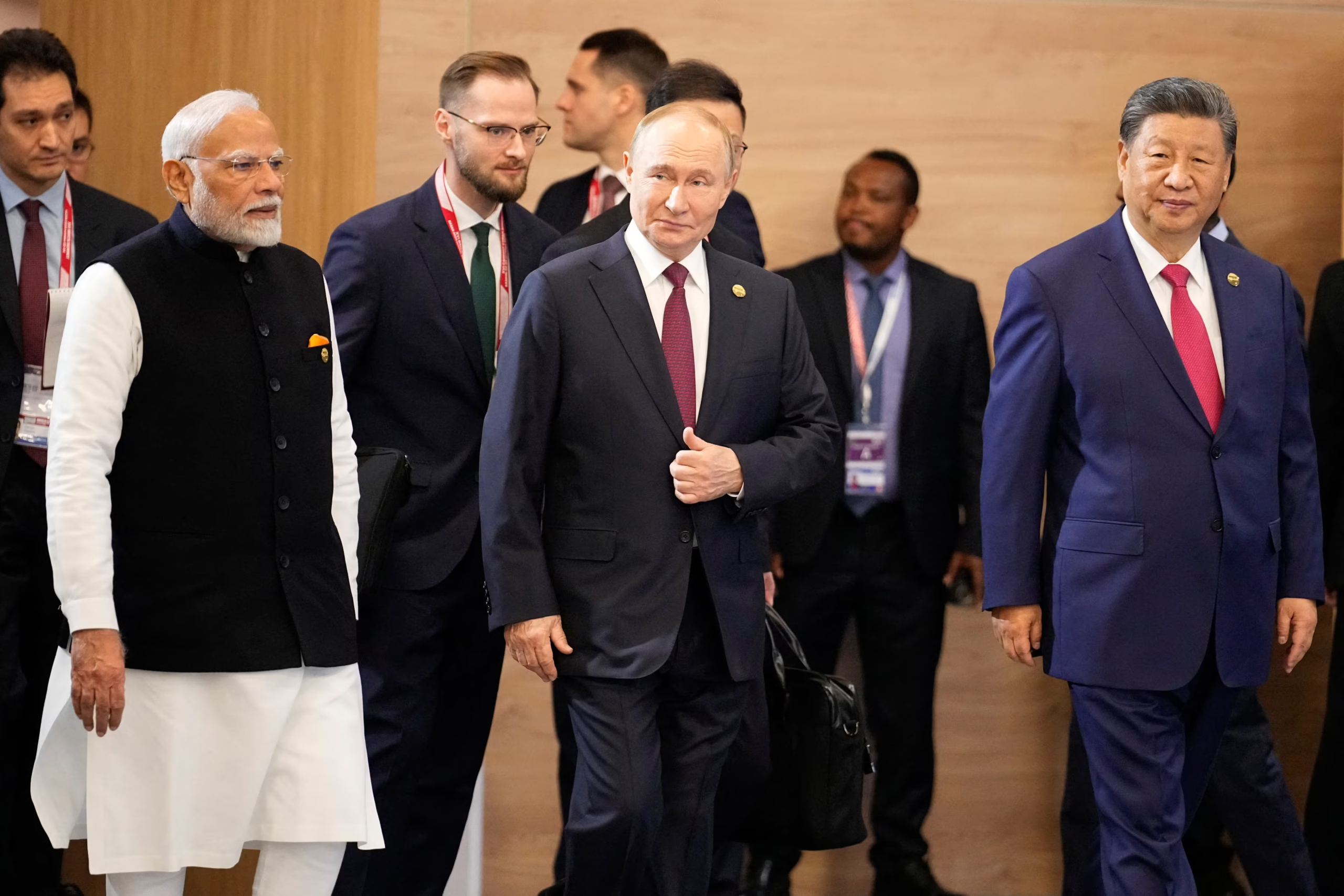

President Xi Jinping of China is set to welcome more than 20 world leaders, including Russian President Vladimir Putin and Indian Prime Minister Narendra Modi, at a regional security summit in Tianjin from August 31 to September 1.
The gathering, part of the Shanghai Cooperation Organisation (SCO) forum, is being described as a major display of Global South solidarity amid an era dominated by U.S.-led diplomacy under Donald Trump and the ongoing geopolitical shifts caused by Western sanctions on Russia.
The upcoming summit marks a significant moment in China-India relations, with Prime Minister Modi making his first visit to China in over seven years. The two neighboring countries have worked to ease tensions following deadly border clashes in 2020.
Modi previously shared a stage with Xi and Putin at last year’s BRICS summit in Kazan, Russia, even as Western nations shunned the Russian leader amid the ongoing war in Ukraine. Russian officials in New Delhi have also confirmed that Moscow hopes to conduct trilateral talks with China and India during the summit.
Experts suggest that Xi will use the summit as an opportunity to highlight an emerging post-American-led international order. Eric Olander, editor-in-chief of The China-Global South Project, noted that the gathering demonstrates how efforts by the White House to counter China, Russia, Iran, and India since January have not yielded the intended effect. “Just look at how much BRICS has rattled Donald Trump, which is precisely what these groups are designed to do,” he added.
This year’s SCO summit is expected to be the largest since the organization’s founding in 2001. Originally formed by six Eurasian nations, the SCO has expanded to include ten permanent members and sixteen dialogue and observer countries. Its remit has grown from security and counter-terrorism to broader economic and military cooperation. However, analysts caution that while the SCO has considerable convening power, its effectiveness in resolving substantial security issues remains limited.
Frictions persist between India and Pakistan, with June’s SCO defence ministers’ meeting unable to adopt a joint statement due to disagreements over references to the April 22 attack in Indian-administered Kashmir. New Delhi also abstained from the SCO’s condemnation of Israeli attacks on Iran earlier in June.
Despite these tensions, the recent rapprochement between India and China, combined with renewed U.S. tariff pressure on India, is expected to encourage a productive meeting between Xi and Modi. Observers predict announcements of incremental border measures, eased trade and visa restrictions, climate cooperation, and enhanced government and people-to-people engagement.
While substantive policy announcements may be limited, the summit’s optics are considered highly influential, showcasing China’s ability to project Global South solidarity and reinforce its geopolitical narrative.
Modi is expected to depart China immediately after the summit, while Putin will remain in Beijing for a World War Two military parade, highlighting Russia’s continued diplomatic engagement with China amid international isolation.
