
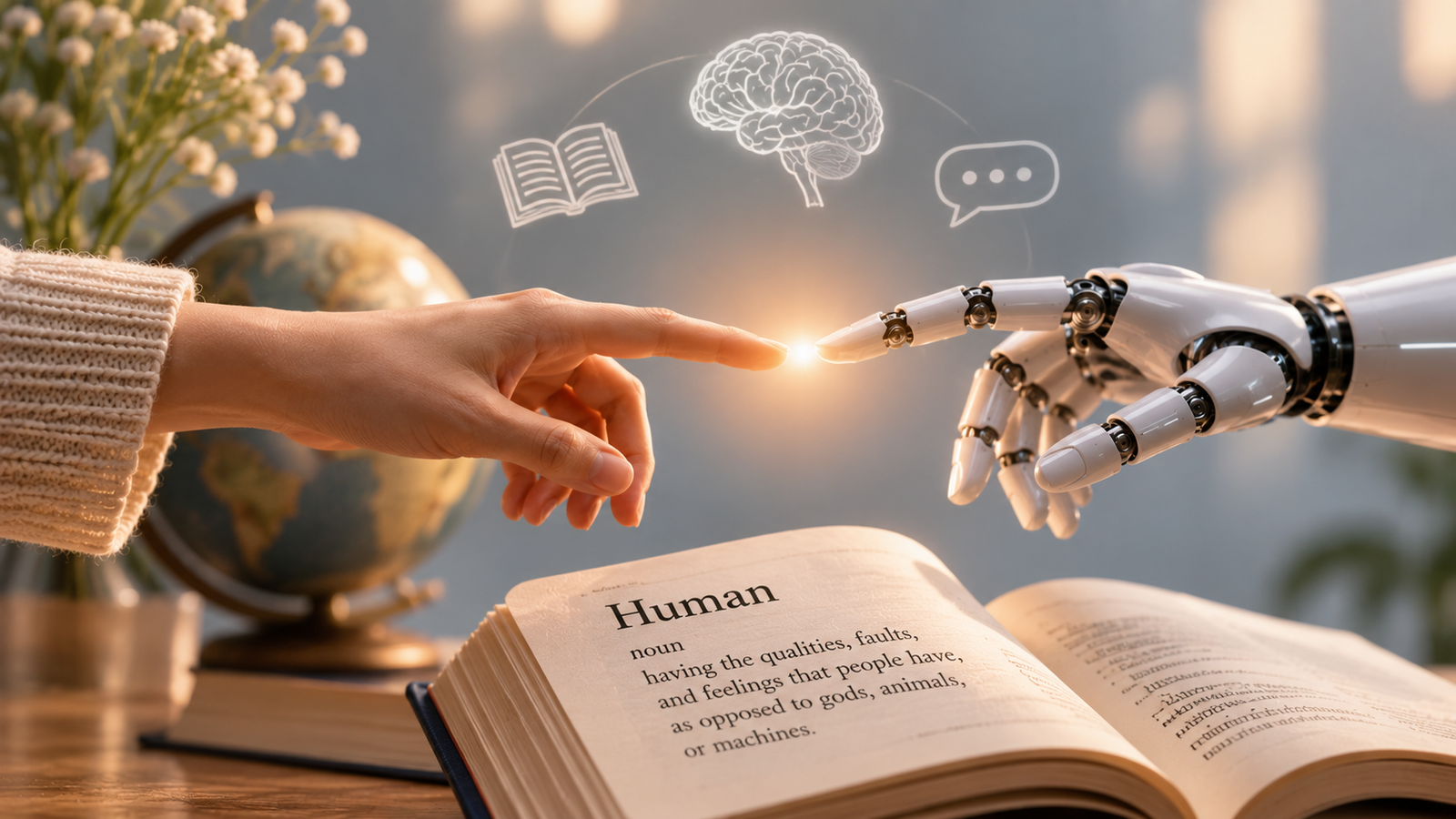

The growing influence of artificial intelligence has sparked fresh questions about human identity, creativity and the future of work. Reflecting these concerns, Cambridge Dictionary has named ‘Human’ its Word of the Year for 2026. The selection highlights how people increasingly distinguish human abilities from those of machines. Moreover, it reflects growing discussions about what makes people unique in an increasingly automated world.
Why Did Cambridge Dictionary Choose ‘Human’ as Its Word of the Year?
Cambridge Dictionary defines ‘Human’ as “having the qualities, faults, and feelings that people have, as opposed to gods, animals, or machines”.
According to chief editor Colin McIntosh, the growing influence of AI has made people reconsider the meaning of the word. He explained that people now need to identify something as human when describing activities once performed exclusively by people.
McIntosh’s research also revealed a significant change in the word’s usage. Its use has increased fourfold since 1900.
He explained that ‘man’ previously appeared more frequently in this context. However, modern language no longer considers it appropriate to use ‘man’ to represent both men and women.
The word ‘human’ entered Middle English during the 14th century through a French word. Shakespeare also used it, although its usage remained relatively restricted afterwards.
Meanwhile, dictionary editors have noticed growing interest in compound expressions such as ‘human-made’ and ‘human-driven’. These terms distinguish human contributions from content and activities generated through artificial intelligence.
Artificial Intelligence Raises Questions About Human Identity
The selection also reflects growing concerns about AI’s influence on creativity, employment and everyday life. As technology advances, people increasingly question which abilities distinguish human beings from artificial systems.
Several prominent figures have contributed to this discussion.
Actors Scarlett Johansson and Matthew McConaughey have raised concerns about protecting human creativity and personal identity. Johansson challenged “an assault on human creativity”, while McConaughey took steps to protect his voice and image against unauthorised digital reproduction.
Microsoft co-founder Bill Gates also commented on the dictionary’s decision. He said, “The measure of AI’s success should be how much it improves human lives”.
Gates has previously advocated for ‘human reserved jobs’, particularly in areas such as caregiving. He has also reiterated his proposal for a robot tax.
The proposed tax could help fund training programmes for workers who lose employment opportunities because of automation.
Similarly, Nobel Prize-winning physicist Geoffrey Hinton has expressed concerns about the development of artificial intelligence. He warned, “we’re creating alien beings. I’m willing to be selfish and choose humans”.
Pope Leo XIV has also addressed emerging forms of “dehumanisation”. He highlighted the “pressing duty to remain profoundly human”.
Experts Question What Separates Humans From AI
The growing debate has also attracted attention from researchers and philosophers. Dr Tom McClelland, a philosopher of science at the University of Cambridge, described the dictionary’s selection as particularly relevant.
He explained that society is reconsidering the meaning of humanity as artificial intelligence becomes increasingly sophisticated.
“We’re trying to understand the difference between a human mind and an artificial mind, between living beings like us and artificial beings that we’re creating. What sets us apart? Is it consciousness, creativity or compassion?”
Meanwhile, Prof Rachel Adams, an expert on AI governance and human rights at the University of Cambridge, highlighted the wider implications.
She said: “AI brings us back to questions that we’ve asked for millennia — who are we? What does it mean to be human?”
She also warned that AI could deepen existing inequalities. However, she acknowledged its potential to help address them.
As AI-generated content becomes increasingly common, academics are also exploring a universal symbol for human-made creations. The proposed label would work similarly to the Fairtrade certification introduced during the 1980s.
Such a symbol could help audiences distinguish work produced by people from material generated by artificial intelligence.
Other Words Considered for Cambridge Dictionary’s 2026 Selection
Several other expressions competed for the Word of the Year title. These included terms connected to artificial intelligence, online culture and changing lifestyles.
The shortlisted words included:
-
Agent: An artificial intelligence system capable of performing complex tasks with limited human control.
-
Wholesome: Something beneficial to physical, moral or emotional well-being.
-
Dusking: The practice of watching daylight turn into darkness for relaxation and reconnection with nature.
Cambridge Dictionary also added several new expressions during 2026. These included ‘aura farming’, which describes behaviours intended to create an impressive or admirable personality.
Another addition was ‘looksmaxing’, referring to efforts to improve physical attractiveness.
The dictionary selects its annual Word of the Year using several criteria. These include search trends and the popularity of particular expressions among dictionary users.
Which Words Could Gain Attention in 2027?
Cambridge Dictionary has also identified emerging expressions that could attract attention next year.
One is ‘Fobo’, meaning the “fear of becoming obsolete” because artificial intelligence could perform someone’s job.
Another expression is ‘weather whiplash’. It describes a “quick change from one extreme of weather to another”.
These emerging terms reflect changing concerns about technology, employment and the environment.
Last year’s Word of the Year was ‘parasocial’. The term describes a perceived connection with a celebrity, public figure or fictional character whom someone does not personally know.
This year’s selection, however, highlights a different concern: understanding what makes people human as artificial intelligence continues to transform everyday life.
For the latest updates, visit and follow The Truth International website (www.thetruthinternational.com) and subscribe to the YouTube Channel.

