
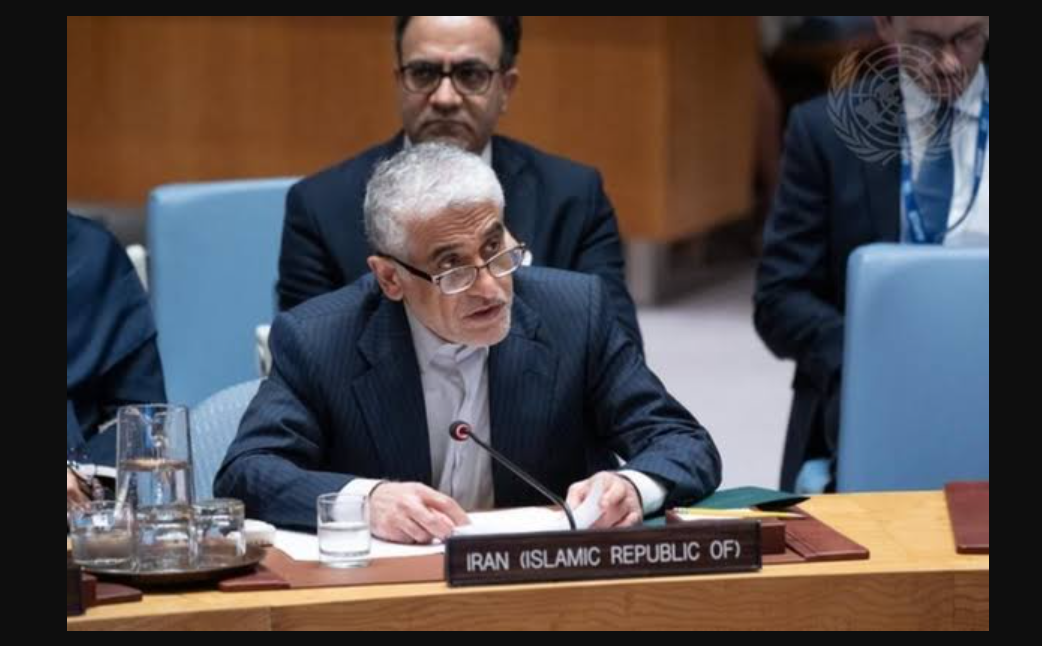

Iran has thanked Pakistan for abstaining from a United Nations Security Council vote that paved the way for a meeting on Tehran’s nuclear programme.
The acknowledgement came after Iran rejected the session as “legally unfounded.” Meanwhile, Iranian officials argued that the meeting lacked any valid legal basis.
Iran acknowledges Pakistan’s position
Iran’s Ambassador and Permanent Representative to the United Nations, Amir Saeid Iravani, issued a statement following the Security Council meeting.
He specifically thanked Pakistan and Somalia for abstaining from the vote. In addition, he praised Russia and China for opposing the meeting.
According to Iran, the session should not have taken place because Resolution 2231 had already expired.
Meeting focused on Iran’s nuclear programme
The Security Council meeting was requested by Bahrain along with Denmark, France, Greece, Latvia and the United Kingdom.
The session discussed the implementation of Resolution 2231 and the United Nations Secretary-General’s latest report regarding Iran’s nuclear programme.
However, Iran disputed the legal foundation of the discussion.
“There is therefore no legal basis for the Secretary General to submit reports, for the secretariat to brief the Council, or for the Security Council to discuss this issue under the agenda item ‘Non-Proliferation’,” Iravani said.
Tehran rejects sanctions mechanism
The Iranian envoy also rejected the use of the “snapback” mechanism aimed at restoring sanctions on Iran.
He argued that France, Germany and the United Kingdom had failed to fulfil their commitments under the Joint Comprehensive Plan of Action (JCPOA).
“A party that has materially breached its obligations cannot invoke rights arising from the same legal instrument,” he said.
Iran defends nuclear programme
Iravani also rejected allegations regarding Iran’s nuclear activities.
“Its nuclear programme has never been diverted to military purposes and has remained exclusively peaceful under the most extensive IAEA verification regime,” he said.
Furthermore, he accused Western countries of using the Security Council for political purposes.
He claimed they were attempting to “distort Resolution 2231, misrepresent the facts, and misuse the Security Council.”
Comments on regional tensions
The Iranian envoy also addressed the situation surrounding the Strait of Hormuz.
“Responsibility for maritime navigation through the Strait of Hormuz, including its reopening and all necessary demining operations, rests exclusively with Iran,” he said.
He added that any external interference could undermine the implementation of the Islamabad Memorandum of Understanding and further increase regional tensions.
In addition, Iravani accused the United States and Israel of violating international law through military actions against Iran.
“The United States and the Israeli regime bear full responsibility for the consequences of their unlawful acts and must be held fully accountable,” he said.
Iran’s latest remarks highlighted its continued opposition to the Security Council meeting while welcoming Pakistan’s decision to abstain during the vote.

