
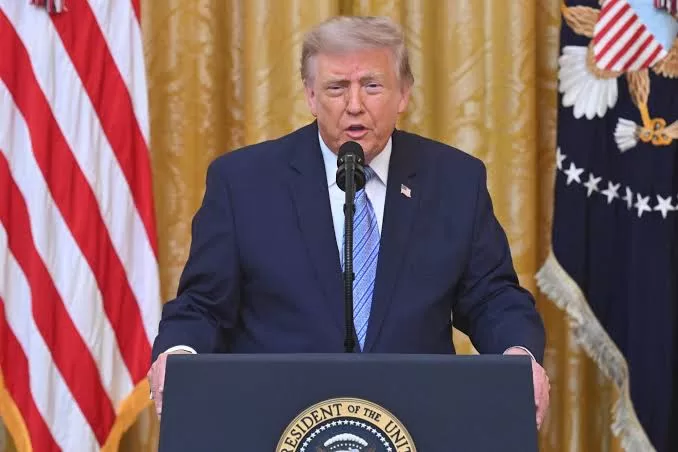

A fresh clash between Donald Trump and the US media has erupted over access to the White House. The US president announced that CNN, MS NOW and Politico would be banned from the White House.
Trump said the decision would take effect immediately and suggested that other media outlets could face similar restrictions.
He accused the three outlets of repeatedly publishing what he described as false reporting about his administration and the United States.
However, the precise scope of the announced ban remained unclear. Reporters from the affected outlets were still seen working at the White House afterward.
Trump Accuses Media Outlets of False Reporting
Trump announced the move through a social media post on Friday.
He accused the outlets of “reporting FAKE NEWS” and said they “shouldn’t be able to constantly write or report FICTION and LIES when they’re covering the President of the United States.”
Trump also warned that “Other Fake News Media Outlets to follow.”
When reporters later asked what prompted the decision, Trump said there was no single incident behind it.
Instead, he described the move as the result of “cumulative stories over the past few years.”
Trump also said, “I don’t have to let them into my, into the people’s house.”
When asked which other organizations could face restrictions, Trump mentioned the New York Times and Washington Post.
Scope of White House Ban Remains Unclear
The announcement immediately raised questions about what access the ban would actually restrict.
The affected outlets continued operating at the White House after Trump’s announcement.
Therefore, it was not immediately clear whether their journalists’ credentials, access to specific events, or broader White House facilities would be affected.
The legal implications could also depend on how broadly the administration applies the restriction.
Courts have allowed presidents discretion over access to certain events and limited press settings.
However, broader restrictions involving generally available press facilities could raise stronger constitutional and due-process questions.
Media Outlets Push Back Against Trump
CNN said it stood behind its journalists covering the White House.
“We have a right under the US Constitution to do that reporting without hindrance or interference from the government,” CNN said in a statement.
“Should the ban which President Trump threatened go ahead, it would be an illegal assault on that fundamental and constitutionally protected right.”
Politico also said it would continue covering the administration.
“We will vigorously defend our First Amendment rights against any attempt to restrict them,” Politico said.
MS NOW did not immediately comment on the announcement.
Meanwhile, press freedom advocates and constitutional experts questioned whether restricting access because of coverage could survive legal scrutiny.
First Amendment Concerns Take Centre Stage
The dispute has placed the First Amendment at the centre of the latest confrontation.
The amendment protects freedom of speech and freedom of the press in the United States.
Legal experts cited in reports argued that government action targeting journalists because of their viewpoints could face constitutional challenges.
Jameel Jaffer, executive director of the Knight First Amendment Institute at Columbia University, said the First Amendment prohibits the president from punishing journalists because he dislikes their coverage.
Seth Stern of the Freedom of the Press Foundation similarly criticised the announced restrictions.
He described the move as a serious First Amendment concern.
However, the exact legal outcome could depend on how the White House implements the announcement.
Trump’s Long Running Fight With the Media
Trump has maintained a contentious relationship with major news organisations for years.
During his first presidency, his administration attempted to revoke or suspend the White House credentials of CNN reporter Jim Acosta and Playboy correspondent Brian Karem.
Federal judges later ordered Acosta’s White House press pass restored.
Trump has also pursued lawsuits involving several major media organisations.
His disputes with the press have continued during his second presidency, including conflicts over White House access.
Earlier in his current term, Trump barred the Associated Press from the usual White House press pool after a dispute over terminology concerning the Gulf of Mexico.
That restriction also became the subject of legal proceedings.
More Media Restrictions Could Follow
Trump’s latest announcement also leaves open the possibility of further restrictions. He specifically suggested that other “Fake News Media Outlets” could follow.
He later identified the New York Times and Washington Post when asked about potential additional targets. For now, however, the practical details of the announced restrictions remain uncertain.
The affected organisations have indicated that they intend to continue their coverage.
Meanwhile, the dispute has renewed attention on the balance between presidential control over White House access and constitutional protections for the press.
As the administration determines how far the announced restrictions will go, the issue could move from a political confrontation into another legal battle over media access and the First Amendment.
For the latest updates, visit and follow The Truth International website (www.thetruthinternational.com) and subscribe to the YouTube Channel.

