
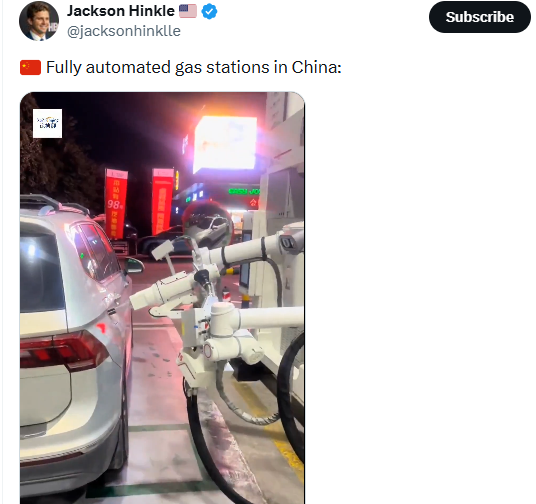

China has begun rolling out fully automated gas stations that operate without on-site human staff, offering a glimpse into the future of fuel retail. These stations rely on advanced technologies, including artificial intelligence, sensors, and mobile payment systems, to deliver a seamless, self-service experience for drivers.
A new era of automation in fuel retail
At these stations, customers handle the entire refueling process independently. They scan a QR code, select fuel type, and complete payment through mobile apps. Meanwhile, automated systems monitor fuel levels, detect leaks, and ensure compliance with safety standards in real time. As a result, the need for attendants has been eliminated, reducing operational costs and increasing efficiency. Click the link below to watch the clip.
https://x.com/jacksonhinklle/status/2050938434772926747
Moreover, these stations integrate smart surveillance and remote monitoring, allowing centralized control centers to oversee multiple locations simultaneously. Consequently, companies can respond quickly to technical issues without requiring permanent staff on-site.
Potential global impact and future expansion
The introduction of workforce-free gas stations highlights China’s rapid push toward automation across industries. Therefore, experts believe this model could be adopted by other countries seeking to modernize infrastructure and cut labor costs. However, adoption may vary depending on regulatory frameworks, safety standards, and public acceptance.
In addition, the concept aligns with broader trends such as smart cities and digital economies. Supporters argue that automation improves convenience and reduces human error, while critics raise concerns about job displacement and system reliability.
Nevertheless, China’s experiment with fully automated fuel stations represents a significant innovation. If successful at scale, it could reshape how people interact with everyday services and accelerate the global transition toward autonomous retail environments.

