

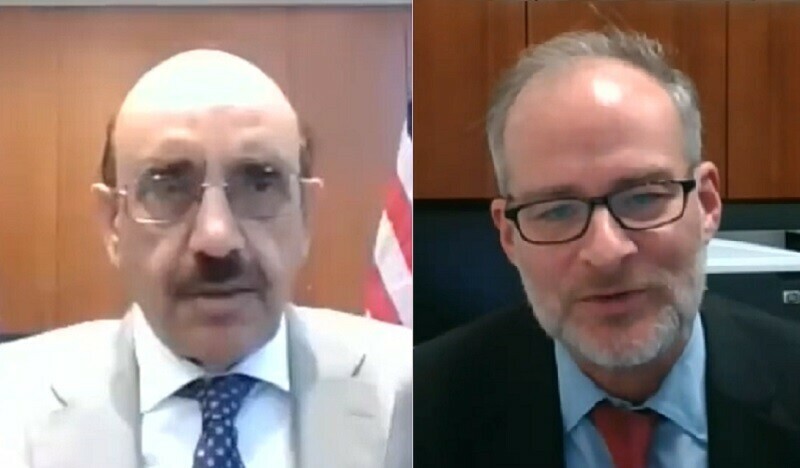

WASHINGTON: A potential food crisis, exacerbated by the war in Ukraine, the ever-rising inflation, and the devaluation of rupee “is a real concern in Pakistan”, US and Pakistani officials warned on Tuesday.
Participating in a discussion through a web-link between Washington and Islamabad, the officials also underlined the need for an evaluation and monitoring mechanism to curb corruption and mismanagement in post-flood reconstructions.
The Russia-Ukraine War
“Yes, it does,” said Pakistan’s ambassador in the US Masood Khan, when the moderator, Adam Weinstein, described the challenges confronting Pakistan as “a perfect storm” and asked if it worried Islamabad.
Shortages of Wheat
“We were directly affected by the Ukraine war. And it led to the shortages of wheat and fertilisers that we used to import from Ukraine,” said the ambassador. Since then, Pakistan was scrambling to get things right, but then came the floods and the situation worsened.
Mr Khan said agriculture was important not only for food security, but also brought about $4.4 billion through exports. “That’s why it has been a setback” for Pakistan, he said.
Pakistan More than an Ally in War On Terror
The moderator noted that so far, the US relationship with Pakistan has been focused mainly on the war on terror, ignoring larger issues, like climate change and natural disasters.
Changing focus
Director for USAID’s Office of Climate and Sustainable Growth at the US embassy in Islamabad Steve Rynecki, who described himself as a ‘development diplomat’, indicated that the policy was changing, and Washington was now focusing on other issues as well.
Climate change, he said, was one of the biggest international challenges of “our time” and “when you have instability brought on by man-made or natural disasters (like the floods in Pakistan), the ramifications and ripples can reach the US as well, whether in the form of refugees or insecurity.”
He said it was in America’s national security and economic interests to monitor the situation in Pakistan and “try to find a way to help”.
post-flood rehabilitation
Ambassador Khan said that besides post-flood rehabilitation and reconstruction, “we also need to focus on macro-economic stability, because reconstruction and revitalisation of our economy must move in tandem.”
While talking about the generous pledges — of almost $10 billion — made at a recent UN-sponsored conference in Geneva, Ambassador Khan agreed with the moderator that all the pledges did not always materialize.
“Realistically speaking, all these pledges that are made at international conferences do not mature very easily, very quickly. But, at the same time, most of the pledges in Geneva have been made by multilateral institutions, banks for instance, and they have repurposed their earlier programmes,” he said.
“So, at least 90 per cent of this money would go to projects. That’s why, I remain optimistic that if we show competence, we can utilize all these funds.”
Pakistan, he said, would also appreciate an evaluation and monitoring mechanism by the lenders. “These are not grants, these are not grants that would be used by the government of Pakistan,” he added.
Parallel work to rebuild Pakistan
The moderator then reminded Mr Rynecki that both China and the United States were doing rehabilitation and reconstruction works in Pakistan and asked if they could coordinate their efforts.
“At this stage, it’s very much parallel,” said the US official. “We have plenty of work in our hands. We have partners that we are working with right now. And other countries in the region (excluding China) that are here to help, we definitely support them.”
Replying to a question about the possible misappropriation of flood aid, Ambassador Khan said: “It depends on what money we are talking about. If we are talking about money that is tied with certain projects by the World Bank or the ADB, they are responsible to monitor how that money is used. And the government would collaborate.”
But “if there are pure grants that have been handed over to the government of Pakistan, we would, even then, welcome any monitoring mechanism,” he added.
The ambassador pointed out that in situations like this, the charges of corruption were always there, but “the government of Pakistan and its institutions are committed to transparency and accountability, because we do not want to give this impression to the international community that somehow this assistance coming for flood relief and reconstruction is not being properly used.”
When the same question was posed to Mr Rynecki, he said USAID and other US foreign assistance providers, adhere to very strict guidance and rules provided by respective inspector general. “So, the inspector general sets the tone for how we are going to allocate and then monitor and see how things are going. There are many ways for people to report impropriety. And what we learned in Iraq and Afghanistan, we bring that to bear here in Pakistan in the current and future situations,” he added.
A wakeup call
The moderator noted that the flood was “a wakeup call” for a relationship that was “narrowly focused on the war on terror for two decades.”
Ambassador Khan said that the US and Pakistan have had a strategic partnership for the past 70 years, adding that Monday’s bombing in Peshawar showed that “supporting the war against terrorism is important”. But he agreed with the suggestion that Pakistan and the US have to recalibrate their relationship, devoting more time to environment, trade, investment and other issues.
Asked why the United States should care, the ambassador said: “The US should care because we have been a partner, a steadfast ally” for more than 70 years. The US absence from the region “will create violability and vulnerability that will hurt US interests as well,” Mr Khan said.
Mr Rynecki said Washington appreciated the importance of Pakistan and regarded it as a challenging area, and “the climate impact adds to the challenge”. Pakistan, he said, also offered “amazing opportunities” to an investor and US investors need to explore those opportunities.
“Pakistan’s prosperity and peace, also reflects on the US. We are working to promote long-term peace and prosperity in Pakistan, focusing on water, energy, and climate,” he said.
