


Transplanted Womb
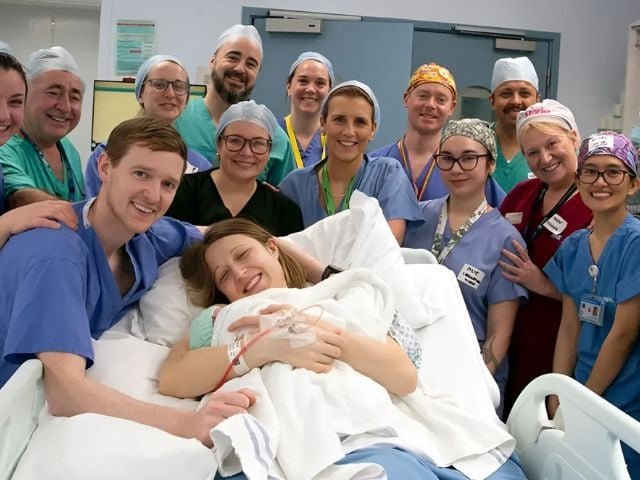
Grace Davidson, a 36-year-old woman born without a functioning uterus due to Mayer-Rokitansky-Küster-Hauser (MRKH) syndrome, has made history in the UK by giving birth to a baby girl named Amy through a groundbreaking womb transplant.
This marks the UK’s only successful womb transplant to date. Grace’s journey began when, as a child, she discovered her condition and initially hoped for her mother to donate her uterus. When that option was not feasible, her sister, Amy Purdie, selflessly offered her womb for the transplant.
The pioneering procedure took place in February 2023, when Grace received her sister’s uterus in a complex 17-hour surgery, which involved a team of over 30 medics.
The transplant was part of a clinical trial aiming to perform 15 womb transplants using deceased donors. Just two years after the transplant, Grace gave birth to her daughter on February 27, 2025, at Queen Charlotte’s Hospital in west London.
Baby Amy weighed just over two kilograms (approximately four and a half pounds) and was delivered via Caesarean section.
The experience of holding her daughter was described by Grace as “incredible” and “surreal,” as she had long dreamed of this moment.
Grace and her husband, Angus, 37, who live in north London, were initially anonymous but chose to share their story after the safe arrival of baby Amy. They are also hopeful of having another child using the donated womb, with embryos still stored for future use.
The success of the womb transplant has given hope to thousands of women in the UK, particularly the 15,000 women of childbearing age without a functioning uterus.
This includes about 5,000 women born without one, who now have a chance at biological motherhood.
Professor Richard Smith, a leading gynaecological surgeon, praised the procedure’s success and its potential to transform the lives of women in similar circumstances.
Grace’s gratitude for her sister’s extraordinary gift is immeasurable. The emotional bond between the two sisters has grown even deeper through this experience, and the name Amy honors the woman who made Grace’s motherhood possible.
Following the birth of a second child, Grace plans to have the donated womb removed, which will also stop her need for immunosuppressive medications to prevent organ rejection.
Womb Transplant UK, the charity supporting Grace’s procedure, aims to continue performing such transplants with the help of donations.
