
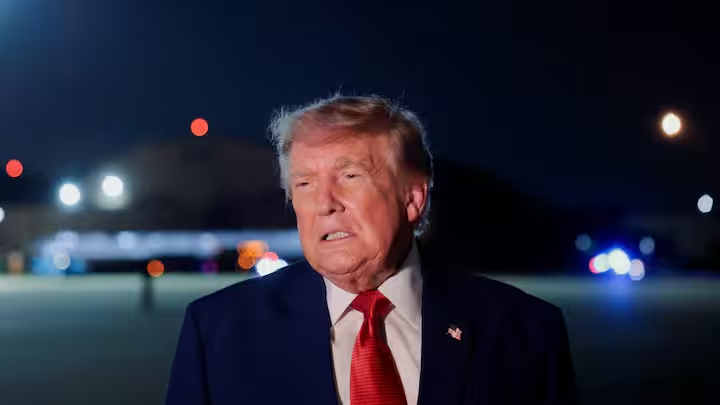

US President Donald Trump has announced what he described as the “MOST CRUSHING ECONOMIC OPERATION EVER TAKEN AGAINST ANY COUNTRY” against Iran.
Trump also warned countries and businesses that continue providing economic support to Tehran of severe consequences.
In a post on Truth Social, Trump accused Iran of rejecting opportunities to reach an agreement with his administration.
He said Washington would now pursue “Economic Warfare and Isolation on an unprecedented scale” against Tehran.
Trump Warns Countries Supporting Iran
Trump said countries providing Iran with an economic “lifeline” would face “TREMENDOUS Economic Consequences.”
He specifically mentioned financial institutions, businesses, airports and government entities that continue supporting Tehran.
The US president also targeted several channels that Iran could use to maintain its economy. These include oil smuggling, swap lines, cash transfers, exchange houses, ship registries and front companies.
Trump said: “It all needs to stop NOW.”
He described the campaign as an “ECONOMIC D-DAY” and urged US allies to support efforts to isolate Iran.
According to Trump, the measures would also reduce Iran’s ability to “project terror worldwide.” He again stressed his administration’s opposition to Iran acquiring nuclear weapons.
“IRAN WILL NEVER HAVE A NUCLEAR WEAPON,” Trump said.
Trump Claims Iran Has Suffered Major Military Losses
Trump claimed Iran’s navy and air force had been destroyed during the conflict. He also said Iran’s military factories had been reduced to rubble.
Additionally, Trump claimed that Iran’s currency had become “worthless.”
His latest announcement followed conflicting signals about the possibility of renewed diplomacy between Washington and Tehran.
Trump has previously indicated that negotiations with Iran could happen “at some point.” However, he did not specify when talks could resume or the conditions required for negotiations.
Trump Says Strait of Hormuz Remains Open
Trump also addressed the strategic Strait of Hormuz amid continuing regional tensions.
He said vessels were still passing through the waterway despite what he described as an effective US naval blockade.
“The Strait is open. A lot of boats are coming through. People aren’t reporting that… the Naval blockade has been extremely effective… We’re going to see what happens,” Trump said.
The Strait of Hormuz remains central to the wider confrontation because of its importance to regional shipping and energy supplies.
Trump’s comments came as tensions continued over Iran’s military activities, nuclear programme and the wider regional conflict.
Iran Says Diplomacy Is Still Possible
Tehran has maintained that it remains open to diplomacy but has rejected negotiations from what it considers a position of weakness.
Iranian President Masoud Pezeshkian said “negotiation is not surrender.” He argued that any talks should take place “at the height of our power.”
Pezeshkian said negotiations should aim to end the war, lift the siege and release blocked resources. He also said nuclear issues could eventually be addressed through negotiations.
“We defend territorial integrity, but war is not our goal,” Pezeshkian said.
Iranian Speaker Takes Tougher Position
Iranian Parliament Speaker Mohammad Bagher Ghalibaf adopted a more confrontational position toward Washington.
Speaking in Baghdad, Ghalibaf accused the United States of seeking to “plunder the countries of the region” and their resources. He described Washington as the “biggest problem” and “main cause” of regional problems.
Ghalibaf also claimed that the United States had suffered military and political defeat. He referred to the confrontation as the “third imposed war.”
Regional Diplomacy Continues Amid Escalating Rhetoric
Despite the increasingly sharp statements from Washington and Tehran, diplomatic contacts have continued.
Iranian Foreign Minister Abbas Araghchi held a phone call with Chief of Defence Forces Field Marshal Asim Munir.
The two officials discussed regional developments, diplomatic efforts and possible political solutions. They also explored ways to strengthen bilateral consultations and cooperation.
The diplomatic contacts come as tensions continue over the conflict and the future of the Strait of Hormuz.
Iran’s nuclear programme also remains a major point of disagreement between Tehran and Washington. For now, both sides continue to signal sharply different positions.
Washington is pushing for greater economic isolation, while Tehran maintains that diplomacy remains possible without compromising its sovereignty and interests.

