

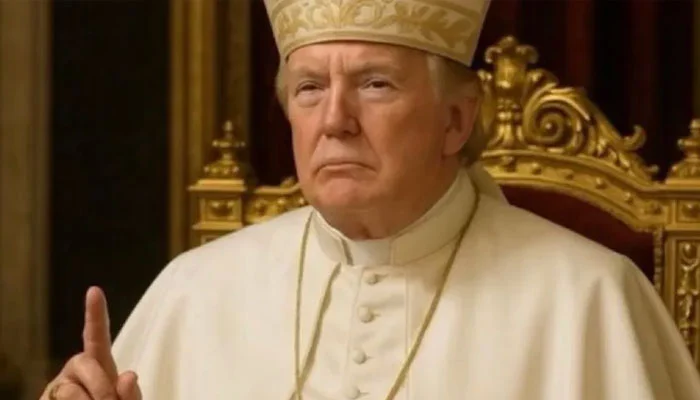

President Donald Trump on Monday dismissed the uproar over an AI-generated image depicting him as the pope, calling it a harmless joke, even as communications experts expressed concern over the implications of blending artificial intelligence with political messaging.
The image, shared over the weekend on Trump’s Truth Social account and subsequently reposted by the White House, showed Trump dressed in white papal vestments. Another AI-generated image depicted him wielding a red lightsaber, similar to those used by Star Wars villains. Both posts appeared to follow Trump’s familiar strategy of using provocative imagery to energize his base and bait critics.
Since returning to the presidency on January 20, Trump has once again dominated headlines. Even during a relatively quiet news cycle, the viral AI-generated images ensured he remained a central topic of discussion online and in the media.
Throughout his political career, Trump has leaned into dramatic visuals—from riding in a garbage truck to standing with a Bible outside a church during civil unrest. But experts say AI-generated content crosses a new line. Unlike staged real-life photos, these images intentionally blur fact and fiction, potentially misleading the public.
“We’re witnessing a new frontier—the fusion of AI and social media as a tool for political narrative control,” said John Wihbey, director of the AI-Media Strategies Lab at Northeastern University. “Trump is exploiting this uncharted space. I expect more politicians globally will adopt similar tactics.”
When questioned about the pope image, Trump told reporters, “It was just a joke, just for fun. I didn’t post it myself, but someone did. You’ve got to have a little fun, don’t you?”
The White House has not commented on who manages Trump’s Truth Social posts or who created the AI-generated memes.
Reactions to the image were divided. Many Catholics in the U.S., Italy, and other countries found it deeply offensive. Former Italian Prime Minister Matteo Renzi condemned it on X, writing, “This image offends believers, insults institutions, and shows how the leader of the global right revels in mockery.”
Democratic strategist Michael Ceraso interpreted the stunt as calculated political theater. “Trump is the first influencer president,” he said, advising Democrats not to get distracted by manufactured controversies. “He draws from pro wrestling—good guy or bad guy doesn’t matter, as long as people are reacting.”
This isn’t Trump’s first foray into AI visuals. Since returning to office, he has posted doctored images of himself as a monarch, a gangster, and even standing at a beachfront resort in war-torn Gaza, blurring the lines between satire, fantasy, and political propaganda.
