
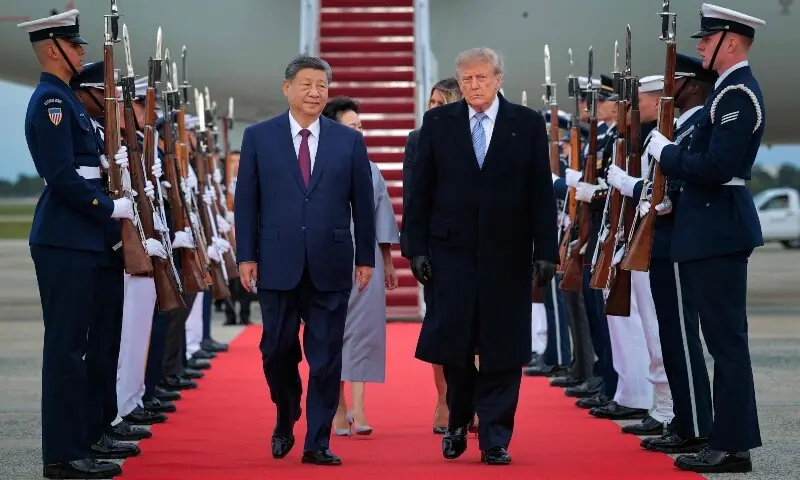

US President Donald Trump arrived in Shenzhen, southern China, on Wednesday to participate in the Asia-Pacific Economic Cooperation (APEC) Leaders Summit. His arrival comes as Washington and Beijing prepare for another round of discussions over their fragile trade agreement.
Chinese President Xi Jinping is also expected to meet Trump on the sidelines of the summit later this week. Both leaders face the challenge of maintaining the existing trade arrangement as it approaches its January deadline.
The meeting could provide an important opportunity to address outstanding disagreements between the world’s two largest economies. Meanwhile, their trade relationship continues to recover from a prolonged period of tariff increases and retaliatory measures.
Trump and Xi Prepare for Crucial Trade Discussions
Trump and Xi are preparing to discuss the future of their trade truce during the APEC gathering in China. Their discussions will focus on keeping the existing agreement in place and preventing another escalation.
The current arrangement remains fragile, particularly as its January deadline approaches. Therefore, both governments face pressure to maintain progress through negotiations.
Trade tensions have repeatedly disrupted economic relations since Trump returned to the White House in 2025. However, Washington and Beijing have gradually shifted towards negotiations after imposing substantial tariffs and trade restrictions.
How US-China Trade Tensions Escalated in 2025
The latest trade conflict intensified in February 2025 when Trump imposed a 10% tariff on Chinese imports. His administration cited concerns involving fentanyl and immigration as reasons for the decision.
China responded by imposing duties on several American products. These included coal, liquefied natural gas, crude oil and vehicles.
However, tensions increased further in April when Trump announced sweeping tariffs, including a 34% duty on Chinese goods. Both countries subsequently raised their tariffs through successive retaliatory measures.
At one point, American tariffs reached 125%, while China’s retaliatory duties climbed to the same level.
Geneva Agreement Offered Temporary Relief
In May 2025, officials from both countries reached a temporary agreement during negotiations in Geneva. The arrangement established a 90-day pause and significantly reduced tariffs.
Washington lowered its duties on Chinese goods from 145% to 30%. Meanwhile, Beijing reduced its tariffs on American products from 125% to 10%.
The two countries later extended the pause in August, creating additional opportunities for negotiations.
Trump and Xi Reached a Trade Truce in October 2025
Another important development emerged in October 2025 when Trump and Xi reached a trade truce following discussions in South Korea.
Under the arrangement, Washington agreed to reduce certain tariffs. In return, Beijing committed to addressing supplies of fentanyl precursor chemicals and resuming soybean purchases.
China also agreed to suspend certain restrictions on rare-earth exports, helping ease another source of economic tension.
Nevertheless, disagreements between the two countries continued into 2026, despite efforts to stabilise their relationship.
US Supreme Court Ruling Complicated Trade Relations
In February 2026, the US Supreme Court struck down Trump’s emergency tariffs. Following the decision, Washington introduced a temporary 10% global duty under a different legal authority.
The development added another dimension to the ongoing trade discussions between Washington and Beijing.
During Trump’s May visit to Beijing, both countries announced plans to establish Boards of Trade and Investment. China also agreed to purchase Boeing aircraft and American agricultural products.
These commitments represented further efforts to strengthen economic cooperation despite continuing disagreements.
New Tariff Agreement Raises Hopes for Trade Stability
In September 2026, another meeting resulted in reduced tariffs on $60 billion worth of non-sensitive goods. Both governments subsequently agreed to extend their tariff truce by two months in November.
Meanwhile, officials held the first formal meeting of the Board of Trade, marking another step towards maintaining economic engagement.
Trump’s arrival in Shenzhen now brings renewed attention to the future of US-China trade relations. His expected discussions with Xi could help determine whether both sides maintain their existing commitments.
However, the January deadline remains an important consideration as the two economies seek to avoid another round of escalating trade restrictions.

