

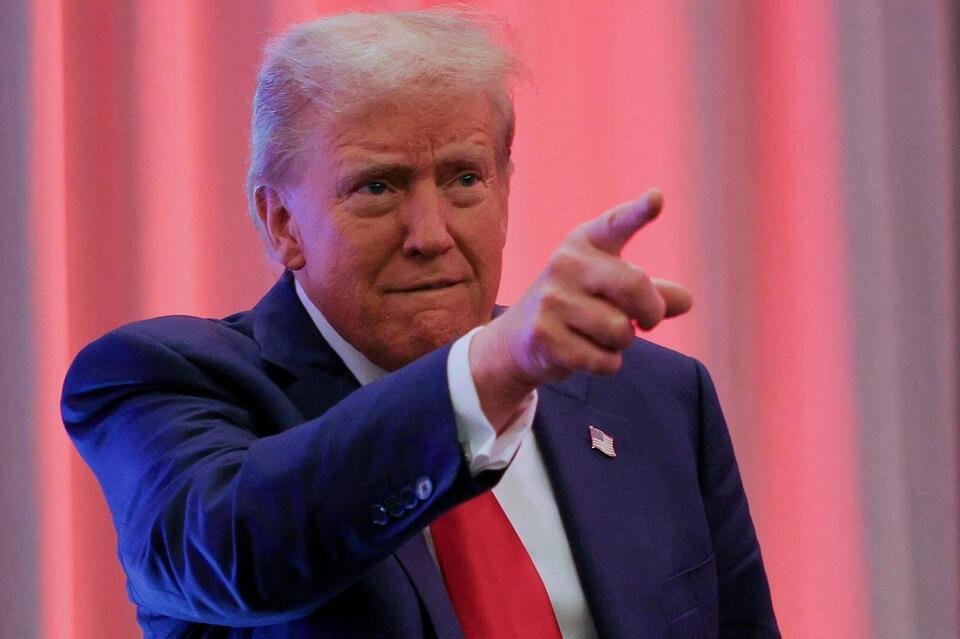

US President Donald Trump is not visiting Pakistan this year. The White House dismissed reports suggesting that Trump would visit Pakistan later this year.
Earlier in the day, several Pakistani television channels had reported that Trump was expected to visit Islamabad in September, followed by a trip to India. However, the channels later retracted their reports.
“A trip to Pakistan has not been scheduled at this time,” a White House official clarified, refuting the media claims.
Pakistan’s Foreign Office also expressed unawareness regarding any such development. “We have no information about this matter,” said Foreign Office Spokesperson Shafqat Ali Khan.
The last visit by a U.S. president to Pakistan was in 2006, when George W. Bush toured the country.
Despite no planned visit, U.S.-Pakistan relations recently saw a diplomatic milestone when Trump hosted Pakistan’s Chief of Army Staff, Field Marshal Asim Munir, at the White House in a rare and high-level meeting.
Meanwhile, Trump is expected to travel to the United Kingdom from September 17 to 19 for his second state visit, hosted by King Charles, according to Buckingham Palace. India is also preparing to host the next summit of the Quad alliance — comprising the U.S., India, Japan, and Australia — though dates for the gathering have yet to be confirmed.
Trump’s assassination attempt was security failure: Report
A congressional investigation into last year’s assassination attempt on then-presidential candidate Donald Trump has condemned the Secret Service for “unforgivable” security lapses and urged stricter disciplinary measures.
The incident took place on July 13, 2024, during a campaign rally in Butler, Pennsylvania, when a 20-year-old gunman, Thomas Crooks, opened fire, grazing Trump’s ear. Tragically, one bystander lost their life, and two others were injured before Crooks was shot dead by a government sniper.
In a report released by the US Senate Homeland Security and Governmental Affairs Committee, lawmakers criticized what they described as “a series of preventable failures that almost claimed President Trump’s life.” The investigation found that the Secret Service had ignored credible intelligence and failed to coordinate effectively with local police.
“The scale of negligence here is staggering, and the disciplinary measures imposed so far simply don’t match the seriousness of what happened,” said committee chairman Rand Paul. “Nobody has lost their job despite an alarming collapse of security procedures, fueled by bureaucratic complacency and unclear protocols. We need accountability and meaningful reforms to ensure such a breach never occurs again.”
Following the incident, the Secret Service acknowledged shortcomings linked to communication breakdowns, technical errors, and human mistakes. The agency announced ongoing reforms, such as better cooperation among law enforcement agencies and the creation of a specialized aerial surveillance unit.
To date, six unidentified Secret Service employees have faced disciplinary action, with punishments ranging from 10 to 42 days of unpaid suspension. All six have been reassigned to restricted or non-operational roles.
Reflecting on the attempt on his life, Trump described it as an “unforgettable” moment. “I didn’t know what was happening at first. I felt the impact, and thankfully I managed to get down quickly. People around me were screaming,” he recalled during an interview earlier this week.
Trump also praised the government sniper who stopped the attacker with a single shot from a long distance, saying, “If he hadn’t done that, things could have been far worse.” Despite acknowledging that “mistakes were made,” Trump expressed satisfaction with the investigation’s overall findings.
