


‘Cordial’ Talks
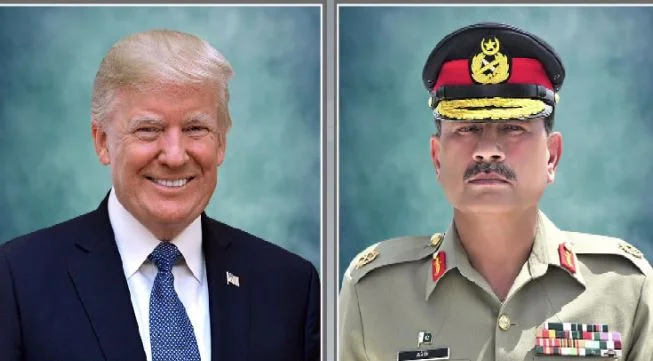
In a landmark diplomatic engagement, US President Donald Trump met with Pakistan’s Chief of Army Staff, Field Marshal Syed Asim Munir, at the White House in what the Inter-Services Public Relations (ISPR) described as a “cordial” and extended meeting that marked a new chapter in US-Pakistan relations.
The high-profile interaction lasted over two hours—well beyond the originally scheduled one-hour slot—reflecting the depth and warmth of the discussions.
General Munir’s visit is historic, making him the first serving Pakistani army chief to be formally received by a sitting US president without holding political office or governing under martial law. The meeting took place over a luncheon in the Cabinet Room and continued into the Oval Office, underscoring its significance.
Attending the meeting from the US side were Secretary of State Senator Marco Rubio and Special Representative for Middle Eastern Affairs Steve Witkoff, while Pakistan’s National Security Advisor and intelligence chief Lt Gen Muhammad Asim Malik accompanied the COAS.
According to the ISPR, discussions focused on counterterrorism collaboration and the expansion of bilateral trade and economic partnerships. President Trump praised Pakistan’s contributions to regional peace and its ongoing efforts in counterterrorism. Both sides reaffirmed their commitment to continued cooperation in combating terrorism and extremism.
Beyond security, the talks covered potential areas of economic collaboration, including trade, energy, cryptocurrency, artificial intelligence, mines and minerals, and emerging technologies. President Trump expressed a strong interest in developing a long-term strategic economic partnership with Pakistan, emphasizing mutual benefits and shared interests.
President Trump also commended Field Marshal Munir’s leadership amid complex regional tensions. In a notable gesture, the Pakistani army chief extended an invitation to President Trump to visit Pakistan on behalf of the government—a move that ISPR described as reflecting the warmth in bilateral ties.
General Munir also conveyed Pakistan’s gratitude for Trump’s role in facilitating a ceasefire during a recent regional crisis with India, acknowledging the US President’s statesmanship and understanding of global challenges.
Trump responded by saying he was “honoured” to meet the COAS and credited both Munir and Indian Prime Minister Narendra Modi for choosing diplomacy over escalation in a potentially nuclear confrontation.
Trump confirmed that discussions also addressed the Israel-Iran conflict, describing Pakistan as having a deep understanding of the situation. “They know Iran very well, better than most, and they’re not happy about anything,” he stated, adding that Pakistan’s insights were valuable.
Notably, the meeting was arranged through unconventional channels rather than standard diplomatic procedures. Sources in Washington revealed that the initiative had been quietly in the works for months and was driven by a network of influential advisers, businessmen, and Republican-aligned lobbying groups.
The White House only confirmed the meeting once it was included in President Trump’s official schedule earlier in the week.
Defence Minister Khawaja Asif hailed the engagement as a milestone in the 78-year history of Pakistan-US relations, crediting it as a success of the current “hybrid” governance model involving both civilian and military leadership.
He emphasized that international and regional issues were addressed in depth and that Pakistan’s strategic role was acknowledged, particularly in the context of its evolving ties with India and the broader regional balance of power.
The White House spokesperson, Anna Kelly, noted that Trump was hosting Munir after calls emerged to nominate him for the Nobel Peace Prize for preventing war between two nuclear-armed states.
While past army chiefs such as Ayub Khan and Pervez Musharraf met US presidents, those meetings came only after they held top political positions. This meeting marks a distinct moment in diplomatic history for both countries.
