
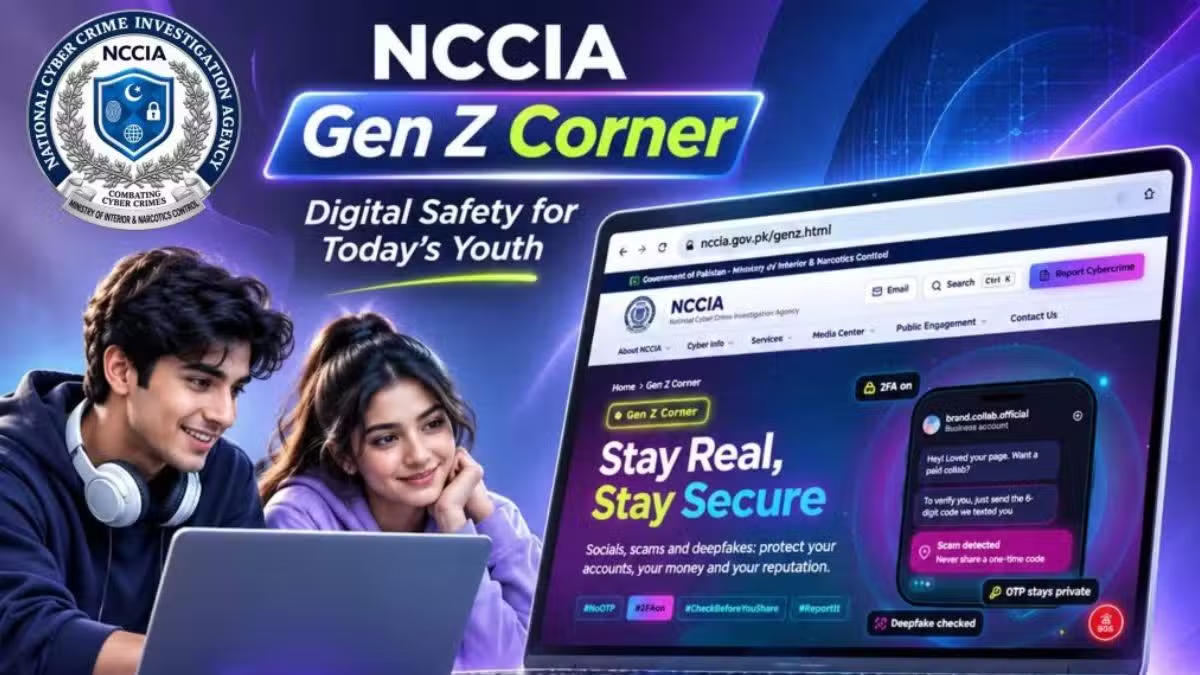

Pakistan’s National Cyber Crime Investigation Agency (NCCIA) has launched a dedicated digital platform to educate young people about online threats and safer internet practices.
Named the Generation Z Cyber Zone, the initiative aims to help young users recognise online scams, identify fake links and protect their personal information.
The platform also encourages responsible social media use and gives young people practical guidance on responding to cyber threats.
Five Common Online Threats Explained
The Cyber Zone highlights five major risks that frequently affect young internet users.
These include account takeovers, deepfakes, sextortion, online bullying and easy-money scams.
The platform explains how criminals use fake brand offers, suspicious verification links and copyright warnings to steal login details.
It also warns that artificial intelligence can clone faces and voices using short video or audio clips.
Another section addresses sextortion, where criminals threaten to expose private images unless victims pay money.
The agency advises victims to stop responding, preserve evidence and report such incidents.
Practical Tips to Protect Digital Accounts
The platform provides simple steps to improve online security.
It encourages users to enable two-step verification, create unique passwords and keep social media profiles private.
Users are also advised to activate login alerts and regularly review app permissions.
The Cyber Zone highlights suspicious messages, requests for verification fees and unrealistic investment promises as common warning signs.
It also encourages users to verify viral content through official accounts before sharing it.
What Should Victims Do After a Cyberattack?
The NCCIA has outlined a four-step response for people facing online threats.
First, users should stop responding and avoid sending money or additional information.
Next, they should save screenshots, usernames, dates, links and payment records as evidence.
They should then secure their accounts by changing passwords from a trusted device and enabling two-step verification.
Finally, victims should report the incident to the relevant social media platform and the NCCIA.
A Wider Push for Digital Awareness
The Gen Z Cyber Zone forms part of the agency’s broader efforts to improve digital awareness among young Pakistanis.
The NCCIA has also introduced a separate Kids Corner to teach children basic internet safety through simple activities and guidance.
Both initiatives reflect the growing need to protect younger internet users as online fraud, digital impersonation and cyber harassment become increasingly complex.
Through the new platform, the agency aims to help Generation Z recognise risks, protect their digital identities and make safer decisions online.
For the latest updates, visit and follow The Truth International website (www.thetruthinternational.com) and subscribe to the YouTube Channel.

