

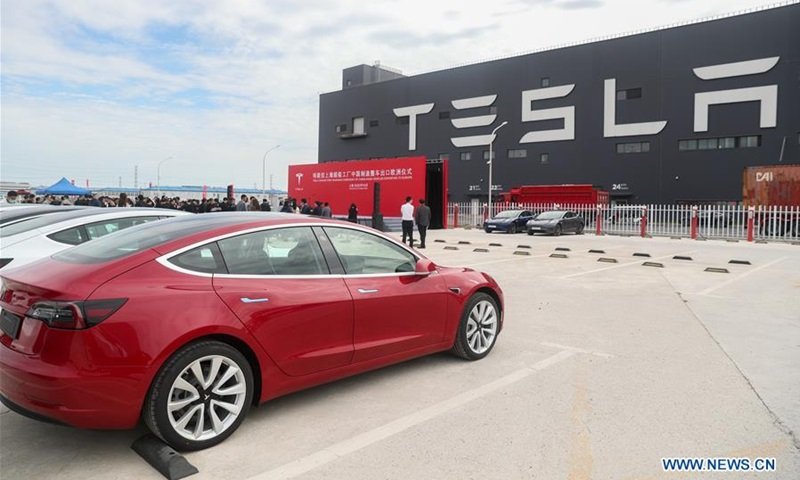

Tesla’s vehicle sales in China took a significant hit in April, defying the robust growth seen among major domestic electric vehicle (EV) competitors, according to industry data reported by CNEVPOST.
The China Passenger Car Association (CPCA) revealed that Tesla sold 58,459 China-made vehicles last month, including exports—a 5.96% drop year-over-year and a steep 25.84% decline from March’s 78,828 units. For the January–April period, Tesla’s China sales fell 18.31% year-over-year to 231,213 units.
In contrast, Chinese EV brands posted impressive gains. Nio delivered 23,900 vehicles in April—up 53% from last year and 59% from March. Xpeng recorded 35,045 deliveries, its second-best monthly performance ever, with a staggering 273% year-over-year surge. Li Auto followed with 33,939 units sold, marking a 32% increase. Xiaomi EV also entered the spotlight, reporting over 28,000 deliveries for April, signaling rising domestic competition as Tesla’s market share continues to slip.
Tesla’s struggles aren’t confined to China. The company is also experiencing a sharp decline across Europe. April 2025 sales fell dramatically in nearly all major European markets. Once a leader in the region’s EV sector, Tesla saw year-over-year drops exceeding 50% in France, the Netherlands, Sweden, Denmark, and the UK. In Germany—the continent’s largest auto market—Tesla’s sales tumbled 46%, even as overall EV sales climbed, according to ARS Technica.
In the UK, where battery electric vehicle (BEV) registrations rose 8.1%, Tesla’s performance was even more dismal—sales plunged 62%, with just 512 vehicles registered out of more than 24,000 BEVs sold that month.
Analysts point to a confluence of issues contributing to Tesla’s downturn: intensifying competition from Chinese and European automakers, a stale and aging product lineup, and growing public backlash toward CEO Elon Musk’s controversial political affiliations and public behavior. Even recent initiatives like the Model Y refresh have failed to meaningfully reignite demand. Outside of modest growth in Italy and Norway, Tesla’s European market performance remains deeply challenged.
A report from GLJ Research’s Gordon Johnson issued this week warned that Tesla may be facing a serious demand crisis. Johnson argued that even the company’s most loyal investors are beginning to acknowledge the deteriorating fundamentals. Despite the narrative that Tesla is more than just a car company, the majority of its revenue—around 86%—still comes from vehicle sales. Attempts to diversify into solar, battery storage, and trucks have yet to gain meaningful traction.
Johnson noted that sales numbers out of both China and Europe are well below expectations and pose serious questions about the company’s ability to hit even conservative delivery targets.
The report warns that unless Tesla can quickly reverse course in its core auto business—particularly with the hype surrounding events like the upcoming June 1 robotaxi announcement likely to fade—the stock could face a significant downward revaluation.
