
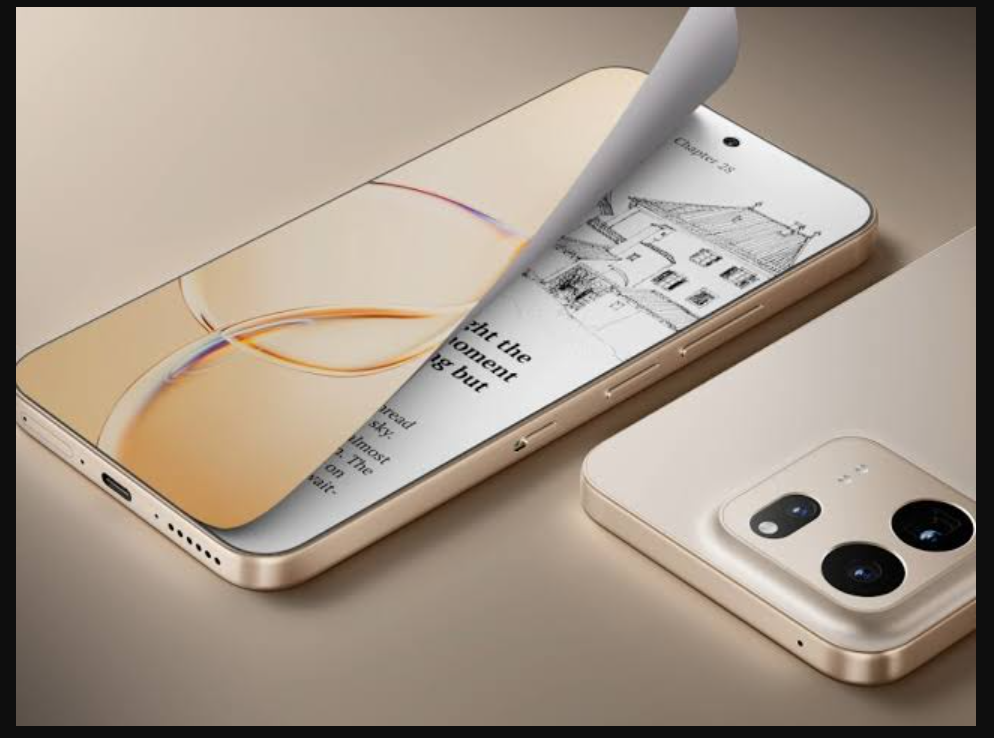

TCL has launched the P80 Ultra, P80 Pro, and P80 smartphones, expanding its NxtPaper lineup with several notable upgrades.
The P80 Ultra leads the series as TCL’s most advanced model, combining NxtPaper technology with an AMOLED display for the first time.
Meanwhile, the P80 Pro retains much of the Ultra model’s hardware but drops the periscope telephoto camera.
The standard P80 also uses an AMOLED panel, although it does not feature TCL’s NxtPaper technology.
TCL P80 Ultra Display Brings NxtPaper to AMOLED
The TCL P80 Ultra features a 6.83-inch AMOLED display with NxtPaper technology.
The panel offers a 1.5K resolution, a 120Hz refresh rate, and 100% DCI-P3 color coverage.
It can also reach a peak brightness of up to 3,200 nits, making the display a key highlight of the phone.
TCL uses circular polarization instead of the linear polarization commonly found on OLED displays.
According to TCL, this approach provides a more natural viewing experience.
It also aims to avoid viewing issues that some displays can cause when users wear polarized glasses.
The display further uses a homogenizing film that mixes red, green, and blue sub-pixels.
This process produces white light across the panel, according to TCL.
The company also says it has reduced blue light output to 2.9% without compromising image quality.
For additional protection, the screen uses Nano Crystal Shield Glass.
TCL describes the material as its strongest anti-glare solution.
Design and Durability
The P80 Ultra features an aluminum frame and comes in three finishes.
These include Sunlit Gold, Burgundy, and Midnight Blue.
The phone also carries an IP68 rating for dust and water resistance.
In addition, it has passed MIL-STD-810H shock tests.
The P80 Pro uses the same 6.83-inch NxtPaper AMOLED display as the Ultra model.
It also offers 1.5K resolution, a 120Hz refresh rate, and up to 3,200 nits of peak brightness.
However, TCL offers the P80 Pro only in Sunlit Gold and Midnight Blue.
The standard P80 retains the same 6.83-inch AMOLED panel, 1.5K resolution, and 120Hz refresh rate.
It also reaches 3,200 nits of peak brightness and covers 100% of the DCI-P3 color space.
However, the standard model does not include NxtPaper technology.
TCL offers the P80 in Sunlit Gold and Midnight Blue, while its design closely matches the P80 Pro.
Performance and Storage
The TCL P80 Ultra runs on the MediaTek Dimensity 7400 Elite chipset.
It comes with 8GB of LPDDR5 RAM and offers either 256GB or 512GB of UFS 3.1 storage.
The P80 Pro uses the same Dimensity 7400 Elite processor.
It also includes 8GB of RAM and provides 256GB or 512GB of storage.
Meanwhile, the standard P80 starts with 128GB of storage and also comes in a 256GB configuration.
Therefore, buyers can choose between different storage options depending on their requirements.
NxtPaper Modes Focus on Reading
All three NxtPaper models include a dedicated NxtPaper slider on the side.
Users can use the slider to activate different reading modes, including Max Ink mode.
Max Ink mode blocks most notifications while allowing calls and messages to come through.
It also puts background applications to sleep to reduce power consumption.
TCL says the feature can extend battery life to as much as seven days when used for reading.
The mode also provides quick access to an e-reader application.
Furthermore, TCL includes more than 500 books on the device.
The phones also feature AI-based tools, including AI-enhanced Reading.
This feature can convert standard e-books into audiobooks.
It can also transform books into a more podcast-like listening format.
Long-Term Software Support
The P80 Ultra runs Android 16 and qualifies for four operating system upgrades.
It will also receive seven years of security updates.
The P80 Pro and standard P80 will receive three operating system upgrades.
However, both models will receive the same seven years of security patches.
This gives the P80 series a relatively long software support period across its different models.
TCL P80 Ultra Cameras
The P80 Ultra features a triple-camera setup on the rear.
Its main camera uses a 50MP sensor with optical image stabilization.
The phone also includes a 50MP periscope telephoto camera with 3x optical zoom.
The telephoto camera features 0.64µm pixels, an f/2.4 lens, and optical image stabilization.
An 8MP ultrawide camera completes the rear camera system.
For selfies and video calls, the phone features a 32MP front camera.
The P80 Pro takes a different approach to its camera system.
It drops the periscope telephoto camera and uses two rear cameras instead.
The setup includes a 50MP main camera with a 1/1.56-inch sensor and optical image stabilization.
It also features an 8MP ultrawide camera.
The P80 Pro retains the same 32MP front camera as the Ultra model.
Battery and Charging
The TCL P80 Ultra packs a 5,800mAh battery with support for 45W wired charging.
The P80 Pro also comes with a 5,800mAh battery and supports 45W wired charging.
The standard P80 uses a smaller 5,000mAh battery.
However, it also supports 45W wired charging.
The larger batteries in the Ultra and Pro models complement their reading-focused features.
In particular, TCL highlights extended battery life when users activate Max Ink mode for reading.
TCL P80 Series Pricing
The TCL P80 Ultra starts at approximately $638 for the 8GB RAM and 256GB storage version.
The 8GB/512GB configuration costs around $697.
The P80 Pro costs approximately $499 with 256GB of storage.
Its 512GB version is priced at around $580.
Meanwhile, the standard P80 starts at approximately $406 for the 128GB model.
The 256GB version costs around $441.
TCL is launching all three P80 models immediately.
TCL P80 Series Specifications
| Specification | TCL P80 Ultra | TCL P80 Pro | TCL P80 |
|---|---|---|---|
| Chipset | MediaTek Dimensity 7400 Elite (4nm) | MediaTek Dimensity 7400 Elite (4nm) | MediaTek Dimensity 7300 Elite (4nm) |
| CPU | Octa-core: 4× Cortex-A78 at 2.6GHz + 4× Cortex-A55 at 2.0GHz | Octa-core: 4× Cortex-A78 at 2.6GHz + 4× Cortex-A55 at 2.0GHz | Octa-core: 4× Cortex-A78 at 2.5GHz + 4× Cortex-A55 at 2.0GHz |
| GPU | Mali-G615 MC2 | Mali-G615 MC2 | Mali-G615 MC2 |
| OS | Android 16; 4 OS upgrades, 7 years security updates | Android 16; 3 OS upgrades, 7 years security updates | Android 16; 3 OS upgrades, 7 years security updates |
| Networks | 2G / 3G / 4G / LTE / 5G | 2G / 3G / 4G / LTE / 5G | 2G / 3G / 4G / LTE / 5G |
| Display | 6.83-inch NxtPaper AMOLED, 1.5K, 120Hz, 3,200 nits, 100% DCI-P3 | 6.83-inch NxtPaper AMOLED, 1.5K, 120Hz, 3,200 nits, 100% DCI-P3 | 6.83-inch AMOLED, 1.5K, 120Hz, 3,200 nits, 100% DCI-P3 |
| RAM | 8GB LPDDR5 | 8GB LPDDR5 | 8GB |
| Storage | 256GB / 512GB UFS 3.1 | 256GB / 512GB UFS 3.1 | 128GB / 256GB |
| Card Slot | Not officially specified | Not officially specified | Not officially specified |
| Rear Cameras | 50MP main OIS + 50MP 3x periscope OIS + 8MP ultrawide | 50MP main OIS + 8MP ultrawide | 50MP main OIS + 8MP ultrawide |
| Front Camera | 32MP | 32MP | 32MP |
| Colors | Sunlit Gold, Burgundy, Midnight Blue | Sunlit Gold, Midnight Blue | Sunlit Gold, Midnight Blue |
| Battery | 5,800mAh, 45W wired charging | 5,800mAh, 45W wired charging | 5,000mAh, 45W wired charging |
| Price | $638 | $499 | $406 |

