

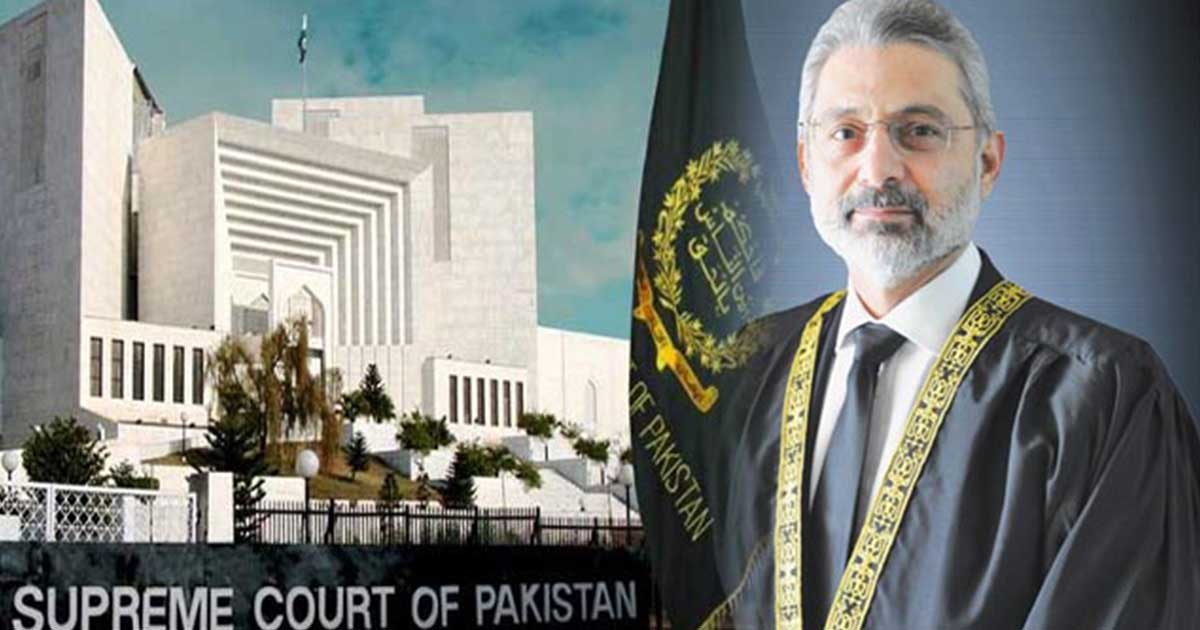

ISLAMABAD: In its detailed judgement the Supreme Court has observed that its June 2020 order to the Federal Board of Revenue (FBR) to probe allegations against Sarina Isa, the wife of Justice Qazi Faez Isa, of not declaring three foreign properties in her name and her children and submit its findings to the Supreme Judicial Council was in violation of the principle of natural justice.
Justice Maqbool Baqar, Justice Manzoor Ahmad Malik (retired), Justice Mazhar Alam Khan Miankhel, Justice Syed Mansoor Ali Shah, Justice Yahya Afridi and Justice Amin-ud-Din Khan wrote the short order, wrote the judgement.
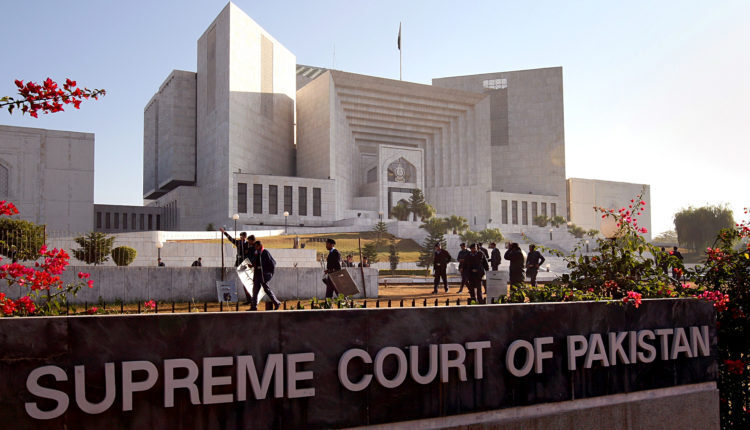
These Judges were members of the 10-judge bench of the Supreme Court that overturned its June 19, 2020 majority order in Justice Isa case. The judgement explained that these directions definitely fell within the scope of the established ground of review namely “error apparent on the face of the record” and could be recalled in exercise of the court’s review jurisdiction under Article 188 of the Constitution.

The Supreme Court bench overturned its June 19 majority order by 6-4, rendering the exercise carried out by the FBR null and void as the fresh verdict trashed the previous decision, which empowered the FBR to evaluate and later impose tax liability against Mrs Isa for possessing three properties in the UK.
Meanwhile, Justice Yahya Afridi, a member of the bench, has cautioned Prime Minister Imran Khan for retaining “delinquents” such as Law Minister Dr Farogh Naseem and Asset Recovery Unit (ARU) chairman Shahzad Akbar in key positions of authority, violating the elementary principles of good governance and exposing the PM’s complicity with them.
Justice Afridi observed that Section 216 of the Income Tax Ordinance (ITO) 2001 was blatantly breached in the case of Mrs Sarina Isa — wife of Justice Qazi Faez Isa — on the unlawful directions of the ARU chairman with the concurrence of the law minister. Thus, they breached the statutory confidentiality of Mrs Isa’s tax returns, observed Justice Afridi in his separate note accompanying the Supreme Court’s detailed verdict issued in the Justice Isa case on Saturday following its April 26, 2021 short order.
Justice Afridi was part of a 10-member Supreme Court bench that overturned its June 19, 2020 majority order in the Justice Isa case that required verification of and a subsequent inquiry by the tax authorities into three foreign properties in the name of the wife and children of Justice Isa.
Also, the minority verdict by Justice Umar Ata Bandial, Justice Sajjad Ali Shah, Justice Munib Akhtar and Justice Qazi Mohammad Amin Ahmed is still awaited.According to the verdict in the detailed judgement, no one, including a judge of the country’s highest court, was above the law, but no one, including a judge, could be denied his right to be dealt with in accordance with law.
Every citizen, it said, notwithstanding his status or position, was entitled to due process of law in any action detrimental to his life, liberty, body, reputation or property under Article 4 of the Constitution and safeguarding of his fundamental rights guaranteed under Articles 9 to 28.
The order said the judicial accountability was the cornerstone of judicial independence, but it did not mean that accountability of the judge was bereft of due process of law and fair trial.
As judges have no public platform to clarify, respond or defend themselves, any attempt to malign judges can damage public trust in the judicial institution. It explained that since the basic order was without lawful authority, the entire superstructure built on it fell to the ground.
Thus, any proceedings taken, orders passed or actions made in pursuance of these directions lost their legal status, the judgment said, while emphasising that the apex court strongly believed that judicial independence and accountability were two sides of the same coin. “To compromise on judicial accountability is to compromise on independence of judiciary – but our only concern in the present matter is that a constitutional court judge in the matter of his accountability, his spouse, must be dealt with in accordance with the law,” the judgement said.
