



ISLAMABAD: In a significant development, the Supreme Court has upheld the controversial law, the Supreme Court (Practice and Procedure) Act 2023, which restricts the powers of the chief justice.
The full bench of the Supreme Court, led by Chief Justice of Pakistan (CJP) Qazi Faez Isa, had previously reserved the verdict on the pleas challenging this law after conducting five hearings since September 18.
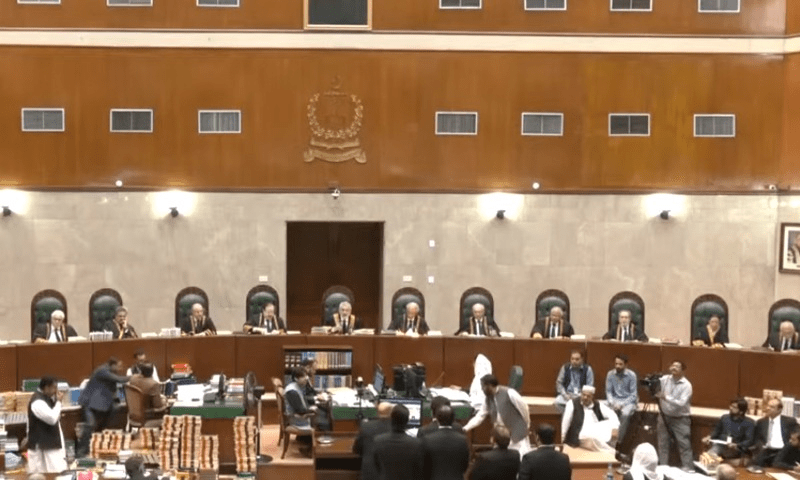
While announcing the decision, CJP Isa noted that five members of the full court bench, including Justice Ijazul Ahsan, Justice Muneeb Akhtar, Justice Sayyed Mazahir Ali Akbar Naqvi, Justice Ayesha A Malik, and Justice Shahid Waheed opposed the law.
CJP Isa also pointed out that, by a majority vote of 8-7, sub-section 2 of section 5 of the act, which pertains to granting the right of appeal retrospectively, has been declared ‘ultra vires,’ meaning it goes against the Constitution.
What is the law?
The law grants the authority to take suo motu notice to a three-member committee, which includes senior judges, including the chief justice. The primary objective is to ensure transparency in proceedings at the highest court and to allow for the right to appeal.
Regarding the formation of judicial benches, the Act specifies that all cases, issues, or appeals before the Supreme Court will be heard and resolved by a panel established by a committee consisting of the Chief Justice and the two most senior judges. The decisions of this committee will be made by a majority vote.
For cases involving the exercise of the Supreme Court’s original jurisdiction, the Act dictates that any matter invoking Article 184(3) must first be presented to the committee.
In cases requiring an interpretation of the Constitution, the Act stipulates that the committee will assemble a bench comprising no fewer than five Supreme Court judges.
In situations where an appeal is needed for a judgment delivered by a Supreme Court bench exercising Article 184(3) jurisdiction, the Act specifies that the appeal must be filed within 30 days of the bench’s order and should be heard by a larger Supreme court bench within a maximum of 14 days.
Furthermore, the law establishes that any application seeking urgent attention or interim relief in a case, appeal, or matter must be scheduled for a hearing within 14 days from the date of its submission.
However, it’s important to note that the provision extending the right of appeal retrospectively to individuals who had previously been affected by an order under Article 184(3) before the Act came into effect was struck down by the court.
