

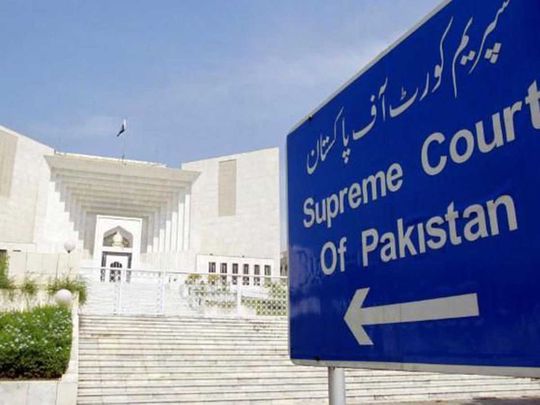

ISLAMABAD: The Supreme Court reconvened on Friday to resume the hearing on a case related to the permanent barring of lawmakers as per Article 62(1)(F) of the Constitution.
The court took notice of conflicting durations of disqualification in the Election Act, 2017, during a prior hearing regarding a petition from former PML-N provincial lawmaker Sardar Meer Badshah Khan Qaisrani, challenging his lifelong disqualification due to a fake degree in 2007.
A seven-member larger bench, led by CJP Isa and including Justices Syed Mansoor Ali Shah, Yahya Afridi, Aminuddin Khan, Jamal Khan Mandokhel, Muhammad Ali Mazhar, and Musarrat Hilali, presides over the proceedings, which are being live-streamed on the SC’s website and YouTube channel.
In the previous session, CJP Isa expressed reservations about permanently disqualifying individuals from parliament, deeming it “against Islam.”
The court seeks clarity on whether a lawmaker’s disqualification period is five years (as per the 2017 Election Act amendment) or a lifelong ban under Article 62(1)(F), governing election eligibility criteria.
CJP Isa referenced an Islamic perspective, citing a verse from Surah Sajdah highlighting the lofty status of humans and emphasizing the judgment of deeds rather than inherent nature.
This case holds the fate of numerous politicians, notably Nawaz Sharif of the PML-N and Jahangir Tareen of the Istehkam-e-Pakistan Party, whose eligibility to contest upcoming elections hinges on this verdict.
The court previously convened on January 2, cautioning against presuming favoritism towards any specific party. In a hearing on December 11, CJP Faez Isa highlighted the conflict between the Supreme Court’s ruling on lifelong disqualification and the 2017 Elections Act amendments, emphasizing the need for a conclusive resolution.
The Supreme Court had previously held that individuals disqualified under Article 62(1)(f) would face a lifelong ban.
However, the PDM coalition government later amended the Elections Act 2017, reducing disqualification to five years, retroactively affecting prominent figures like Nawaz Sharif and Jahangir Tareen, both deemed “dishonest” under Article 62(1)(f) and barred for life in 2017.
