

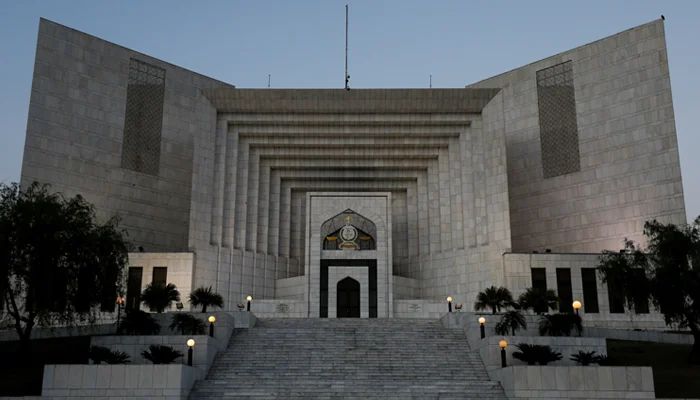

ISLAMABAD: The Supreme Court (SC) has concluded proceedings and reserved its verdict on a petition related to the Right To Information (RTI) Act, which seeks to disclose information concerning its staff and the recruitment process to fill vacant positions within the apex court.
A three-member SC bench, led by Chief Justice Qazi Faez Isa and consisting of Justice Aminuddin Khan and Justice Athar Minallah, reserved the verdict after hearing arguments from the Attorney General for Pakistan (AGP) and the petitioner.
Chief Justice Isa noted that all, including the apex court, must adhere to laws established by parliament, but acknowledged that the petitioner raised complex legal points in this case. He also mentioned the court’s intention to examine how other countries handle similar matters.

The bench directed both the petitioner and AGP Mansoor Usman Awan to provide responses to the queries raised by the court within two weeks. In 2019, Mukhtar Ahmed Ali filed a petition under the RTI Act, seeking information about the staff and recruitment at the apex court.
The SC registrar had previously challenged a July 12, 2021 order from the Pakistan Information Commission (PIC) that directed the SC registrar to share the requested information with the appellant within 20 working days. The registrar argued that the PIC’s jurisdiction did not extend to constitutional courts.
During the recent proceedings, the petitioner explained his motive for seeking information, citing his interest in promoting transparency within the country’s institutions.
Attorney General Awan highlighted the SC registrar’s challenge of the PIC’s order and noted that the matter had gone through legal processes.
Privacy Concerns
Chief Justice Isa raised concerns about the potential disclosure of judges’ private family details if the PIC made such a request, prompting questions about whether the judiciary or the judges’ family members could challenge such an order.
The AGP clarified that the SC registrar had engaged Chaudhry Aamir Rehman’s services in a non-governmental capacity.
Responding to constitutional matters, the AGP stated that the SC was not immune to the Access to Information Act 2017 under Article 19-A of the Constitution. He emphasized that while the court could regulate the process of providing information to the public, it could not outright refuse to provide information.
Justice Athar Minallah questioned whether the armed forces of Pakistan were obligated to provide information under the Access to Information Act 2017, to which the AGP replied that they were exempt from such requests under the law.
Justice Minallah expressed concerns regarding potential contradictions with Article 19-A of the Constitution when certain cases limit access to information. Ultimately, the court reserved its verdict on the matter.
