

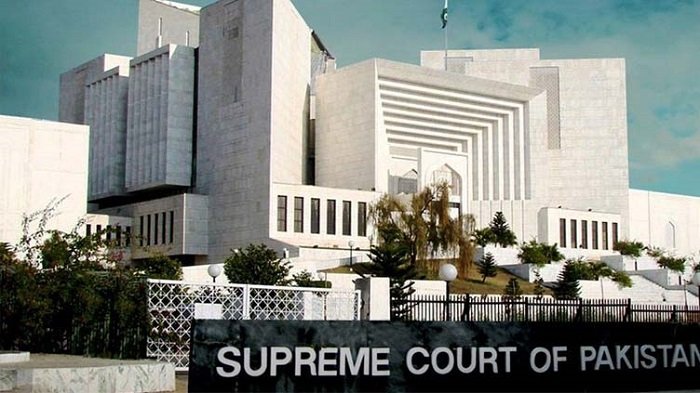

ISLAMABAD: The Supreme Court of Pakistan has rejected coalition government’s request to form a full bench to hear the case pertaining to the ruling of the deputy speaker of Punjab Assembly in which Dost Muhammad Mazari cancelled 10 votes of MPAs of PML-Q for the re-election of chief minister of Punjab.
Rejection of PML-Q votes led to the victory of Hamza Shehbaz who secured 179 votes against 186 votes of Pervez Elahi.
The Supreme Court made it clear that the current bench will continue to hear the case of deputy speaker’s ruling about PML-Q MPAs votes and victory of Hamza Shehbaz.
Announcing the verdict on Monday night, the Supreme Court said that the existing bench will hear again the case of deputy speaker’s ruling on Tuesday morning at 11am.
In the decision, the apex court said the detailed decision of the court will be released later on.
Meanwhile, Interior Minister Rana Sanaullah said that the government will boycott the proceeding of the case in the Supreme Court in case the court did not constitute the full bench.
Earlier, chief Justice of Pakistan (CJP) Umar Ata Bandial decided against ruling on the coalition government’s plea to constitute a full court bench to hear the case about ruling of Punjab Assembly deputy speaker regarding the Punjab chief minister’s re-election — included a review of its interpretation of Article 63-A. CJP said that the court will hear more arguments before it takes a decision about the formation of a full court.
Justice Bandial stated this during the hearing of a petition filed by PML-Q leader Chaudhry Parvez Elahi challenging Punjab Assembly Deputy Speaker Dost Mohammad Mazari’s decision in the chief minister’s re-election last week, which led to Hamza Shehbaz’s victory.
During the re-election, Mazari rejected the votes of 10 PML-Q lawmakers, which were cast in Elahi’s favour, citing a letter written by PML-Q President Chaudhry Shujaat Hussain in which he had instructed them to vote for Hamza instead.
A three-member bench, comprising Justices Bandial, Ijazul Ahsan and Munib Akhtar are hearing the petition. During the previous hearing on Saturday, they had allowed Hamza — who was re-elected on July 22 — to remain “trustee” chief minister till Monday (today).
After hours-long hearing, when the court took a break to deliberate and subsequently resumed, it was expected that a decision on the request for full bench would be announced, but that was not the case as the CJP remarked: “We have to see the Constitution [further].”
“Article 63-A has a long journey,” he added.
Law Minister Azam Nazir Tarar told the bench that arguments on Article 63-A’s review had still not begun. “This is a grave matter. This is a province of 120 million [people].”
The chief justice reminded the law minister that it was a five-member bench that had “sent the [previous] prime minister home”, referring to the court’s unanimous verdict in March that had restored the National Assembly as well as the no-trust move against Imran Khan, which eventually led to his ouster.
With the federal government, in its statements outside the court, threatening to boycott the case if a full bench was not formed, the chief justice said: “If the incumbent government is not accepting the Supreme Court’s [supremacy] then it is a grave [concern].”
The minister said that forming a full court would increase the judicial credibility of the court.
Meanwhile, Deputy Speaker Dost Muhammad Mazari’s lawyer Irfan Qadir referred to Justice Qazi Faez Isa’s case, which he said was heard by 10 judges. “That was the matter of a judge. This is the matter of an entire province.”
“I am not saying that the [bench’s] neutrality is in question,” he clarified, adding that if a full court was constituted, “the respect and confidence in court” would increase.
“There is an impression that [certain] cases go to the same bench,” he added.
“A full court bench is constituted in serious matters,” the top judge replied.
