

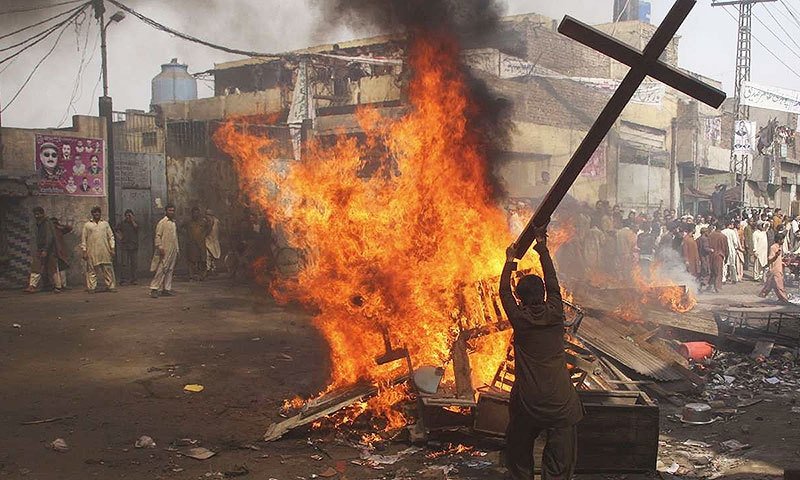

On Tuesday, the Supreme Court granted bail to a Lahore Waste Management Company sanitation worker who has been on trial for blasphemy since April 2021.
While hearing an appeal from the Lahore High Court’s (LHC) rejection of a similar bail plea in June 2022, a Supreme Court bench consisting of Justice Qazi Faez Isa and Justice Syed Mansoor Ali Shah granted bail to Salamat Mansha Masih, subject to furnishing the bail bond in the sum of Rs50,000.
On January 4, 2021, Salamat Masih was taken into custody and placed in the Lahore district jail. Along with accepting the plea, the court made the observation that the State should be extremely cautious and careful when dealing with blasphemy cases, and that the accused should be afforded complete protection until the charges against them are proven.
Justice Isa expressed regret that people are so quick to accuse one another, saying that it seemed like everyone was pointing fingers and blaming one another for insulting the religion without realizing that this was not a minor crime but rather one punishable by death.
Advocate Abdul Hameed Khan Rana, speaking on behalf of the accused, recalled how four college students had accused Haroon Ayub and Salamat Masih, who were present in the Model Town Park Lahore at the time, of committing blasphemy while preaching Christianity and also gifting a book in Urdu language that contains sacrilegious matter, and had presented the book to them.
The defense attorney countered that the book was related to the Bible and did not contain any material that would be considered sacrilegious to any religion, a point that was conceded by the concerned Lahore senior police officer representing the prosecution.
A lack of sufficient evidence linking the defendant to the alleged blasphemy was cited by defense counsel. An eight-hour lag in filing the FIR against his client was, according to his argument, unreasonable.
Quaid-i-Azam Mohammad Ali Jinnah, who stated that people of all sects would be free to practice and follow their faith independently in Pakistan, was cited by the court as it expressed surprise that the incident occurred in the park without anyone being made a witness to it.
We should avoid further polarisation of a society that is already fractured and divided in the name of religion,” Justice Isa remarked. We simply cannot continue to subsidise tragedies like the one in East Pakistan.
One judge wondered why more Muslims didn’t pursue such careers given the importance of tidiness in Islam. He argued that the Christian brothers should be thanked because “at least they clean up for us.”
The Supreme Court’s October 31, 2018 decision in the case of Aasia Bibi, a Christian woman facing the death penalty for blasphemy, affirmed the importance of the court’s mandate to make such decisions after conducting a fully qualified trial on the basis of credible evidence, rather than the individuals or a gathering (mob).
