

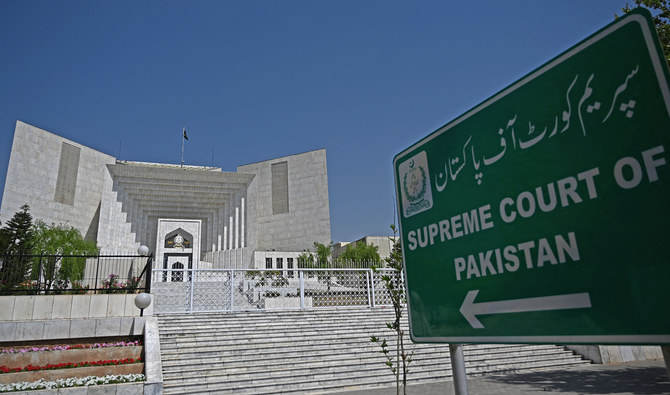

ISLAMABAD: The Constitutional Bench hearing cases against the military trials of civilians were informed on Thursday that Article 245 of the Constitution, which permits the armed forces to assist civil authorities, does not grant the military judicial powers to replace civilian courts.
Senior counsel Uzair Karamat Bhandari, representing PTI founder Imran Khan, stated, “Article 245 does not provide the armed forces with judicial powers.”
The seven-member bench, led by Justice Aminuddin Khan, was hearing intra-court appeals (ICAs) against the October 23, 2023, five-judge order that invalidated the military trials of civilians involved in the May 9 violence.
Bhandari referenced the 2010 Iftikhar Muhammad Chaudhry case, which clarified that no inherent powers exist outside the Constitution and that any power granted to an institution must be derived directly from the Constitution’s text.
Bhandari argued that if the armed forces sought to exercise judicial power over civilians, they must point to a relevant constitutional provision, comparing it to the situation where parliament attempts to impose a property tax—a matter within the provincial assemblies’ jurisdiction.
The counsel also cited the 1980 Darvesh Arvi case, explaining that amendments to the Pakistan Army Act 1952, under the Defence of Pakistan Ordinance, to punish arson and attacks on government buildings, were declared unconstitutional. This ordinance vested magistrate powers in army officers such as captains.
Bhandari recalled that the army had been deployed in Karachi, Hyderabad, and Lahore after the 1977 general elections due to civil unrest, and the same principle applied in May 2023 following the May 9 events, when civilians were handed over for military trials after Article 245 was invoked.
He emphasized that Article 245’s invocation was limited and exhaustive, outlining specific actions the armed forces could take. Bhandari also mentioned that the National Assembly passed a resolution before invoking Article 245, but he stressed that this resolution was politically influential, not legally binding. The law must function within the constitutional framework, he added, citing the F.B. Ali case, which ruled that the military trial of civilians under the Pakistan Army Act (PAA) does not fall under the scope of Article 8(3)(a) of the Constitution.
Bhandari argued that the current bench could not overrule the F.B. Ali case, as no such request had been made before the court. He questioned the rationale behind transferring 105 suspects to military custody while others were tried in civilian courts.
Justice Jamal Khan Mandokhail noted that the F.B. Ali case, which has been upheld by the Supreme Court in subsequent rulings, remains a point of contention. Bhandari suggested that Section 2(1)(d)(i) and (ii) of the PAA be reconsidered within the context of the 1973 Constitution. He also raised concerns about the selective nature of the military trials, noting that more than 5,000 individuals were arrested during the May 9-10 events, but only 105 were transferred to military courts, despite similar charges against those tried in anti-terrorism courts (ATC).
Justice Musarrat Hilali remarked that the charges against those sent to military custody were unclear, as the record remained inaccessible. She also questioned why only a small subset of the arrested individuals faced military trials.
Bhandari argued for closing this loophole in future proceedings, stating that the charges against those tried in military courts remained opaque, further complicating the matter. He shared his personal experience of being detained for two hours when attempting to obtain a power of attorney, underscoring the lack of transparency in the process.
