
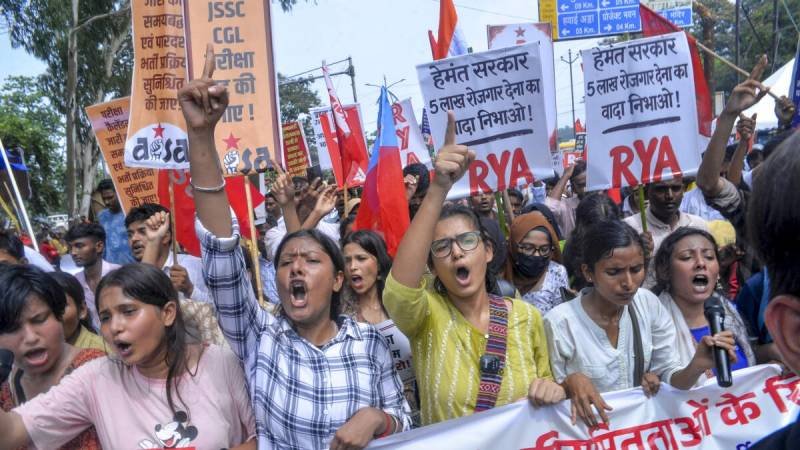

Indian students intensified protests in Jharkhand on Monday as they marched toward the state assembly over alleged irregularities in government recruitment exams. The demonstrations have continued for nearly two weeks, with several students also staging hunger strikes. Protesters are demanding major changes to the system used to conduct recruitment examinations.
At least six protesters are currently on hunger strike. Student leader Devendra Nath Mahto, 33, has reportedly been fasting for more than a week.
Students Demand Changes to Recruitment Exams
The protests in Ranchi, Jharkhand’s capital, began on July 29. Students have raised concerns over several examinations conducted for government recruitment.
Mahto said protesters want fundamental changes to the existing system.
“We want the whole system to change,” Mahto said, demanding an end to the use of a private company that conducts tests for state civil service.
The protesters are specifically calling for the cancellation of several examinations. They also want a federal police investigation into the private company involved in conducting the tests.
For many young Indians, government jobs remain highly desirable. However, millions of candidates compete for a limited number of public-sector positions.
As a result, concerns about examination fairness can quickly trigger widespread frustration among students.
Police Deploy Barricades Around Assembly
Hundreds of police officers were deployed around the Jharkhand assembly on Monday. Authorities placed barbed-wire barricades around the building as students moved toward the area.
The heightened security followed several rounds of talks between protesters and the state government. However, those discussions failed to produce an agreement.
Large groups of students continued marching while chanting slogans. Their demonstrations added pressure on the state government to address their demands.
The protesters want authorities to review examinations conducted by the private company. They are also seeking an independent investigation into alleged irregularities.
Hemant Soren Attempts to Ease Tensions
Jharkhand Chief Minister Hemant Soren has taken steps to ease tensions surrounding the protests. He has accepted some of the students’ demands, while several members of the civil service body overseeing the examinations have resigned.
Soren has also called for dialogue to resolve the dispute.
“Every problem can be resolved through dialogue,” Soren said in a speech on Sunday.
Despite these efforts, protesters continued their march toward the assembly. Their ongoing demonstrations suggest that students want broader changes rather than limited concessions.
The government now faces pressure to find a solution that addresses concerns over examination procedures and restores confidence among candidates.
Jharkhand Protests Echo Wider Student Anger
The demonstrations in Jharkhand have also drawn comparisons with a recent student-led movement in New Delhi.
Protesters in the Indian capital rallied for 36 days over alleged problems within the country’s examination system. The movement was organized online by the Cockroach Janta Party.
The protests eventually contributed to the resignation of then-Education Minister Dharmendra Pradhan. That outcome gave the movement an unusual political victory.
It also pushed examination integrity higher on India’s political agenda. The Jharkhand protests now reflect some of the same concerns.
However, the political circumstances differ between the two movements. The New Delhi protests challenged Prime Minister Narendra Modi’s Bharatiya Janata Party.
The Jharkhand demonstrations, meanwhile, are directed at a state government that opposes the BJP.
Exam Integrity Remains a Major Concern
The protests highlight growing frustration among young Indians who rely on government examinations as a pathway to stable employment. For many candidates, months or even years can go into preparing for competitive examinations. Any allegations of irregularities can therefore create serious concerns about their future.
The Jharkhand students are now pressing the state government for stronger action. They want greater accountability from the agencies involved in conducting recruitment examinations. The continued hunger strikes have also increased pressure on authorities to respond quickly. However, a lasting resolution will likely depend on whether the government can address the protesters’ central concerns.
As students continue demanding changes, the Jharkhand movement could keep examination integrity in the spotlight. It also shows how deeply young job seekers care about fairness in India’s competitive recruitment system.

