

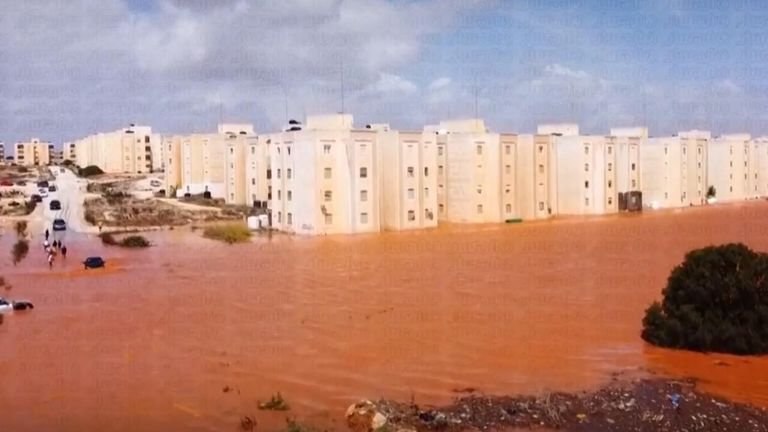

ISLAMABAD: Storm Daniel has unleashed its fury on Libya’s northeast, resulting in a tragic loss of at least 2,300 lives, while leaving a staggering 10,000 individuals unaccounted for.
The deluge of rain from the storm has reportedly caused the rupture of two significant dams, exacerbating the already severe flooding in this region of the country.
Tamer Ramadan, head of the International Federation of Red Cross and Red Crescent Societies (IFRC) delegation in Libya, stated that “the death toll is huge and around 10,000 are missing.”
Othman Abduljalil, the health minister in Libya’s eastern parliament-backed government, reported that as many as 6,000 people are missing in the city of Derna alone, describing parts of it as a “ghost town.”
The floods have overwhelmed several cities in the country’s northeast, bordering the Mediterranean Sea, with Derna experiencing particularly severe impacts.
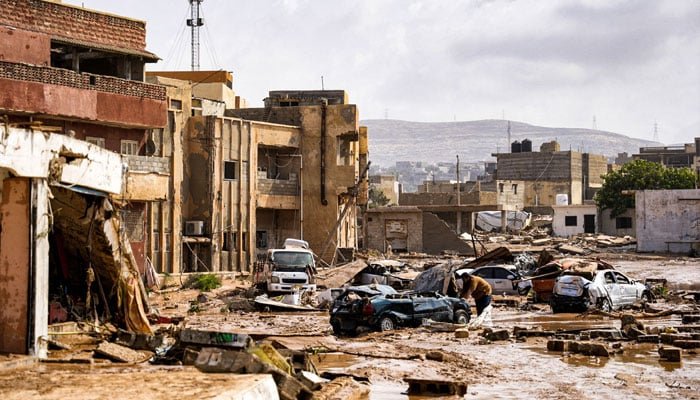
Hichem Abu Chkiouat, the minister of civil aviation and a member of the emergency committee in the eastern region, painted a grim picture, stating, “The situation was catastrophic. The bodies are still lying in many places. There are families still stuck inside their homes, and there are victims under the rubble.”
Libya’s Flood Crisis: Political Divisions Hinder Aid
A powerful low-pressure system that evolved into a tropical-like cyclone, known as a “medicane,” is responsible for the floods, which caused catastrophic flooding in Greece and has caused the devastation in Libya. This extreme weather system, similar to tropical storms and hurricanes, has wreaked havoc in Libya, a nation already grappling with political divisions and the aftermath of a decade-long conflict.
The scale of the disaster has raised concerns that Libya’s political fractures may hinder aid efforts. Rival administrations have divided the country since 2014, with the UN-backed Government of National Unity (GNU) in the capital, Tripoli, opposing the eastern-based government led by commander Khalifa Haftar.
The floods have affected multiple cities, leading to the destruction of bridges and entire neighbourhoods. Heavy destruction, the absence of phone lines, and insufficient preparedness for such a catastrophe have complicated rescue and relief efforts
Osama Aly, head of Libya’s Emergency and Ambulance authority, admitted that “Libya was not prepared for a catastrophe like that. It has not witnessed that level of catastrophe before.”
Several countries, including Turkey, the United Arab Emirates, and Egypt, have offered aid and assistance to Libya in the wake of this devastating natural disaster. The United States and the United Nations are also coordinating efforts to provide support and relief to those affected by the floods.
