

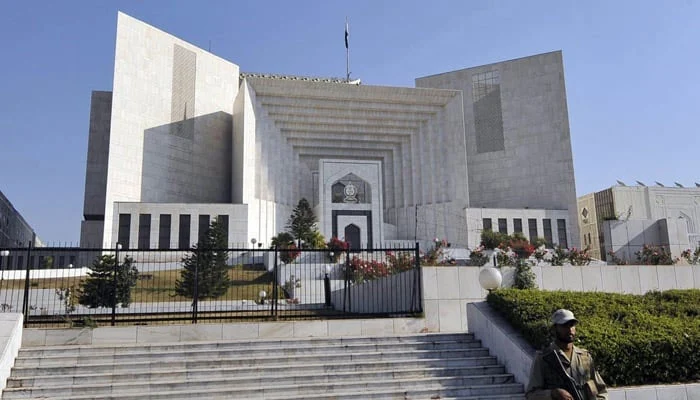

ISLAMABAD: The Caretaker government of Sindh has contested the Supreme Court’s ruling against conducting trials of civilians in military courts.
On October 23, the Supreme Court (SC) delivered its verdict by a 4-1 majority in response to pleas opposing the trial of civilians in military courts. The Chairman of PTI and others approached the highest court to challenge the military trial of individuals implicated in the May 9 riots, which were sparked by the arrest of Pakistan Tehreek-e-Insaf (PTI) chief Imran Khan in the Al-Qadir Trust case.

The plea presented by the Sindh government asserts that the SC did not thoroughly review the relevant law and circumstances.
The Sindh government has implored the superior court to suspend its verdict until a decision is reached on the review plea, particularly since the accused individuals are demanding their trials be conducted in military courts.
Earlier, the federal government informed the Supreme Court that military courts have commenced trials of civilians. In a miscellaneous petition submitted to the apex court, the government informed about the initiation of trials of civilians in compliance with the court’s order dated August 03.
According to the government’s plea to the court, a total of 102 individuals were apprehended in the aftermath of the incidents on May 09 and 10.
Council Of Islamic Ideology Permits Women To Perform Hajj And Umrah Without Male Guardians
In another development, the Council of Islamic Ideology (CII) has conditionally permitted women to undertake the Hajj or Umrah without a male guardian or mahram, as outlined in its written response to an inquiry from the Ministry of Religious Affairs.
According to the CII, women are allowed to perform these pilgrimages without a male guardian if they are not in danger during their journey to the holy Islamic sites.
The council specifically highlighted that if a woman travels to Makkah and Madina accompanied by reliable female companions, she is permitted to undertake the pilgrimage without a male guardian, based on the legal principles of Ja’fari, Shafi’i, and Maliki. However, it emphasized that a married woman must seek permission from her husband, while an unmarried, widowed, or divorced female pilgrim should obtain consent from her parents.
