

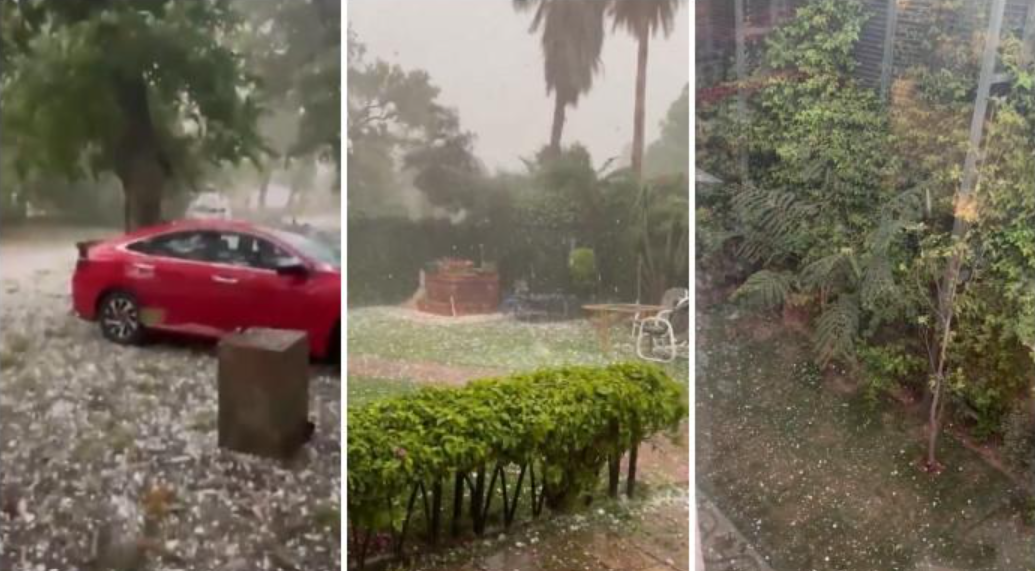

A powerful hailstorm struck Islamabad and parts of Khyber Pakhtunkhwa (KP) on Wednesday afternoon, causing widespread damage to vehicles, infrastructure, and trees. The storm, which lasted around 35 minutes, brought fierce winds and large hailstones that shattered car windshields, broke tree branches, and damaged solar panels.
In Islamabad, areas like Tarnol were hit particularly hard, with several trees uprooted and traffic severely disrupted. The heavy rainfall led to flash flooding in low-lying areas, overwhelming drainage systems and leaving commuters stranded in the sudden downpour.
Despite the destruction, some politicians took to social media platform X to share their personal experiences, calling the weather intense yet oddly invigorating—a striking shift from the recent heat.
In a related development, the National Disaster Management Authority (NDMA) has issued a warning of extreme summer weather ahead, cautioning that prolonged heatwaves are expected to impact mountainous regions including KP, Balochistan, the Potohar Plateau, Murree, and surrounding areas.
According to the NDMA’s April–June seasonal outlook, shared during a briefing at the National Emergency Operations Centre (NEOC), cyclonic activity is likely to occur in the Arabian Sea during May and June, potentially affecting coastal zones.
The forecast predicts above-average temperatures and below-normal rainfall across the country. Southern Punjab, Sindh, and Balochistan are expected to bear the brunt of the heat, with temperatures possibly exceeding 45°C in cities such as Karachi, Larkana, Badin, Umerkot, Tharparkar, and Matiari.
Other areas, including Sukkur, Shikarpur, Dadu, Sanghar, Bahawalpur, Rahim Yar Khan, and Lahore, are also expected to experience intense heat. Meanwhile, Gilgit-Baltistan and Chitral face the added threat of glacial lake outburst floods (GLOFs) due to rapidly melting glaciers.
The combination of extreme heat and reduced rainfall may significantly impact agriculture, potentially resulting in lower crop yields, water shortages, and food security challenges nationwide.
The NDMA has advised the public to avoid prolonged exposure to the sun, especially during peak hours, and to adopt safety measures to prevent heat-related health issues during the upcoming heatwave period.
