

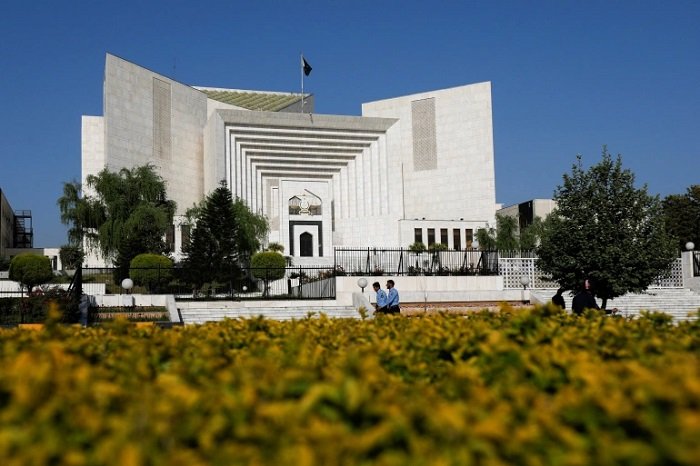

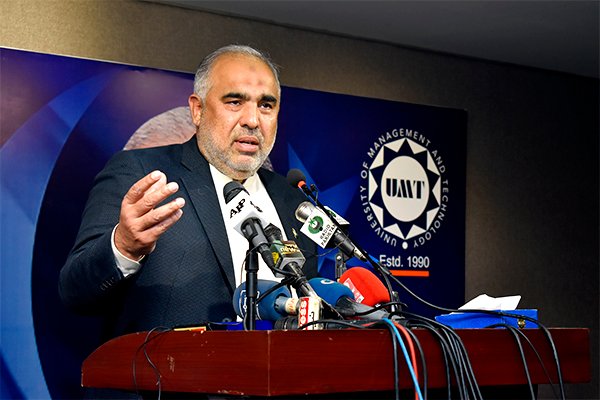
ISLAMABAD: On Thursday, a two-member bench of the Supreme Court suspended a Peshawar High Court (PHC) order that had granted blanket bail to PTI leader Asad Qaiser and others in cases related to the violence that erupted after the arrest of party chief Imran Khan on May 9.
Justice Sardar Tariq Masood and Justice Mussarat Hilali, in their review of an appeal by Khyber Pakhtunkhwa (KP) against the Peshawar High Court (PHC) order, expressed concerns about the broad relief provided by the high court. As a result, they temporarily halted the execution of the order issued on August 4, 2023, until the next hearing.
It’s important to highlight that, apart from granting bail to the PTI leaders, the high court had also forbidden the police and prosecution department from arresting the individuals named as respondents — Asad Qaiser, Rangaiz Ahmed, Aqibullah, and Attaullah — not only in the current case but also in any other criminal cases. Additionally, the high court had issued a circular to all judicial officers in the province regarding this matter.
Nonetheless, the Supreme Court bench, on Thursday, suspended the implementation of this circular and served notices to the aforementioned respondents.
Advocate Sher Afzal Marwat was in Courtroom No. 2 to represent the respondents, but when notices were issued to them, the court requested him to present his arguments.
The KP Additional Advocate General, Mohammad Nisar, informed the apex court that the respondents had been named in an FIR filed at the Swabi police station on June 2, 2023, under sections 409 and 162 of the Pakistan Penal Code, as well as Section 5(2) of the Prevention of Corruption Act (PCA) 1947. In a separate case, the respondents were accused of involvement in the May 10 incidents and were booked under terrorism charges.
To seek transitory bail, the respondents filed a writ petition before the Islamabad High Court (IHC) under Section 498 of the Criminal Procedure Code (CrPC). On July 17, the IHC granted bail, valid until July 24, with the condition that the respondents should approach the appropriate court.
Mr. Nisar argued that the respondents failed to comply with this order and did not approach the designated court. In the meantime, the Swabi sessions judge received the IHC order. On August 2, the respondents submitted another application to the Abbottabad sessions judge, allegedly concealing the prior request for transitory bail.
The sessions judge, while granting transitory bail, directed the respondents to approach the relevant anti-corruption court. Instead of following this directive, the PTI leaders went to the PHC, which granted them bail, even though the previous order was still in effect, according to the arguments of the KP AAG.
Rangaiz was apprehended while en route to Swabi, and the matter was subsequently brought before a PHC judge who referred it to the PHC chief justice. The chief justice issued instructions to the relevant authorities to produce Rangaiz, who was subsequently presented in court.
The AAG argued that the high court’s bail grant severely disrupted the established criminal procedure code. The high court released Rangaiz without requiring a bail application or bond and instructed against his arrest not only in the current case but in any other criminal case.
AAG Nisar also cited portions of the PHC order which prevented the arrest of the respondents, stating that once they were granted pre-arrest interim bail, no further arrests could occur without prior court permission.
The PHC sent a circular to all district and sessions judges based on this order, which, according to AAG Nisar, was riddled with legal flaws. It set accused individuals free for a “cognizable offense” without the necessary bail procedures, contradicting the law.
The broad order preventing anyone’s arrest conflicted with the established criminal procedure, as highlighted by the AAG. Notably, on October 5, a bench led by Justice Sardar Tariq Masood expressed concern over the increasing trend of Lahore High Court issuing blanket bail orders, prompting questions about the legal validity of such orders that prohibit arrest even in cases with unknown FIRs.
