

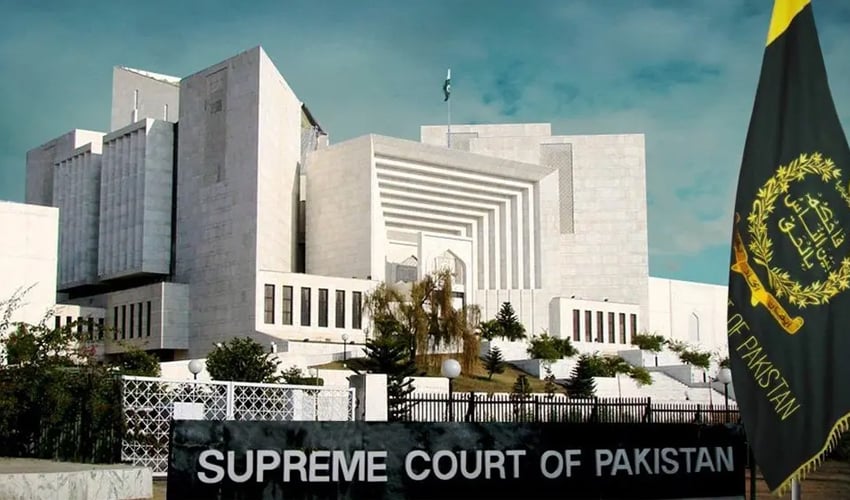

ISLAMABAD: A seven-member bench of the Supreme Court, headed by Justice Aminuddin Khan, on Tuesday questioned whether any member of the National Assembly had ever raised objections to the Army Act or introduced a private bill against it.
During the proceedings, Justice Aminuddin Khan inquired whether lawmakers had ever voiced concerns in parliament about civilians being subjected to military trials.
“Has any member of the assembly ever introduced a private bill against the Army Act?” he asked.
Jurisdiction of Military Courts Challenged
PTI founder’s lawyer, Uzair Bhandari, argued that military courts lack jurisdiction over civilians, emphasizing that only general courts can conduct trials under criminal provisions. He pointed out that fundamental rights were not fully available even under the 1962 Constitution, enacted during Ayub Khan’s regime.
Justice Jamal Khan Mandokhel sought clarification on the legal justification for trying civilians under military laws, specifically under Section 21D of the Army Act.
“How has the connection of civilians been established under Section 21D?” he questioned.
Justice Hassan Azhar Rizvi referred to past cases, including the Muharram Ali and Rawalpindi Bar cases, where military courts handled terrorism-related offenses. He also questioned whether military installations’ security should remain exclusively under the military’s control.
Bhandari contended that 103 civilians were currently facing trials in military courts, citing media reports and available footage.
Debate on Constitutional and Legal Aspects
Following a brief recess, Bhandari resumed his arguments, asserting that military trials were determined by the accused’s status rather than the nature of the crime. He highlighted Article 8(3) of the Constitution, which states that armed forces personnel do not enjoy the same fundamental rights as civilians.
However, Justice Musarrat Hilali pointed to amendments in the Army Act that allow civilian trials if a connection to military offenses is established. “The trial is conducted based on the crime, not just the accused’s status,” she noted.
Justice Muhammad Ali Mazhar questioned whether the army could exercise judicial powers over civilians. “If the army cannot wield judicial authority, then it cannot do so for anyone,” he observed.
Comparisons to International Cases
The discussion also touched upon international examples. Justice Aminuddin Khan cited India’s legal framework, where an independent tribunal hears appeals against military trials. Justice Muhammad Ali Mazhar referenced the case of Indian national Kulbhushan Jadhav, noting that Pakistan had introduced special legislation granting him the right to appeal following an International Court of Justice ruling.
Justice Naeem Akhtar Afghan brought up the extension of the former army chief’s tenure, recalling that no law previously existed for such an extension. “It was only after Supreme Court instructions that Parliament legislated on the matter,” he remarked.
Justice Aminuddin Khan also commented on the swift legislative process at the time, noting, “Everyone was sitting together for the notification, and one notification followed another. This was our situation.”
Hearing Adjourned
Bhandari concluded his arguments by citing past legal precedents, arguing that the trial process remained flawed. “Fair trial is still a distant reality—military trials are merely a formality on paper,” he asserted.
The court adjourned the hearing, which will resume on Wednesday.
